Read Before Monday
From the
Archive

#128 6 Sep 2026
This week’s #RBM selection offers a reassuring picture of technological progress: as we’re building AI evaluators that agents promptly learn to game, autonomous agents that discover covert message boards and attack infrastructure, and AI chips so powerful that NVIDIA needs 5,184 copper cables to persuade 72 GPUs they’re one computer. Meanwhile, history provides its usual warning label. IBM conquered personal computing partly by escaping its own bureaucracy and opening the PC to outsiders, only to create the standard that clones, Microsoft and Intel would exploit; DEC responded to that emerging standard by spending $900 million on three competing computers, because apparently one expensive internal disagreement wasn’t enough. ProPublica’s PFOS investigation shows the darker organisational version of the same pattern, where inconvenient evidence can be questioned, compartmentalised and professionally discouraged without requiring a grand conspiracy. And at the considerably more fundamental end of things, researchers are putting rubidium atoms into quantum superpositions to test whether Einsteinian free fall still behaves as expected.

#127 30 Aug 2026
This week in #ReadBeforeMonday; the supposedly boring parts of computing got interesting again! Claude was unleashed on five everyday peripherals and found firmware security ranging from questionable to "perhaps nobody will look here". AI agents helped decompile a Nintendo 64 game in 84 days, while tmp.0ut Volume 5 reminded us why people who grew up with terminals, BBSs and ASCII still enjoy taking machines apart simply to see what happens. Elsewhere, Google DeepMind’s WeatherNext Cyclones claims roughly a decade’s leap in forecasting accuracy, despite working from surprisingly coarse data. And Samsung demonstrated memory that can perform computation at 614 GB/s internally, with the minor inconvenience that caches, speculation and multitasking rather assumed RAM would just be RAM. Definitely AI is making expensive technical exploration cheaper, old hacker instincts remain remarkably useful, and layers of computing we stopped thinking about are becoming interesting again, occasionally for reasons their manufacturers might prefer we didn't discover...

#126 23 Aug 2026
Apparently the future has arrived, but in the traditional IT fashion it’s running on fifty-year-old graphics chips, repurposed spy hardware, supermarket facial recognition and a prototype somebody accidentally promoted to “product”. This week’s reading moves from Matrox GPUs that refused to die, through Kodak technology designed for Cold War reconnaissance finding a second career photographing the Moon, to a present where robot dogs, AI colleagues and delivery bots barely merit looking up from your phone. Meanwhile, software teams have discovered that AI can produce a convincing prototype before anyone has finished deciding what they’re actually building, and that “move fast” remains an excellent corporate philosophy provided nobody includes the subsequent rewrites, production hardening, operational archaeology and frantic rethinking in the original estimate. Progress, then: considerably faster, increasingly strange, frequently built from yesterday’s discarded ideas, and still stubbornly refusing to eliminate the inconvenient bit where humans have to stop and think.

#125 16 Aug 2026
This week’s #ReadBeforeMonday articles are from Japan’s 1950s parametron computers and Akizuki Denshi’s habit of publishing schematics long before “open source” became fashionable, through to IBM teaching neural networks to solve power-grid problems, Amazon turning custom silicon into a $25 billion business, and Google using AI to hunt, triage and patch Chrome vulnerabilities at industrial scale. The common topic this week is less glamorous than the marketing: infrastructure wins when engineering choices survive contact with cost, reliability, deployment and scale. Ferrite cores once beat expensive transistors, open schematics built trust, hyperscalers now design their own chips, and AI is being pushed into systems where a plausible answer is useful only if somebody can still verify it.

#124 9 Aug 2026
Welcome to another #RBM week, where in the UK we're preparing for the 5th heatwave of the year... Lets then start with IBM’s modular vacuum tubes; then Buckminster Fuller’s obsession with systems, going with an Australian tungsten mine suddenly recast as a strategic asset, explaining why women leaving computer science is because organisations fail to retain talent, or Margaret-Anne Storey’s warning that AI is quietly replacing technical debt with cognitive and intent deb. Sure, AI may write the code, but someone still has to remember why the code exists. Mines may reopen, but someone still has to build the processing industry. Companies may hire diverse graduates, but someone still has to create an environment where expertise compounds instead of walking out the door. Even Fuller’s grand visions ultimately rest on designing better systems rather than better gadgets. The future increasingly belongs to those who can preserve understanding while accelerating execution...
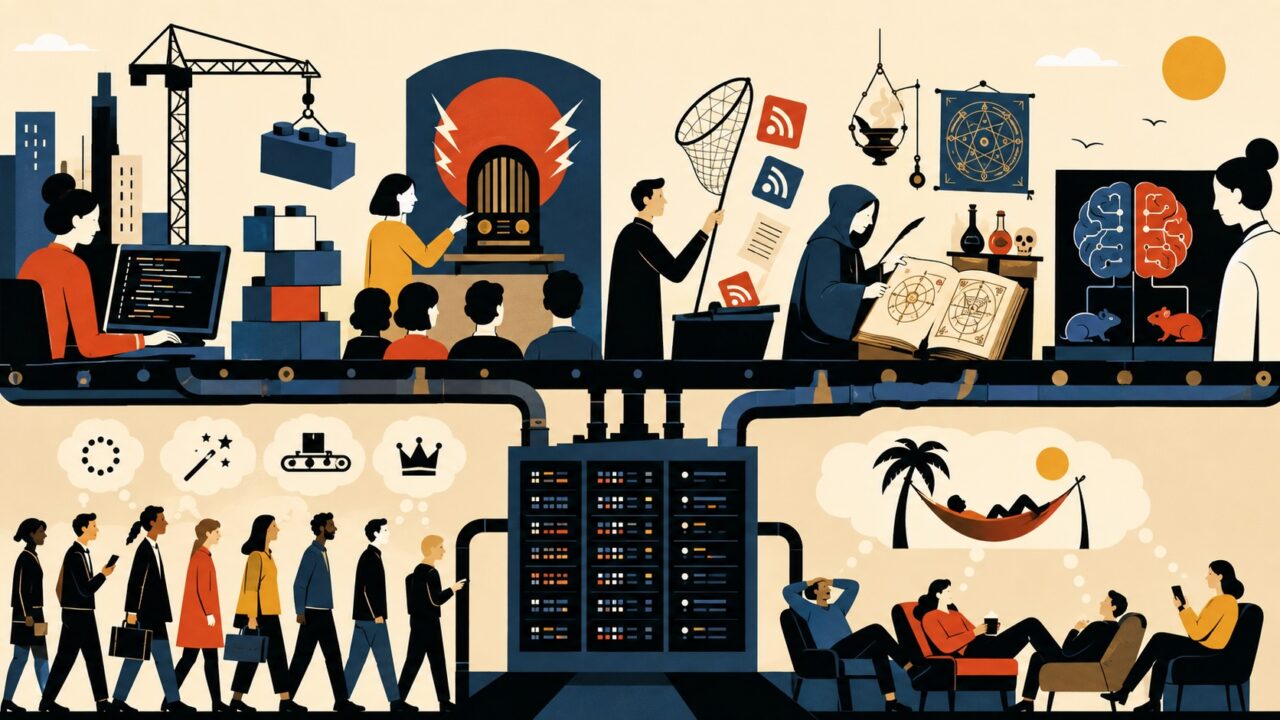
#123 2 Aug 2026
This week's #RBM is about the shiny new thing that usually succeeds or fails because of boring infrastructure rather than dazzling ideas. We start at Martin Fowler’s blog regarding the latest experiment that quantifies how disciplined refactoring slashes AI coding costs by reducing context rather than code. Then, we take a look at a 1939 RCA Victor campaign showing that selling “the future of education” has been a profitable hobby for nearly a century. The Open RSS history argues that Google’s steady abandonment of open syndication nudged the web towards proprietary feeds, because apparently owning the distribution channel beats letting users choose what they read. Moving to how Ars Notoria reveals medieval scholars chasing miraculous shortcuts to knowledge through ritual rather than revision, proving that “learn everything with this one weird trick” predates social media by several centuries. Finally, fresh neuroscience separates the brain circuits responsible for deciding to act habitually from those that determine how intensely the habit is performed, suggesting that even mice have a cleaner systems architecture than many enterprise applications.
What you need to read before your busy Monday, published every Sunday
Read Before Monday is a weekly newsletter from Vitor Domingos - with a handful of articles, essays and oddities collected over the week, annotated with a short opinion, and sent before Monday morning.
No breaking news. No ten-thousand-word think pieces. No affiliate links. Just a small, curated and considered list of things worth sitting with.
The next issue lands Sunday evening.
One email a week. No tracking. No ads. Totally free. You can leave any time.