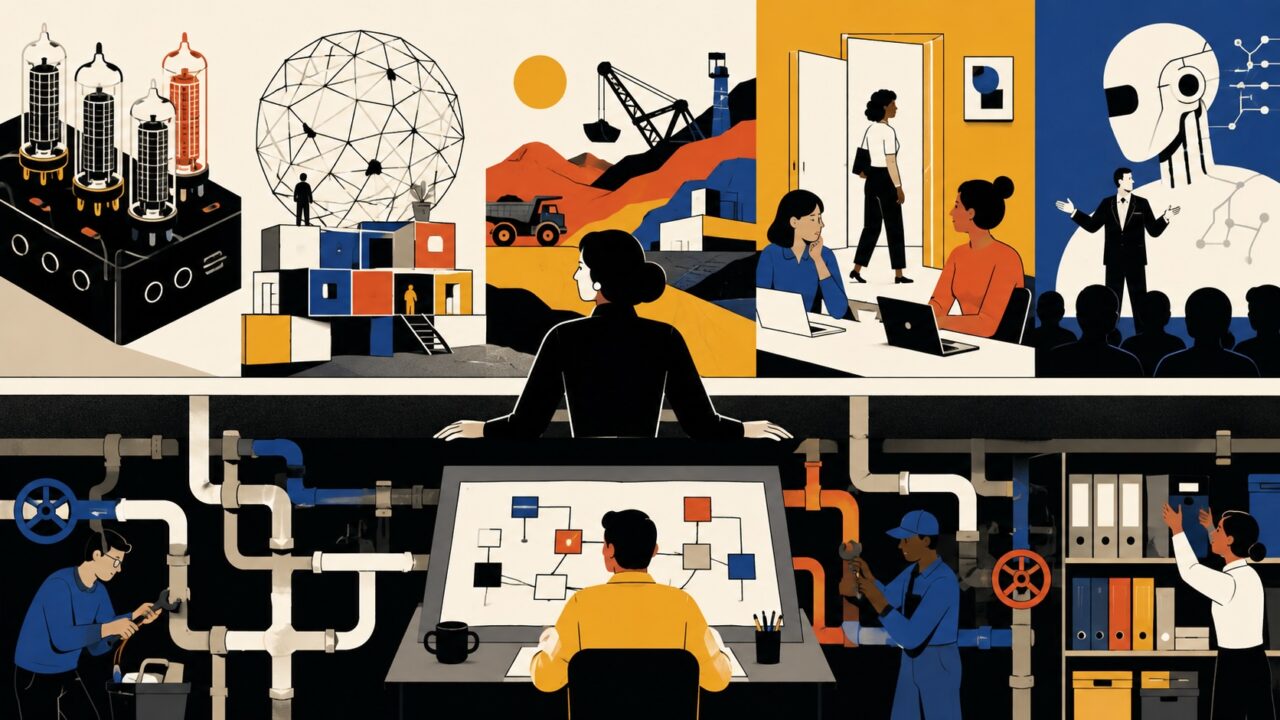
Welcome to another #RBM week, where in the UK we’re preparing for the 5th heatwave of the year… Lets then start with IBM’s modular vacuum tubes; then Buckminster Fuller’s obsession with systems, going with an Australian tungsten mine suddenly recast as a strategic asset, explaining why women leaving computer science is because organisations fail to retain talent, or Margaret-Anne Storey’s warning that AI is quietly replacing technical debt with cognitive and intent deb. Sure, AI may write the code, but someone still has to remember why the code exists. Mines may reopen, but someone still has to build the processing industry. Companies may hire diverse graduates, but someone still has to create an environment where expertise compounds instead of walking out the door. Even Fuller’s grand visions ultimately rest on designing better systems rather than better gadgets. The future increasingly belongs to those who can preserve understanding while accelerating execution…
In this issue
5 piecesKen Shirriff explains the design and operation of a pluggable thyratron module from the IBM 604 Electronic Calculating Punch

The article combines historical context with a practical demonstration of powering the module, showing how its gas-filled 2D21 thyratron behaves as a latching electronic switch. Ken also reverse-engineers the module’s circuit and explains why IBM packaged vacuum tubes with their supporting components into replaceable units. It places the IBM 604 between electromechanical accounting machines and fully programmable electronic computers. Although the 604 lacked stored programs, memory and looping, it delivered electronic-speed arithmetic in an affordable commercial package, with more than 5,600 units produced. Ken argues that the modular construction simplified manufacturing and maintenance while providing IBM with practical experience that influenced its later vacuum-tube computers.
Gotta love bench testing old hardware! It's always satisfying, but what caught my attention wasn’t the glowing tube, it was the packaging. IBM’s decision to wrap a tube together with its supporting circuitry into a standard module looks almost mundane today because we’ve internalised the idea of replaceable components. In 1948 it was a manufacturing decision with architectural consequences. With the article, Ken could make it easily become another nostalgia piece about warm valves and blinking lights, yet it keeps returning to production, maintenance and serviceability. Those are the reasons technologies survive outside laboratories. Sure, standardised modules create organisational knowledge as much as electronic systems, but once engineers learn to design, test, swap and manufacture repeatable building blocks, the same habits migrate into later machines. You can almost see the ancestry of plug-in cards, blade servers and even cloud infrastructure in that way of thinking. As we often celebrate the breakthrough component, whether it’s a GPU, accelerator or exotic memory technology, but yet the durable competitive advantage frequently comes from packaging, deployment and maintenance economics instead. Those are harder to photograph, but they’re what customers actually live with.
Women continue to leave computer science and technology careers at disproportionately high rates despite sustained efforts to improve recruitment

The article examines it, drawing on research and interviews, it argues that retention is shaped less by the education pipeline than by workplace culture, career progression, bias and everyday experiences once women enter the profession. It presents these factors as cumulative rather than isolated. The discussion suggests that organisations seeking to address skills shortages need to focus on career development, inclusive management and equitable opportunities instead of relying primarily on hiring initiatives. The article also places the issue in the wider context of persistent gender imbalance across academia and industry, where improving retention has implications for innovation, workforce capacity and leadership diversity.
The gap between the diagnosis and the evidence is what I kept noticing; whilst the broad themes are familiar, women leave because progression stalls, culture disappoints and small biases accumulate into career-changing decisions. I don’t doubt those mechanisms. They match years of reporting and research. What I’d still want is stronger evidence about which interventions reliably change outcomes across different companies rather than isolated success stories. We know that retention is the central problem, and instead of assuming the answer is simply persuading more students to study computer science, there's a more useful framing, because every experienced engineer who leaves takes knowledge, mentoring capacity and organisational memory with them. There's also a management problem disguised as a diversity problem; where engineering organisations optimise relentlessly for deployment pipelines, uptime and developer productivity, yet often treat career progression and team health as soft variables. Those systems deserve the same discipline. Promotion criteria, project allocation, technical leadership opportunities and manager incentives all form part of the operating architecture. If those mechanisms consistently produce unequal outcomes, they’re engineering failures as much as HR failures. I’d also resist assuming every departure has the same cause. Labour markets, family decisions, changing interests and better opportunities all interact with workplace experience. Untangling those factors is difficult, which makes careful measurement more valuable than confident narratives.
Fuller reflects on the principles that shaped his work across engineering, design and systems thinking

The article presents R. Buckminster Fuller’s essay “Everything I Know”, and rather than describing individual inventions, it explains how personal experience, observation and experimentation led him to view humanity as part of an interconnected system constrained by physical laws rather than political or economic assumptions. The essay argues that many accepted social and industrial practices arise from inherited habits rather than necessity. Richard Buckminster Fuller contends that careful attention to energy, resources and whole-system relationships enables more effective solutions to global problems. Throughout, he encourages readers to question conventional thinking, relying on empirical observation instead of authority as the basis for decision-making.
RBF has always occupied an unusual place in engineering culture. Some people read him as a visionary, others as an inspired eccentric. This essay reminded me why both reactions persist. He has an extraordinary ability to connect ideas across physics, design, economics and human behaviour, and occasionally he leaps across the gaps without showing enough working. I do like his habit of stepping outside inherited assumptions, as engineers spend much of their careers improving existing systems. Fuller asks whether the system itself deserves to exist in its current form. That’s a productive question because it shifts attention from optimisation to redesign. The idea of accomplishing more with fewer resources still feels remarkably current in an era of constrained energy, semiconductor shortages and pressure to reduce environmental impact. The essay also leaves me wanting firmer evidence. Fuller often moves from observation to sweeping conclusions about civilisation with remarkable confidence. Some of those conclusions have aged well, others depend heavily on readers accepting his intuition. I’d rather see stronger links between principle, experiment and measurable outcome. But, Fuller repeatedly treats technology as part of a larger system whose interfaces matter more than its individual components. Modern computing, distributed infrastructure and sustainable engineering all reward that habit of thinking across boundaries rather than within disciplines. Yet, his greatest strength is encouraging engineers to ask bigger questions before building better answers.
David Fickling argues that tungsten, once a niche industrial commodity, is increasingly viewed through the requirements of military supply chains
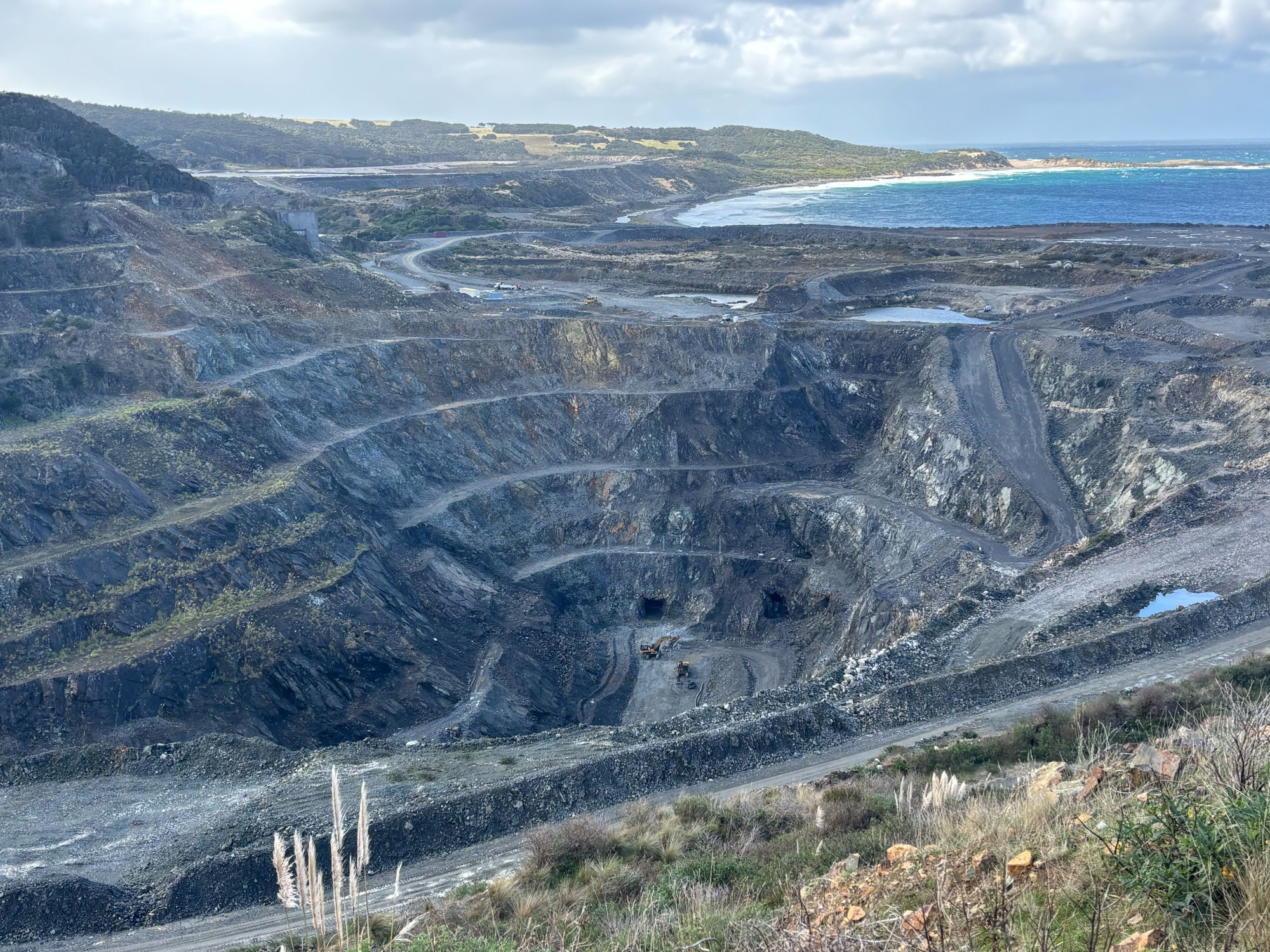
The Bloomberg Opinion uses the reopening of a remote tungsten mine in Australia as a lens to examine how critical minerals have become central to defence planning and geopolitical competition. The article links one mining project to broader changes in industrial policy, where governments are financing extraction, processing and stockpiling of strategically important materials. It suggests that supply-chain resilience has become a defence objective in its own right, with Australia positioned as an important partner because of its mineral resources and political alignment with the United States.
Right, a remote tungsten mine sounds like a local business story until you realise it’s really about how wars reshape industrial geography... The mine matters because governments suddenly care where a dense grey metal comes from, who refines it and who controls the transport routes between them. That’s a very different conversation from the globalisation consensus of twenty years ago. The piece is strongest when it reminds readers that supply chains are strategic assets; commodities that barely registered in financial headlines now influence defence planning, diplomatic relationships and industrial subsidies, and Tungsten isn’t unique in that respect, but it’s an unusually clear example because there are few practical substitutes for many military applications. Digging ore out of the ground is only one stage of the value chain. China spent decades building refining capacity, technical expertise and commercial ecosystems around these minerals. Recreating that network in allied countries is a much larger undertaking than reopening individual mines. The real signal isn’t the mine itself. It’s that obscure materials have become leading indicators of geopolitical strategy. That’s a useful way to read the story.
Generative AI is changing the primary risks in software engineering

Margaret-Anne Storey argues that technical debt is the dominant concern with AI-assisted development, which accelerates the accumulation of cognitive debt, the erosion of a team’s shared understanding of a system, and intent debt, the loss of explicit goals, constraints and rationale that explain why a system exists. Storey proposes a “triple debt model” in which software health depends on maintaining alignment across code, people and artefacts. The article contends that AI can increasingly reduce technical debt through refactoring, testing and code review, while simultaneously weakening the feedback loops that build understanding. Margaret-Anne Storey recommends treating shared understanding as a first-class deliverable, capturing intent through living artefacts such as architectural decision records and executable specifications, and monitoring all three forms of debt together rather than focusing solely on code quality.
Bingo! Margaret-Anne has put a name to something many engineering teams are already feeling; the surprising claim isn’t that AI creates more code. It’s that AI may quietly make technical debt less important than the knowledge gaps left behind. That’s a much more interesting proposition because it challenges twenty years of software engineering orthodoxy. Technical debt has always been visible because it’s encoded in repositories, issue trackers and architecture diagrams. Cognitive debt is harder to spot because it lives in conversations, confidence and mental models. Intent debt is harder still because it depends on whether anyone remembers why the system exists in the first place. AI compresses implementation effort so aggressively that those invisible forms of debt can accumulate before teams realise they’ve traded understanding for velocity. Right now I'm struggling to see evidence that these debts can be measured consistently across organisations, and Storey acknowledges this herself by proposing signals rather than established metrics. That’s the next research challenge! If you can’t observe the debt, it’s difficult to manage it systematically. But, the triple debt model is a genuinely useful way to think about software health in the AI era!
My Week in AI
- Introducing Kitesurf The agent-first browser that runs in V8 isolates on Cloudflare Workers | blog.cloudflare.com
- Responding to the next frontier of critical cyber capabilities | openai.com
- The next generation of MCP | blog.cloudflare.com
- U.K. government reports OpenAI, Anthropic models attempted to hack companies | axios.com
- AI’s top startups are barely publishing their research | science.org
- Managing AI Coding Costs at Scale | databricks.com