
This week in #ReadBeforeMonday; the supposedly boring parts of computing got interesting again! Claude was unleashed on five everyday peripherals and found firmware security ranging from questionable to “perhaps nobody will look here”. AI agents helped decompile a Nintendo 64 game in 84 days, while tmp.0ut Volume 5 reminded us why people who grew up with terminals, BBSs and ASCII still enjoy taking machines apart simply to see what happens. Elsewhere, Google DeepMind’s WeatherNext Cyclones claims roughly a decade’s leap in forecasting accuracy, despite working from surprisingly coarse data. And Samsung demonstrated memory that can perform computation at 614 GB/s internally, with the minor inconvenience that caches, speculation and multitasking rather assumed RAM would just be RAM. Definitely AI is making expensive technical exploration cheaper, old hacker instincts remain remarkably useful, and layers of computing we stopped thinking about are becoming interesting again, occasionally for reasons their manufacturers might prefer we didn’t discover…
In this issue
5 piecesChaz Schlarp describes using Claude Opus 5 for agent-driven reverse engineering of five everyday peripherals

In "Everything I own, owned" shows that across roughly 13 hours of agent work and 98 prompts, Schlarp uncovered weak or absent firmware protections, including a plaintext command shell in a Shure MV7 microphone, a defeatable recording LED on an Insta360 Link webcam, and unauthenticated memory writes on an Elgato Key Light Mini. Much of the generated tooling was validated against physical hardware. Schlarp argues that AI dramatically reduces the per-device labour previously required for firmware reverse engineering, making hardware modification far more accessible for interoperability and personal control. The same capability changes the security calculation: malicious firmware implants could become economical across many device models, while WebUSB, WebHID and network interfaces provide possible delivery routes. Schlarp suggests agentic reverse engineering could eventually enable malware that discovers, analyses and compromises unfamiliar peripherals automatically.
Damn! The number that sticks with me is 13 hours... (only!) Not because that's astonishingly fast in isolation, but because five unrelated devices fell apart under roughly two working days of agent attention. Reverse engineering used to have a useful economic defence: even mediocre firmware could be annoying enough to understand that attackers needed a reason to bother. Charz experiment suggests that friction is disappearing! The Key Light Mini is the sharpest example. Elgato actually signs its firmware, which sounds reassuring until an exposed memory-write path lets the running system disable the check. Security concentrated at one checkpoint becomes surprisingly fragile when an agent can patiently map everything around it. That changes the sensible default for endpoint design. A USB microphone may be a small computer with writable firmware, privileged interfaces and enough undocumented behaviour to deserve suspicion. We have spent decades making computers distrust files from the internet while cheerfully plugging tiny mystery computers into them. That asymmetry is starting to look expensive.
WeatherNext Cyclones achieves state-of-the-art accuracy forecasting tropical cyclone tracks, intensity and wind structure

Google DeepMind’s WeatherNext team evaluated on historical cyclones from 2023 to 2024, the model gained more than 24 hours of lead-time advantage over leading weather models across those measures. Its three-day forecasts reportedly match the accuracy previous models achieved at two days, an improvement Google DeepMind equates to roughly a decade of meteorological progress. WeatherNext Cyclones combines global atmospheric dynamics with expert-curated observations from nearly 5,000 historical storms, despite operating on relatively coarse 28x28km inputs. It can generate 15-day forecasts in under a minute on a TPU and now produces 1,000-member ensembles to capture low-probability scenarios such as rapid intensification. Google DeepMind is open sourcing WeatherNext Cyclones, WeatherNext 2 and a smaller WeatherNext 2-mini, aiming to support operational forecasting, research and specialised local models.
The oddest detail here is 28x28km; as cyclone intensity is driven by fine-scale processes around the storm’s core, so conventional wisdom has pushed forecasting towards increasingly fine spatial resolution. WeatherNext Cyclones apparently gets competitive intensity forecasts from inputs roughly 100 times coarser than traditional models. Google admits its scientists don’t fully understand why. That deserves more attention than the "decade of progress" headline. If the result holds up, AI weather forecasting may be learning useful large-scale signatures that act as proxies for physical processes it cannot explicitly resolve. That's powerful, but scientifically awkward. A model can be operationally valuable while leaving meteorologists with a new problem: distinguishing genuine learned structure from correlations that happen to survive the evaluation set. The 1,000-member ensemble makes this particularly interesting. Cheap inference changes forecasting from producing a better single answer towards cheaply exploring a distribution of plausible futures. For emergency planning, the nasty tail of that distribution can matter more than its centre. So, open sourcing the weights and code is therefore the consequential next experiment. Independent meteorologists can test unusual storms, different ocean basins and failure modes rather than admiring Google's aggregate scores. If a coarse model keeps beating expensive high-resolution approaches outside Google's evaluation, meteorology may have acquired both a remarkably useful forecasting tool and a rather good scientific mystery.
Snowboard Kids for Nintendo 64 has been fully decompiled, with matching C implementations for every function, in 84 days

Chris Lewis compares with 596 days for his Snowboard Kids 2 project. Lewis attributes the acceleration partly to AI agents, but also to nearly two years of accumulated experience, community expertise, improved tooling and the smaller game. Roughly 4.8% of matching commits involved expert intervention, which Lewis says remained essential. Agents proved particularly effective on library code and benefited from tooling that diagnosed mismatches caused by the proprietary IDO 5.3 compiler. Lewis ran agents across four Git worktrees, recorded reusable compiler discoveries, imposed explicit task deadlines and let similarity searches inspect results across worktrees. He says Codex generally outperformed other tested models, while stressing that his comparisons were unscientific. The completed decompilation enables deeper game analysis, static recompilation and more ambitious modding, although substantial documentation remains unfinished.
Yeah, Chris tried the cheap, obvious automation first: run m2c across 1,830 unmatched functions and automatically accept exact matches. It found 17. The big productivity gain came elsewhere, from building an environment in which agents could repeatedly attack messy problems, retain discoveries and receive increasingly useful feedback. That distinction feels important for anyone deploying coding agents. The impressive part isn't that an LLM can emit plausible C from MIPS assembly. He built a small production system around the models: four parallel worktrees, explicit deadlines, shared compiler learnings, similarity search across workers and tooling that explains why two compiled functions differ. The agents become more useful because the surrounding machinery converts vague failure into actionable information. There's also a nice corrective to the usual "AI replaced months of engineering" story. Chris had already spent nearly two years learning this peculiar craft, the community had reverse-engineered parts of a long-dead SGI compiler, and specialist humans apparently rescued matches that might otherwise have stopped the project around 89 to 90%. The agents arrived on top of accumulated human knowledge rather than replacing it.
Digital zine devoted to low-level computing, executable formats, reverse engineering, malware research and programming experiments
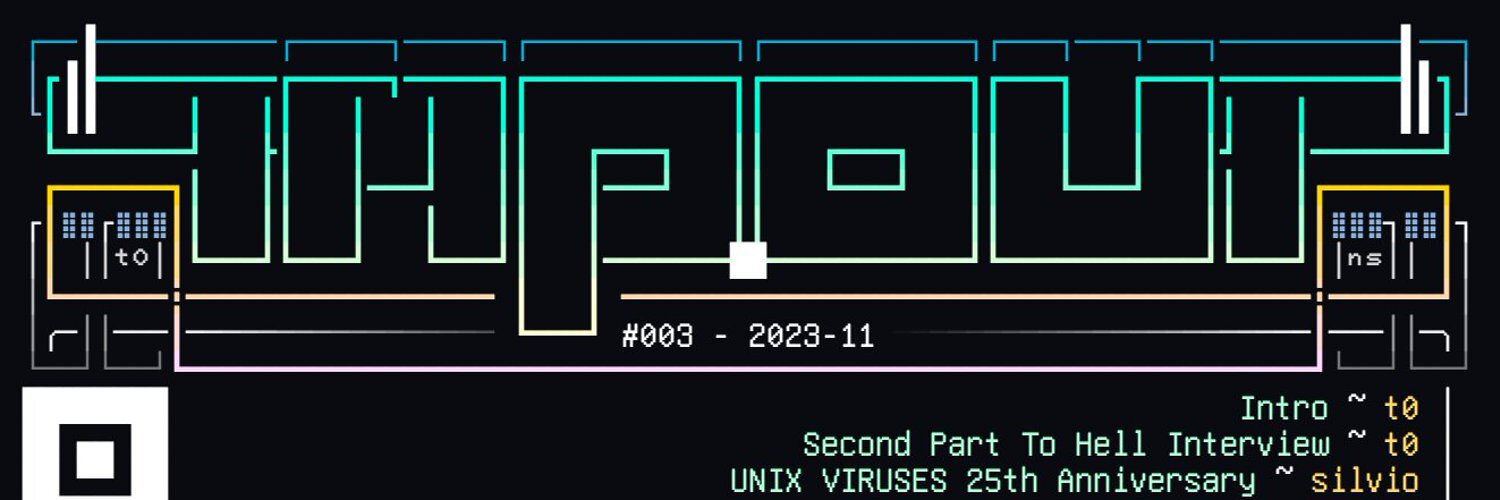
tmp.0ut rather than presenting a conventional web publication, its home page uses elaborate ANSI-style text art and a terminal-like table of contents linking 21 pieces. Topics include tiny ELF binaries, metamorphic code, Linux executable loading, code virtualisation, syscall-hook detection, binary golf, static kernel patching and an accompanying mixtape. The latest issue deliberately connects contemporary security research with older hacker and Unix culture. Its centrepiece interview with Unix pioneer Doug McIlroy covers early computing constraints, Multics, Unix, debugging and the invention of pipes, alongside discussion of modern executable formats. The staff introduction describes the issue as things people made because they were fun, encouraging exploration and imagination. The presentation reinforces that ethos: the site itself feels closer to a BBS, textfile or demoscene artefact than a conventional technical publication.
When I opened tmp.0ut, I immediately felt that little jolt of recognition you get when a screen looks like somewhere you used to go rather than something you're supposed to consume. If you spent years in terminals, dialling into BBSs, reading textfiles or admiring absurdly elaborate ANSI screens, the interface isn't decoration. It's part of the content. That's why the Doug McIlroy interview belongs here so perfectly. You're reading the inventor of Unix pipes talking about machines with tiny memories, 1200 baud feeling fast, debugging with printf, and the evening when pipes suddenly worked. Around him are articles about 57-byte ELF files, metamorphic code, binary golf and strange loader tricks. Different decades, same impulse: understand the machine deeply enough that its supposed boundaries become suggestions. Modern computing has made almost everything prettier and much less visible. tmp.0ut goes in the opposite direction. The characters are the graphics. Handles matter more than job titles. There is a mixtape. People spend ridiculous amounts of effort shaving bytes or abusing executable formats because it amuses them. For anyone who remembers BBS culture, that feels less like retro cosplay than continuity. And I think that's the nostalgia worth preserving. Not beige cases, CRT filters or simulated modem noises, but the feeling that a computer is a place you can explore. You type something, something strange happens, and curiosity tells you to keep going.
Chester Lam examines Samsung’s LPDDR5X-PIM, which puts processing-in-memory blocks beside each of 16 DRAM banks
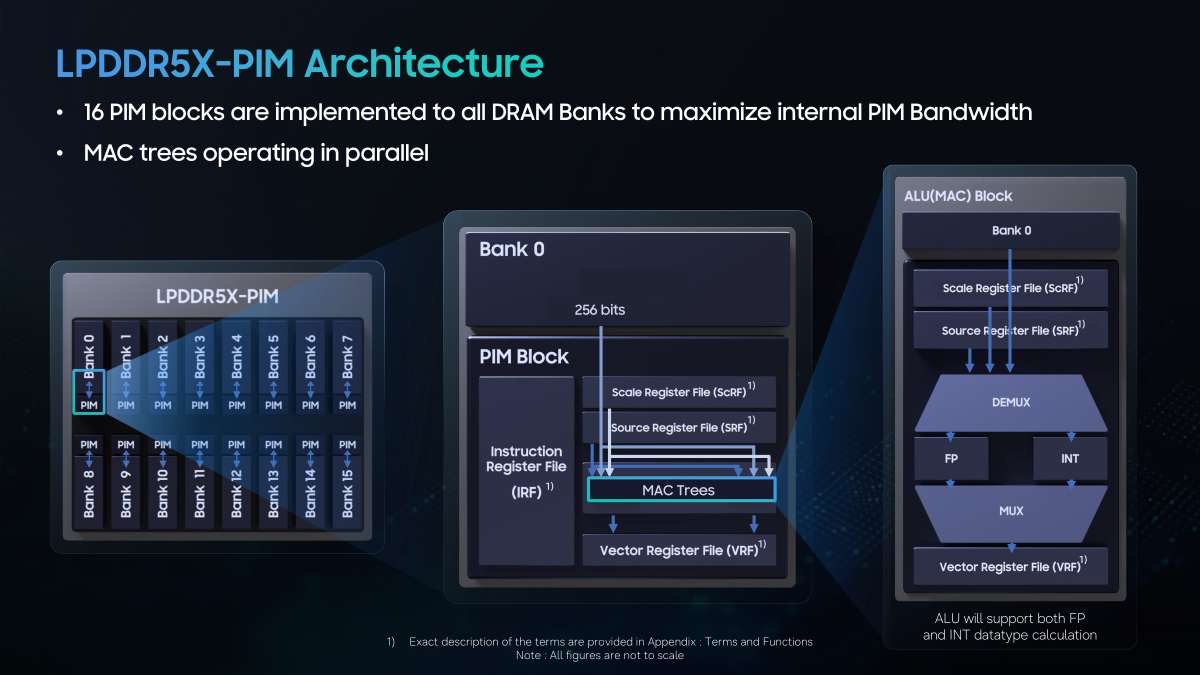
In Chips and Cheese, details how these blocks perform multiply-accumulate operations using internal memory bandwidth that reaches 614 GB/s, compared with 76.8 GB/s for regular external accesses. Samsung preserves compatibility with standard LPDDR5X memory controllers by repurposing special row addresses and conventional read and write commands to configure and trigger PIM operations. Lam argues that this compatibility creates substantial software problems. PIM changes the meaning and side effects of ordinary memory accesses, conflicting with multitasking, caches, prefetching and speculative out-of-order execution. Memory may need isolation, locking and uncacheable mappings, while context switches could require saving PIM state across banks. Lam concludes that practical adoption probably requires broader architectural changes, including explicit compute commands, cache-coherent memory controllers and CPU instructions capable of transparently selecting PIM execution.
I think there’s a wonderfully awkward contradiction at the centre of this design; Samsung has gone to considerable lengths to make PIM look like ordinary LPDDR5X, then given ordinary memory operations decidedly extraordinary side effects. A read might perform a computation. A write might alter PIM state. Suddenly all the clever tricks processors have accumulated around the assumption that reading memory is harmless become liabilities. That makes the 614 GB/s figure almost secondary. Modern CPUs aren't fast simply because DRAM is fast. They’re fast because decades of architecture have been built around hiding the fact that DRAM isn't: caches, speculation, prefetching, out-of-order execution and interleaved channels. PIM gets closer to the data, then potentially asks software to surrender several of those mechanisms to use it safely. PIM itself is an old and seductive idea: if moving data costs too much, move computation to the data. Samsung demonstrates that the arithmetic is perhaps the easy bit. The difficult part is persuading fifty years of computer architecture that memory has quietly started thinking.
My Week in AI
- How to spot AI writing | archive.ph
- The load-bearing vocabulary of Claude | louisabraham.github.io
- Ask Claude Code where your usage went. Token audit, limit diagnosis and usage forensics | github.com
- Nvidia has been in talks to acquire Hugging Face for more than $13 billion | businessinsider.com
- Previewing the Model Hardware Standard | anthropic.com
- Fujitsu tests AI construction oversight in Japan | technode.global