
This week’s #RBM reading starts in 1977, when Commodore squeezed an entire computer into the PET, only to discover that people also wanted a usable keyboard. GeoWorks later proved that a graphical desktop could run beautifully on 1MB of RAM, although developing software for it required a $7,000 workstation, which rather defeated the point. Fast-forward to 2026, and McKinsey finds AI increasingly doing our shopping, apparently because choosing our own groceries has become too demanding. Meanwhile, Steve Streeting turns a caffeine habit into an expensive engineering discipline involving espresso machines, grinders and temperature controls. Finally, we discover how military searchlights went from tracking enemy bombers to attracting customers to car dealerships. It+s decades of technological progress, culminating in illuminating a second-hand Ford Fiesta…
In this issue
5 piecesIan Matthews argues that the Commodore PET was the world's first personal computer
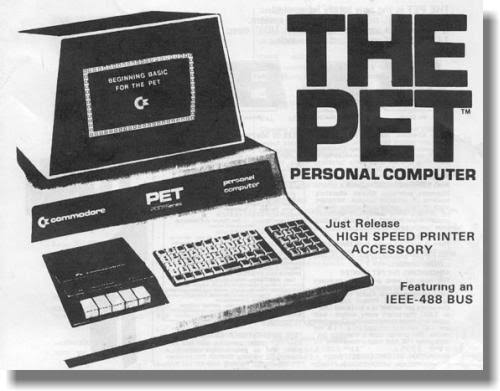
Writing for Commodore citing its January 1977 demonstration ahead of the Apple II and TRS-80, and unlike earlier hobbyist boards, the PET combined a monitor, keyboard, cassette storage, MOS 6502 processor and ROM-based software in a machine intended to work straight from the box. Matthews also recounts engineer Chuck Peddle's hurried prototype development and his later recollections distinguishing early demonstrations from public release. The article traces Commodore's move from prototypes into manufacturing and distribution, initially struggling to fulfil demand while raising prices and requiring dealers to provide servicing. User complaints prompted a proper keyboard, while later PET variants added memory and, in the SuperPET, a second processor aimed at educational and technical users. Matthews argues that Commodore's subsequent emphasis on home computers, alongside weak promotion and Jack Tramiel's departure, contributed to its loss of the business market.
This PET story most interesting detail is the cassette drive that had to be evicted to make room for a proper keyboard. Originally it was made a virtue of packing everything into one box, including a screen and storage. Then actual owners encountered those calculator-style keys. The machine had arrived ready to run, but its everyday interface needed changing. That's an unusually clear example of physical packaging becoming an architectural constraint. A programmer's most-used component, the keyboard, had been shaped by Commodore's history of making calculators and by the limited space inside the chassis. Once the keys changed, the storage design changed with them. It's hard to call a design decision merely cosmetic when fixing it requires moving an entire storage device. The PET made computing approachable partly by removing the assembly work its predecessors left to enthusiasts. Putting the entire experience in one enclosure also embedded a collection of assumptions about how people would use it. Sometimes the least glamorous component of a machine determines whether the rest of its engineering brilliance is worth anything.
GeoWorks, a lightweight graphical operating environment that competed with Windows on early PCs
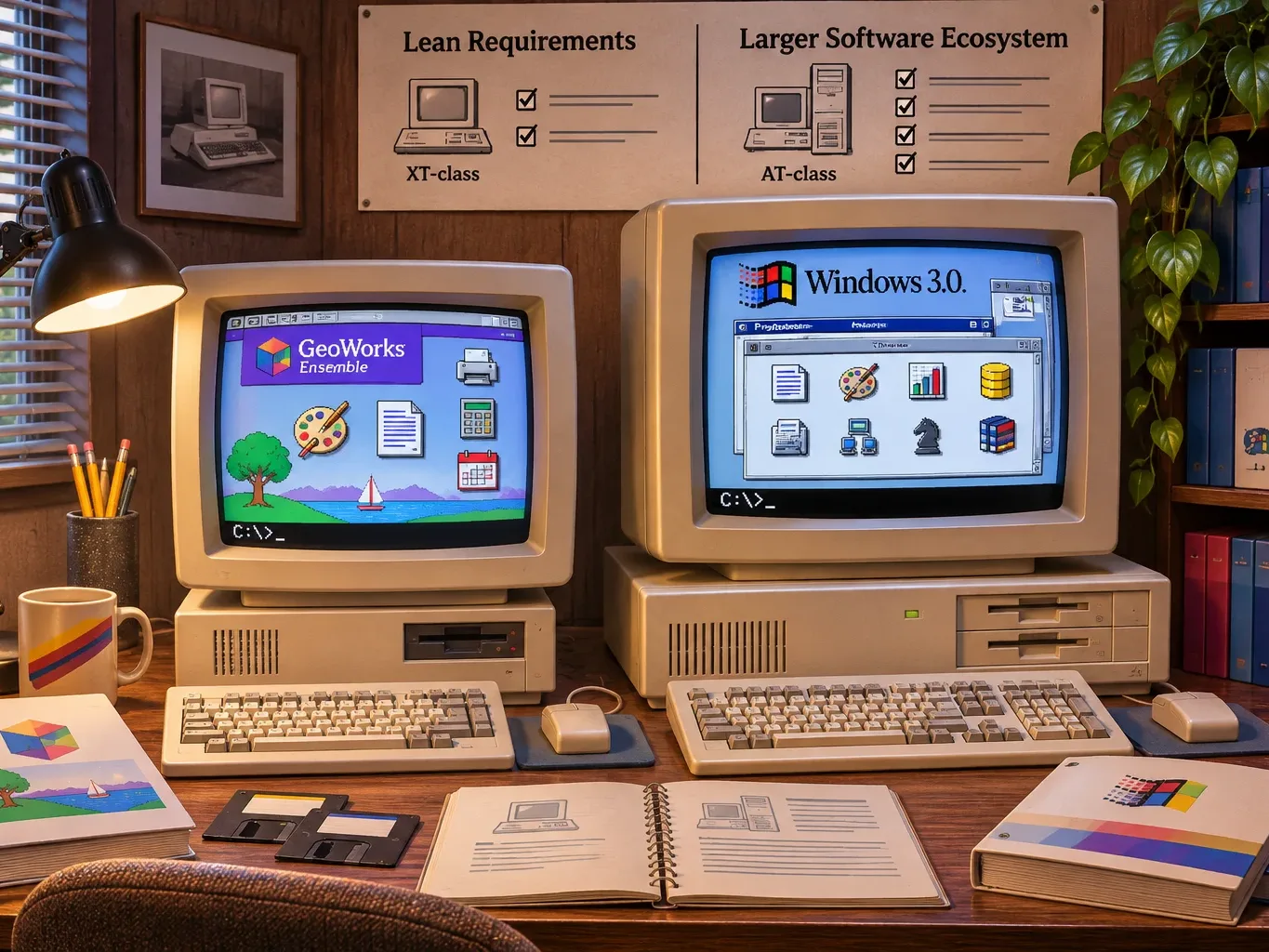
Writing for Atlas Obscura, in an article originally published by Tedium, Ernie Smith, revisits GeoWorks, developed from Berkeley Softworks' GEOS for the Commodore 64, it ran effectively on modest 286 and 386 machines, offering beginner-friendly interfaces and bundled productivity applications. Smith draws on his experience running GeoWorks on a computer with just one megabyte of RAM, alongside contemporary accounts of its capabilities. The article argues that GeoWorks' technical efficiency couldn't overcome its weak third-party software ecosystem. Early developers needed expensive Sun workstations, while Microsoft offered accessible Windows development tools such as Visual Basic. GeoWorks nevertheless found applications through AOL's early DOS interface and devices including the Tandy Zoomer, Nokia 9000 Communicator and Brother GeoBook. Smith concludes with the platform's uncertain future following ownership changes and the death of Breadbox founder Frank S. Fischer.
GeoWorks could make a modest 286 feel like a respectable graphical computer, yet creating software for it initially required equipment vastly more expensive than its target hardware. That's a peculiar way to democratise computing: invite everyone into the shop, then make potential suppliers buy the building. The usual retelling of graphical desktop history gives Windows the advantage of momentum and Microsoft's established position. Smith includes both, but the development requirement points to something more structural. For a desktop platform, every awkward little user requirement is a potential application. An accessible development environment lets someone build it, test it and perhaps sell it. With GeoWorks, that experiment began with a substantial capital investment. Many ideas would never reach the stage of being rejected by actual users. AOL's involvement makes the contrast sharper. Its distribution could put GeoWorks technology in front of modem owners, but visibility alone wasn't going to produce a thriving software catalogue. Microsoft, meanwhile, was making Windows programming approachable through Visual Basic. GeoWorks had made running graphical applications remarkably inexpensive while making their creation unnecessarily difficult. GeoWorks was impressive engineering. Unfortunately, its development requirements meant that much of the ingenuity needed to make it successful would have had to come from people who couldn't afford to participate.
McKinsey analyse a June 2026 survey of approximately 21,000 consumers across 11 markets

They argue AI is progressing from shopping advice towards executing purchases. In a weighted sample, 53 per cent had used AI for a shopping task within three months, while 14 per cent of AI users globally reported completing a purchase with an AI tool. These figures describe self-reported behaviour. Stand-alone AI tools lead product discovery, whereas retailer assistants nearly match them at checkout, although the two checkout questions are differently phrased. The article links AI's appeal to easier filtering and fewer clicks, with particular potential in grocery and beauty. For retailers and brands, McKinsey recommends accurate machine-readable product information, live inventory and delivery details, and safeguards for customer data. Its central commercial argument is that businesses must adapt as more shopping decisions pass through AI systems.
Right, this grocery example is where this stops feeling like a slightly cleverer search box... A household's regular shop is full of untidy constraints: favourite brands, acceptable substitutions, delivery slots, allergies, how ripe the bananas should be. McKinsey suggests an agent that knows household history could take much of that friction away. That's totally plausible and far more useful than having a chatbot describe ten varieties of washing-up liquid.... But - and it's a big one! - household shopping is also a running series of tiny decisions; meaning, that handing them to software and some decisions become invisible. A substitution that saves a pound, a familiar brand favoured again, a new product never surfaced: none looks dramatic in isolation. Across fifty weekly baskets, these defaults could become a significant influence on what a family buys. The claimed convenience might be real, while the customer gradually loses sight of the alternatives. That's a demanding definition of agency, and a better one than counting how many shopping conversations happened in ChatGPT.
Steve Streeting describes his progression from unpleasant office vending-machine coffee to increasingly sophisticated home espresso equipment

Initially drinking coffee for caffeine during long coding hours, he traces filter machines, Starbucks, Italian cafés and an inexpensive Delonghi EC140B before buying a Rancilio Silvia in 2010. His account uses problems encountered at each stage, from overheated filter coffee to a corroding boiler, to explain how his taste and brewing technique developed together. In 2016, Steve upgraded to a Rocket R58, seeking tighter temperature control, dual boilers, quieter operation and more consistent extraction. He argues that grinder quality, freshly roasted beans and repeatable technique matter alongside the espresso machine, recommending roast-dated beans and substantial investment in grinding equipment. The article explains the trade-offs between semi-automatic and bean-to-cup machines, particularly the satisfaction of manual preparation. It offers practical advice through personal experience rather than comparative testing, showing how equipment choices become increasingly specialised as enthusiasm develops.
Right, temperature surfing is an excellent name for an irritating problem! With the Rancilio Silvia, Steve had to guess when the boiler was at the right temperature to pull a shot. Make milk first, forget to purge the residual steam, and the next espresso could be ruined. By the time he bought the Rocket R58, he wasn't searching for a button that would make coffee for him. He wanted the machine to stop springing surprises. That's a curious sort of progress.... Plenty of appliances improve by hiding the process from the user. Steve went in the opposite direction: a more elaborate machine, a more serious grinder, fresher beans and greater attention to technique. Yet the extra engineering made the parts he enjoyed more repeatable. He could concentrate on learning rather than wondering whether a wandering boiler temperature had just sabotaged the experiment. An expensive way to protect a hobby from its equipment, perhaps, but a coherent one. Steve's journey suggest me that the best upgrade is the one that lets you taste the difference your own decisions made...
J B Crawford traces the searchlight from improvised naval illumination during the American Civil War through electrically powered defence systems and into modern advertising

He describes how carbon-arc lamps made powerful beams practical, with examples from the 1870 siege of Paris, world fairs and both world wars. The central argument is that searchlights repeatedly changed military tactics before radar largely removed their defensive purpose. The most important technical development was the integration of searchlights with acoustic locators, synchro position transmitters, radar and anti-aircraft fire-control equipment. This made targeting faster and kept operators away from exposed lamps, although improved radar eventually made visible beams unnecessary. Crawford also traces their civilian afterlife: military surplus put formerly expensive equipment within reach of car dealerships, while modern Xenon lamps sustain specialised advertising and aviation uses. The history connects military systems engineering, public spectacle and the economics of technological obsolescence.
Sky Tracker's four Xenon beams rotate through a cloverleaf pattern, driven by a cam that would be absurdly unhelpful to an anti-aircraft crew... that detail captures the searchlight's long career better than any dramatic night-sky photograph. Sure, military engineers spent decades making the beam point at a particular object, with listening horns, synchros, binocular controls and eventually radar feeding the aim, and the advertising machine deliberately throws that precision away. Its purpose is to keep moving until someone looks up. What's striking is how little of the visible object had to change for its value to invert. A searchlight made its own position obvious, which was dangerous when bombers could attack the crew; remote operation became a survival requirement. Once military surplus became available at bargain prices, that conspicuousness became the selling point for a car dealership. The same brilliant beam that once announced a target could announce a sale. The transformation happened through economics as much as design: thousands of expensive military machines suddenly became cheap enough to hire for an evening. This history also explains why the visual cliché survived its technical purpose; radar displaced the searchlight because it could locate aircraft without the spectacle, while advertisers wanted the spectacle itself. Brilliantly inefficient, by design.
My Week in AI
- The components of agent memory | anthropic.com
- Coding Agents Are Leaking Your Secrets to GitHub | apiiro.com
- The End of AI Frontiers – Machine Learning (Theory) | hunch.net
- RIP, vector database | turbopuffer.com
- GPT-6 and Intelligent UI for everyone | openai.com
- AI Can Draw Blueprints Now | stephenjgallagher.substack.com