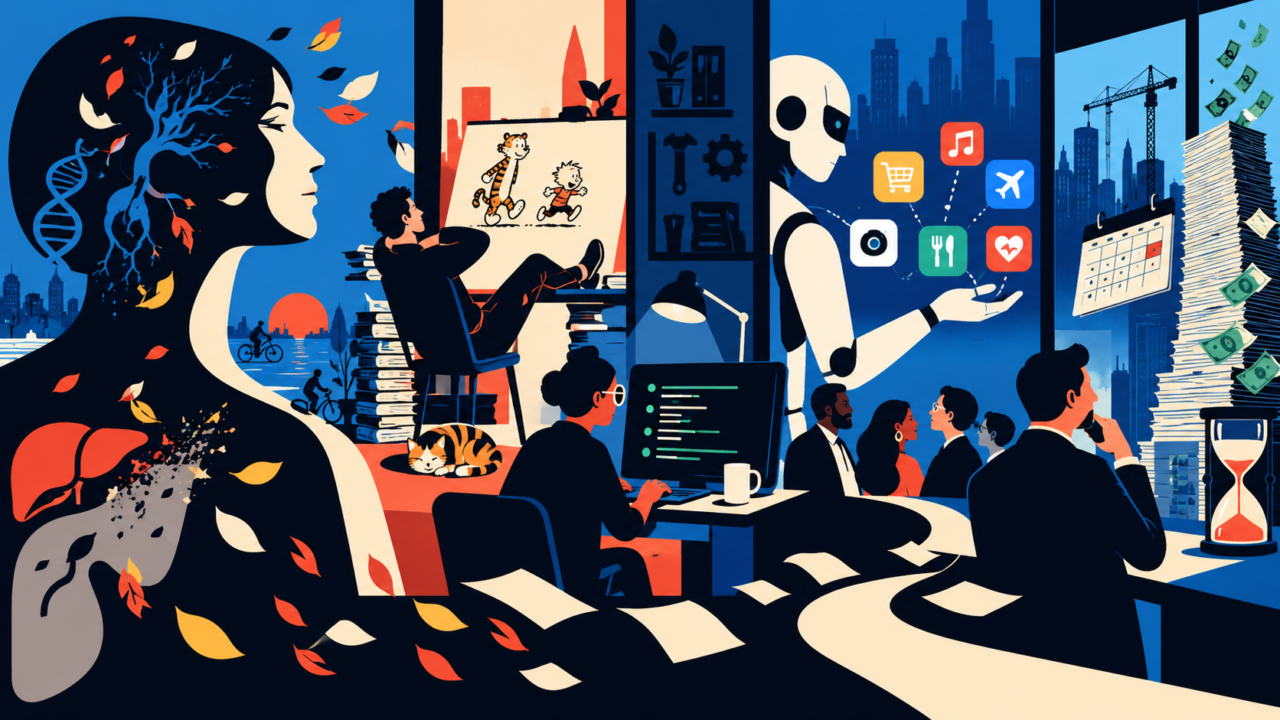
This week’s reading suggests that entropy remains undefeated, whether it’s attacking your cells, your art, your command-line tools, the app economy or next year’s AI budget. Eric Topol starts at the biological end, where ageing may involve cells gradually forgetting what they were supposed to be, their epigenetic guardrails loosening until a liver cell begins eyeing a career in fibrosis; science has some promising levers, naturally, but no human rejuvenation button just yet. Bill Watterson tackled a rather more familiar form of identity loss by spending six years refusing to turn Calvin and Hobbes into mugs, lunchboxes and whatever other plastic tat awaited, proving that sometimes the only winning move in capitalism is to leave several million dollars on the table and go home. The Command Line Interface Guidelines makes essentially the same argument for software: know what you are, tell humans what you’re doing, don’t break everything for sport, and remember that `–help` is part of the product rather than an admission of defeat. OpenAI, meanwhile, would quite like ChatGPT to become the place where applications are discovered, invoked and operated, potentially replacing the app-store ritual with agents deciding which software you need, although the awkward little matter of who gets paid for all this remains somewhere in the “details to follow” drawer. And Section completes the circle by reminding enterprises that AI is not another tidy SaaS line item: licences are the cheap bit, inference eats the budget, organisational change eats the calendar, and the return may take two years to become visible.
In this issue
5 piecesEric Topol argues that ageing is partly driven by specialised cells losing their epigenetic identity, complementing older damage-accumulation models
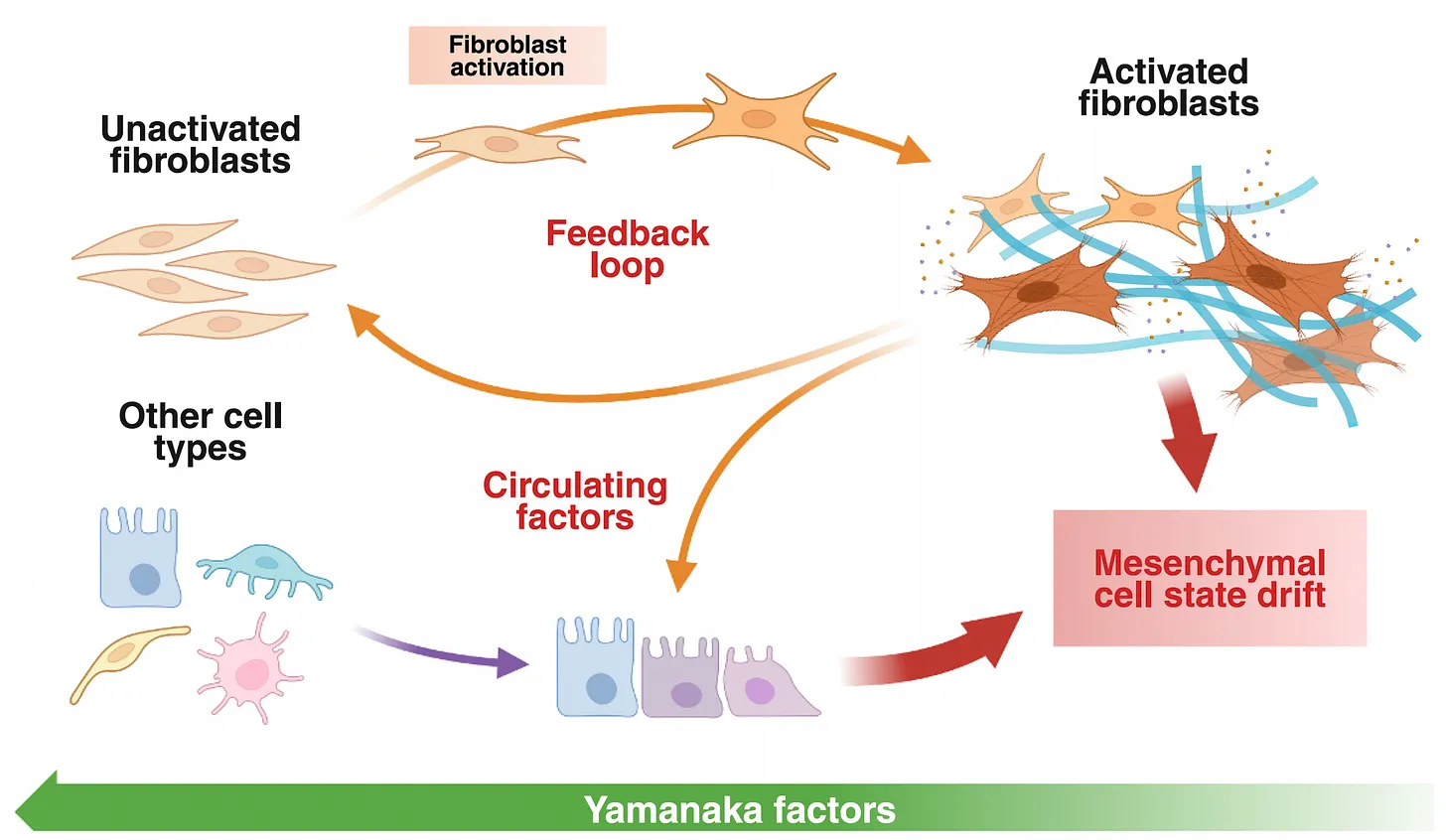
Drawing on new Nature and Cell papers, Ground Truths author describes a three-layer regulatory system in which slow chromatin architecture preserves cell identity. With age and chronic inflammation, PRC2-associated constraints erode, the Waddington landscape becomes shallower, and cells drift towards fibroblast-like mesenchymal states linked to scarring, inflammation and disease. Topol says this model may explain what epigenetic ageing clocks capture: changes in PRC2 low-methylated regions reflecting slow-layer erosion. The Cell work reports mesenchymal drift across 46 tissue types, while proposed interventions include caloric restriction, partial reprogramming with Yamanaka factors, and lithium-related pathways. Human reversal remains unproven at organ or whole-body level, and Topol acknowledges uncertainty over how identity loss interacts with accumulated damage, but presents preserving cellular identity as a promising framework for age-related disease.
The detail I keep coming back to after reading this article, is Topol’s claim that epigenetic clocks are reading erosion in PRC2-associated regions. Ageing clocks have had an awkward status: impressively predictive, mechanistically fuzzy, and therefore dangerously easy to treat as scoreboards. If the new model holds, the clock becomes more interesting because the number is tied to a specific failure of cellular identity. The intervention story then gets much stricter. A therapy that lowers an epigenetic age score is weak evidence by itself. The meaningful test is whether cells recover the correct identity, function normally, and stay there without sliding into fibrosis, pluripotency or cancer. Partial reprogramming makes that tension almost comically explicit: the same machinery that might restore a cell’s youthful programme can, with too much reprogramming, erase the very identity you were trying to save. That framing also makes the 96-year-old fibroblast result more useful than the usual “reverse ageing” headline. It shows reversibility exists at least in cells. It does not show that a human organ can be safely reset. The next stage needs boring, unforgiving evidence: durable function, tissue specificity, dose windows and long follow-up. Rejuvenation will deserve the name when identity survives the treatment.
Matthew Morgan portrays Bill Watterson’s career as a sustained attempt to protect creative integrity from commercial pressure

In an essay published by The Republic of Letters, Matthew traces Watterson’s six-year fight against Calvin and Hobbes merchandising, his insistence on controlling every aspect of the strip, and his successful push for unrestricted Sunday layouts. Morgan presents these decisions as costly choices in which Watterson repeatedly preferred artistic control to money, reach and convenience. The essay also complicates Watterson’s self-image as a powerless artist battling corporate interests. Morgan argues that Calvin and Hobbes gave him considerable negotiating leverage, while acknowledging his unusually uncompromising temperament. His expanded Sunday format barely reduced newspaper distribution, but made production slower and contributed to burnout. After two nine-month sabbaticals, Watterson ended the strip in 1995, then largely withdrew from public life, leaving a body of work whose scarcity became inseparable from its appeal.
I'm a big fan of Bill Watterson and Calvin & Hobbes. When I was a teenager, back in the 90's, I would love to get to the Sunday pages of Publico (Portuguese newspaper) and read the colourful strip. 10 years ago, and with adult money now, I bought the whole Calvin and Hobbes collection and I have it now with me, all of it, nothing's missing! So the most revealing number here is seven; out of 1,800 newspapers carrying Calvin and Hobbes, only seven actually dropped the strip when Watterson demanded more space and fewer layout restrictions. The supposed commercial catastrophe barely happened. Watterson’s integrity mattered, but so did the bargaining power created by making something people genuinely did not want to lose. He could refuse merchandising, demand sabbaticals and redesign the Sunday page because Calvin and Hobbes had become unusually difficult to substitute. Quality gave him leverage, then he spent that leverage on keeping the work strange, personal and inconvenient. The uncomfortable twist is that winning did not solve his problem. More control produced better conditions for the art but also more work. Removing the standard Sunday layout meant every page required fresh decisions; the machinery he rejected had been constraining him, but it had also been doing useful labour. Eventually the freedom became exhausting. Autonomy has an operating cost. Watterson kept paying it until the price was the strip itself. The extraordinary thing is that when the bill finally became too high, he still refused to finance another decade by turning Hobbes into a stuffed toy.
The Command Line Interface Guidelines, argues that modern command-line programs should be designed as human-first interfaces without abandoning Unix composability

Written by Aanand Prasad, Ben Firshman, Carl Tashian and Eva Parish, it reframes the CLI as a conversational UI, where help, errors, progress, prompts and defaults shape whether users can understand and recover from interactions. The guide supports this with concrete conventions drawn from tools including Git, jq, Docker Compose, Heroku and standard Unix utilities. It translates that philosophy into practical rules for output, arguments, interactivity, configuration, compatibility, distribution and analytics. Human-readable output should coexist with stable machine-readable forms such as plain text or JSON; dangerous actions should be explicit; interfaces should change additively where possible; and telemetry should require clear consent. For engineers building developer tooling, the broader implication is that command syntax is an API for both people and automation, so usability and backward compatibility have to be designed together.
Recently at Hitachi, we've been working on our OFE (Outcome Forward Engineering) and that encompasses, of course, a CLI. So building the perfect one - for engineers - is something quite close to the heart and these guidelines and rules are quite good - we adopted them. The line I’d pin above every internal-tools backlog is the recommendation to print something within 100 milliseconds. That sounds like a tiny UX nicety, but it exposes the guide’s deeper argument: responsiveness is information. A silent command forces the user to diagnose whether it is working, blocked, waiting on the network or dead. One line of status collapses that uncertainty before any actual performance improvement has happened. That principle scales beyond spinners. The guide repeatedly separates human-facing behaviour from machine-facing contracts: TTY-aware output, --plain and --json, explicit exit codes, prompts only when interaction is possible. I like this because it treats usability and automation as two views of the same interface rather than rival requirements. The shell is full of tools that accidentally make humans parse machine output and machines scrape prose. Neither constituency enjoys the arrangement. A CLI can acquire technical debt without adding much code; it merely has to teach users that an accidental behaviour is dependable.
Sarah Perez argues that OpenAI’s Dev Day announcements collectively amount to an attempt to disrupt the traditional app store model
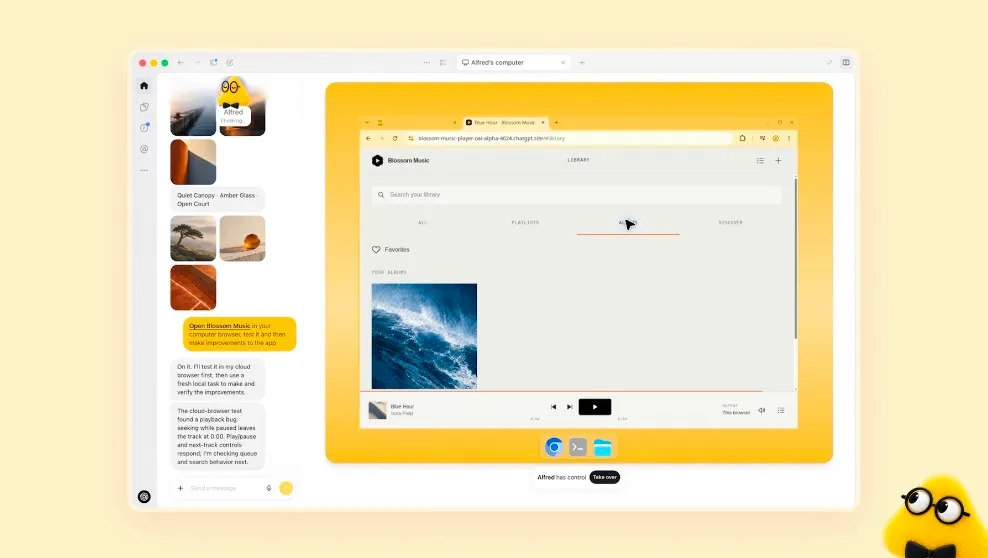
By making ChatGPT a place where software is discovered, launched and used, Sarah points to conversational app suggestions, interactive extensions, “Sign in with ChatGPT” and the company’s claim that ChatGPT has 1.2 billion weekly users. Developers can build AI-native app experiences inside ChatGPT rather than relying only on websites, desktop software or mobile app stores. Perez extends the argument to OpenAI’s Dots agents, which can use connected apps and, according to OpenAI, access an ecosystem of more than 4,000 apps. The article says this could shift tool selection from users towards agents, while OpenAI also adds an enterprise marketplace and more transparent plug-in review. The challenge to existing app stores remains incomplete, because OpenAI announced no comparable billing or revenue-sharing system and did not say third-party subscriptions would disappear.
4,000 - once a Dot can choose among thousands of connected apps, software discovery starts becoming a machine-readable problem. The user may never visit a marketplace, compare screenshots or even know which product completed part of the task. The agent needs to understand that a tool exists, when to invoke it and whether it can safely do what is required. That changes the developer optimisation problem. Being available inside ChatGPT is only the first hurdle. Tools will need clear capabilities, predictable authentication, sensible permissions, reliable execution and descriptions that an agent can interpret correctly. An excellent application could become effectively invisible if the orchestration layer rarely decides to call it. The missing billing system therefore feels secondary for now. OpenAI already has pieces that shape discovery, identity, execution, review and enterprise purchasing. Revenue sharing can arrive later if the distribution channel proves valuable enough. For developers, the more immediate shift is stranger: the next version of app-store optimisation may be aimed partly at software rather than people. Screenshots and catchy names matter less when your first customer is an agent deciding, in milliseconds, whether your tool belongs in the plan.
2027 AI budgets must move beyond software licences and explicitly fund inference, enablement and organisational change
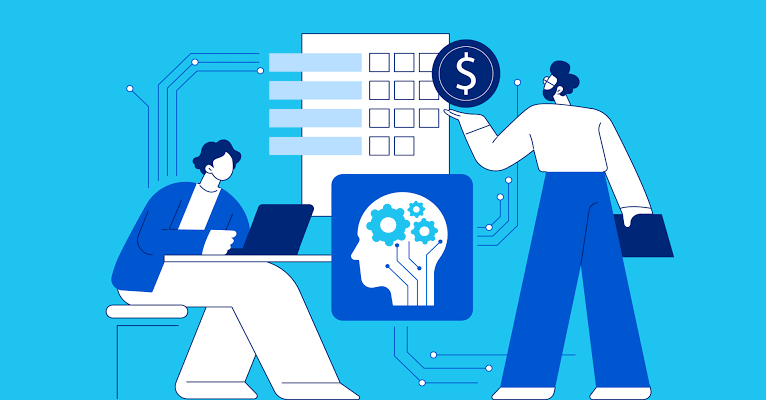
Section Head of AI Michael Domanic proposes roughly $6.6 million annually for a 1,000-person company undertaking serious AI transformation, divided approximately 7% for licences, 80% for inference and 13% for enablement. His model also budgets separately for employee usage, cross-functional agents, AI leadership, coaching and experimentation. Domanic recommends tying expenditure to measurable business outcomes, ramping budgets rather than committing the full amount immediately, and reporting value quarterly. He suggests funding some investment through reduced backfills, vendor spending and unused software, while setting token caps and 25-30% inference contingencies. Returns may take 12-24 months to become financially visible, he says. For CTOs and AI leaders, the framework treats AI less like conventional SaaS procurement and more like a variable operating capability requiring active financial management.
I think the useful provocation here is that 80% figure; if inference really becomes the dominant cost of enterprise AI, procurement stops looking like SaaS and starts looking more like cloud computing. Buying access is cheap; sustained use is where the meter spins. Success can therefore make the budget worse before it makes the P&L better. That creates an awkward incentive problem. A company that celebrates token consumption, agent runs or raw adoption may simply be rewarding expensive behaviour. Domanic’s example of employees becoming more selective about model choice points towards a healthier engineering metric: value produced per unit of inference. The most capable model should not become the organisational equivalent of taking a taxi to the kitchen. I’m less convinced by the precision of the $6.6 million template. Without underlying data, numbers such as 80%, 20 agents or 5-7% of engineering salary are planning hypotheses dressed rather neatly. Section also sells the enablement and transformation services included in its own prescription, which makes that precision worth interrogating. Still, the budgeting model captures something important. AI costs are becoming behavioural. Architecture, model choice, agent design and employee habits can all move the bill materially. CFOs will increasingly need FinOps-style visibility into inference, while CTOs will need to explain why some expensive workloads deserve to exist at all.
My Week in AI
- Microsoft Fabric is where AI agents learn how the business works | thenewstack.io
- Pi 1.0 | earendil.com
- Introducing dots | openai.com
- Gemini 4 Argon our next era of frontier intelligence | blog.google
- Googleax - Google's open agentic orchestrator | github.com
- OpenClaw🦞-Today we’re announcing OpenClaw Enterprise | openclaw.ai