Here we are, in another week, and welcome to my new subscribers! This is a newsletter that goes out to you every Sunday, just in time for you to Read Before Monday 🙂 So… across industries, 2025 reveals a deeper truth: scale alone won’t save us. Social video may have overtaken traditional news, but trust and context still matter more than clicks. Biotech dreams of mood-boosting bots, yet happiness continues to hinge on messy, human connections. In healthcare, outdated AI evaluation fixates on explainability while ignoring real-world breakdowns, something a new framework finally begins to fix. A breakthrough algorithm promises smarter data sorting with fewer moves, but it’s elegance in design, not brute force, that makes it sing. And in robotics, grand visions of scaling stumble against the hard limits of physical reality. Finally, if you missed it, I also wrote about how to turn autonomy into advantage by leveraging Agentic AI, which is quietly reshaping enterprise strategy.
In this issue
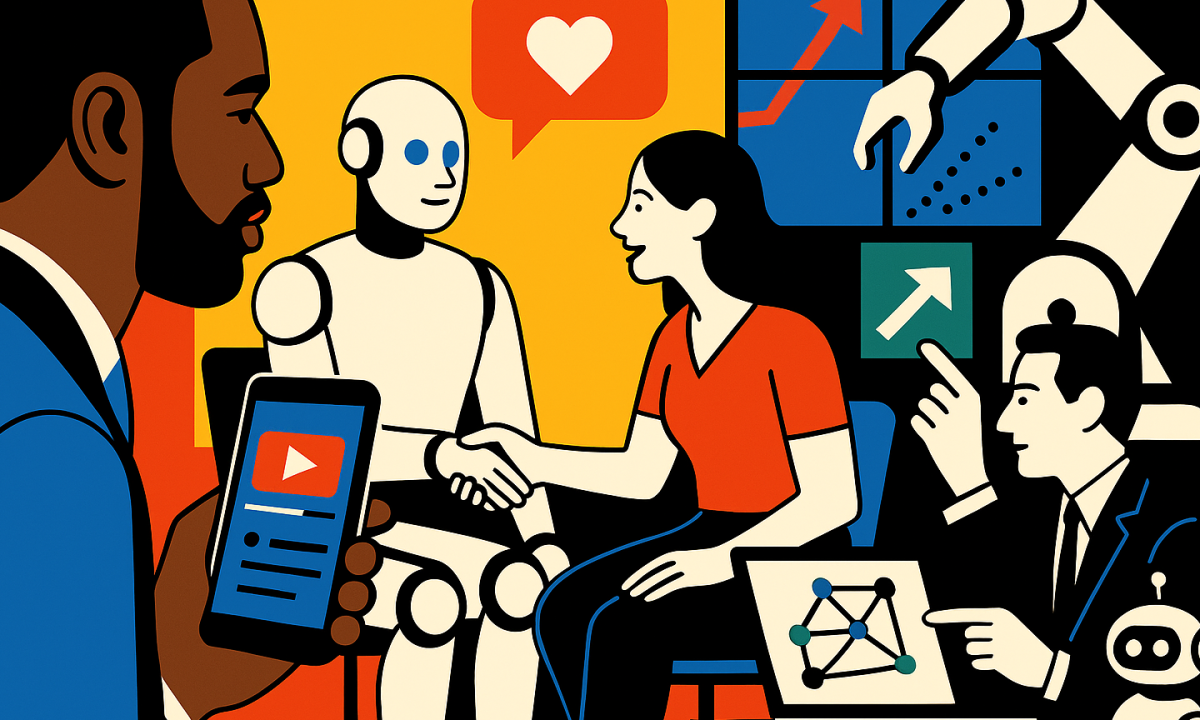
5 piecesThis 2025 Reuters Institute Digital News Report , based on input from nearly 100,000 consumers across 48 markets, highlights seismic shifts in news consumption

amid a backdrop of political, economic, and environmental uncertainty. Notably, social and video platforms now outpace TV and websites as primary news sources for Americans, especially those under 35, and influencers like Joe Rogan and Tucker Carlson attract audiences that traditional media struggles to reach. Meanwhile, rising use of AI chatbots (15 % of under‑25s weekly) introduces both convenience and risks, including the decline of referral traffic to publishers. Publisher challenges now include adapting to video-first formats, battling platform dependency, and navigating the ethical implications of algorithmic and Generative AI usage.
I find it telling how our news habits now mimic social media scrolls more than headline scans. This is clearly a moment of reinvention: publishers must become playful creators or risk irrelevance. Yet the biggest challenge remains in trust; do we crave human storytelling, or will our appetite for instant AI summaries erode our ability to think critically? Is convenience worth losing the context? Sure, youth-oriented consumption is shifting decisively toward social video and influencer-led formats, challenging legacy business models predicated on website referrals and subscription funnels. However, sustainable success will require robust measurement of AI-tool efficacy, maintaining editorial control to ensure integrity, and tackling emerging threats of misinformation and news avoidance. The real test: whether traditional news brands can transform from distributors to trusted digital personalities.
In “ What Technology Can’t Change About Happiness ”, Adam Piore explores the limitations of biotech and nanotech,

like hypothetical “mood bots” that tweak genes in the brain, to enhance human happiness. While such advances may shift our “happiness set point,” decades of well-being research show that real satisfaction stems mainly from deep social relationships, not apps, pills, or genetic edits. So, psychologists emphasise that subjective well-being hinges on intimacy, community, and meaningful connections, elements that technology can’t replicate.
Pills, bots and gene edits, sounds like cheat codes for life, but our hearts seem smarter than our biotech. Sure, I’d like to dial up serotonin on demand, but genuine joy hits differently when it’s earned, like after a hard day with friends or sharing laughter with family. Maybe what’s irreplaceable isn’t brain chemistry but moments that fill us with messy, unpredictable life. Tech might gift us neural fireworks, but it can’t script a finale worth remembering. So, the challenge for technologists - like me - lies in designing systems that complement, rather than replace, human relational architecture. Future innovation may require hybrid approaches, merging genetic tools with social-technology platforms that foster bonds and community. Engineering better brains without engineering better lives risks creating elegant but hollow machines of emotion.
The article “ An Algorithm for a Better Bookshelf ” explains advances in the “list labelling” or bookshelf problem,

a classical data-structure challenge involving how to insert items into a sorted list (or books into a shelf) while minimising moves. The recent breakthrough from Andrew Bender, William Kuszmaul, and colleagues combines two strategies: history independence and randomised, lazily timed rebalancing. This achieves an expected insertion cost of approximately log n × (log log n)², pushing close to the theoretical lower bound.
It’s almost poetic - right?! - that what started as a humble analogy of leaving space on a physical bookshelf has morphed into cutting-edge math, algorithmic defiances, and randomness to outwit data storms. There’s something deeply satisfying about engineers and theorists teaming up to tame adversarial chaos with lazy, stealthy adjustments. This combination of history-independence with randomised, lazily triggered rebalancing shows a rare synergy between security-informed design and performance goals. Under the hood lies a method elegantly resisting adversarial input while maintaining near-optimal efficiency. Practical adaptations could yield new benchmarks in database indices, network routing tables, and real-time priority queues, redefining performance expectations for sorted data under dynamic loads.
In “ Healthcare AI Has a Risk Problem ”, Dr. Sarah Gebauer, MD argues that traditional evaluation models for healthcare AI are dangerously outdated,
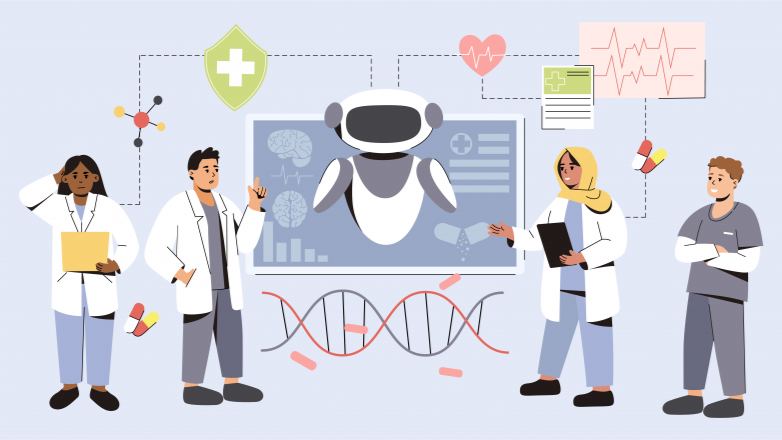
often focusing on superficial or legally safe questions like training data specifics or explainability. Instead, she proposes a broader “Healthcare AI Integrity Framework” that categorises risk by how it can be mitigated in real clinical environments. This includes three Domains; misuse, mistakes, and structural risks, alongside three impact dimensions: clinical/safety, regulatory/legal, and reputational/ethical. Gebauer draws from AI biosecurity and systems thinking, emphasising that governance should not attempt to predict every failure, but rather design for classes of potential breakdowns.
You can't stop squinting at training data and start seeing how the whole AI organism fits into a living, breathing hospital, right? I’m struck by how often we confuse precision with insight. Gebauer’s framework dares to be messy and honest, mapping how real people mess up, overthrust, underprepare, or build too fast. Healthcare AI doesn’t just need smarter tech; it needs wiser stewards. The tripartite domain model alongside cross-cutting impact categories, reflects principles from safety engineering and systems resilience. But also crucially, this approach encourages institutions to assess not just AI design integrity but its embeddedness in workflows, incentives, and policy.
Nishanth Kumar’s post “ Will Scaling Solve Robotics? ” reflects on a major question raised at CoRL 2023:

can scaling up neural network architectures with massive datasets replicate the foundation-model breakthroughs seen in language and vision, and apply them to robotics? The author synthesises arguments from the conference: proponents argue scaling enables emergence of generalised, robust robotic capabilities, while sceptics caution that robotics presents unique challenges; physical grounding, real-world interaction, and safety concerns, making simple scale-up strategies insufficient.
There’s something almost romantic in believing one giant model will unlock universal robotics, like a robotic messiah arriving on a USB stick. Despite being an old post, it clearly captures that tension: hope and hubris dancing at a conference podium. I admire the vision, yet suspect our future will be hybrid, scaling when sensible, modular when necessary, and always grounded in the messy art of robots learning from the real world... No? I do think robotics introduces irreversible constraints, physical data collection, continual adaptation, safety oversight, that foundation models didn’t face. Maybe the path forward likely lies in hybridising scale with modularity, continual learning, and grounded control. Scaling is vital, but alone, it’s not the full solution.
Last Week in AI
- OpenAI strikes landmark $30bn per year data centre deal | capacitymedia.com
- Ilya Sutskever becomes CEO of Safe Superintelligence after Meta poached Daniel Gross | cnbc.com
- A couple tried for 18 years to get pregnant. AI made it happen - CNN | edition.cnn.com
- How big could an “AI Manhattan Project” get? | epoch.ai
- DeepSWE: Training a Fully Open-sourced, State-of-the-Art Coding Agent by Scaling RL | together.ai
- X-UniMotion: Animating Human Images with Expressive, Unified and Identity-Agnostic Motion Latents | byteaigc.github.io