Welcome to another edition! It’s a long weekend in the UK, so I decided to take it easy and just share some good old topics, that some might forget, some might not even know. Let’s start with why every movie feels like déjà vu, turns out the hero’s journey is a narrative template older than your Netflix backlog, and despite our craving for originality, there’s something primal and oddly comforting in the loop of ordinary → chaos → rebirth. Then, get into the pixel soup of HDR: your phone’s sneaky wizardry that rescues blown-out skies and sunken shadows by mashing multiple exposures into one “perfect” image. It’s technology trying to mimic our eyes, but sometimes it feels like overdone makeup on reality. Speaking of overconfidence, Intel once ruled the silicon kingdom but watched the mobile revolution speed by like a motorbike past a cruise ship, because being big doesn’t mean being nimble. Meanwhile, the humble numeric keypad, that unsung 3×3+1 hero, owes its layout quirks to 19th-century inventors and a few ergonomics studies in the 1960s that still control your muscle memory. And finally, a shoutout to Visual Basic, the OG Lego kit for coders, before Microsoft dropped the manual and scattered the bricks with .NET. All in all, it’s a tour through the quiet revolutions in design and code that still shape our lives; one keystroke, camera click, and plot twist at a time.
In this issue
5 piecesThe Aeon essay examines why modern entertainment , from films and TV to plays and novels, as they seem to recycle the same storyline

. Building on Joseph Campbell’s "hero’s journey," it notes the frequent pattern: a protagonist begins in an ordinary world, an inciting incident disrupts life, they embark on a quest, encounter mentors or allies, face trials, transform, and return home fundamentally changed.
This feels we’re peeking behind the curtain of every Netflix binge, plus we need to add some Artificial Intelligence. Bit annoying that the cosmic journeys of our favourite characters are built from the same blueprint, but already knew that someway, If we look back, the best year for movies was 1999 - yes, check it out! But, going back to the topic, there’s something comforting in this loop, the hero’s journey taps into our collective psyche. Maybe it's less monotony and more a shared map, our storytelling compass guiding us home each time. For media executives and producers, this hero’s journey represents a proven model, rooted in psychological resonance and storytelling pedagogy, that de-risks investment. From a strategic standpoint, the dominance of formulaic plots also reflects constraints in talent pipelines and market incentives: studios favour predictable structures to secure audience engagement and maximise ROI. As content channels multiply, differentiation may arise not from abandoning these arcs entirely, but from integrating novelty within the framework, through subversions, intertextual world-building, and nonlinear structures. Taking this as analogy, leaders in storytelling industries - consulting for instance - need to balance structural reliability with experimental innovation, leveraging the archetypal arc as a foundation upon which to architect truly distinctive narratives.
This great article clarifies two related definitions of HDR , first, the classic iPhone “HDR mode” (since 2010), and second, the modern computational “High Dynamic Range” process
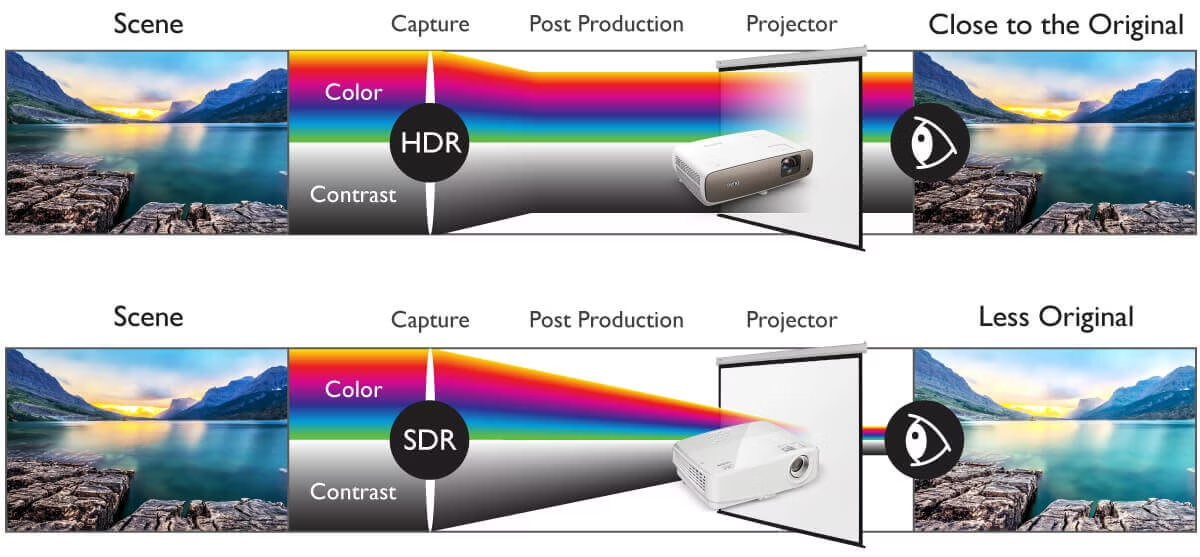
. It explains HDR photography’s core idea: capturing multiple exposures and merging them to preserve detail in both shadows and highlights, effectively expanding tonal range beyond what a single exposure can record .
Ahhh the digital wizardry behind every iPhone snapshot, right?! On one hand, I appreciate how HDR saves me from blown-out skies or murky shadows - hey, I don’t always bring a tripod or bracket exposures. I only do RAW now when I use my drones, for aerial photography, which craves authenticity over auto-tune. Still, it's comforting that when light is wild, say, neon signs against a dusky sky, HDR steps in like a savvy assistant ensuring I don’t lose the moment. Now, the availability of user-adjustable HDR intensity (as in iPhone 16 Pro) signals a shift from automatic “one‑size‑fits‑all” algorithms toward customisable workflows, balancing mass-market simplicity with creative flexibility. I do think that, as smartphone cameras continue to push technical boundaries, we should view HDR not merely as a feature, but as a foundational platform on which to build modular imaging experiences.
Intel wining and losing ” traces Intel’s trajectory from dominance in desktops, laptops, and servers,

“ fuelled by its early lead in 14 nm process technology and profitable Core M chips, through the erosion of its lead and growing vulnerabilities in new markets like mobile. It highlights how Intel, confident in its process dominance and legacy x86 strategy, failed to adapt swiftly enough to mobile and low-power segments.
Oh boy! I wrote so much about this latest dying stage of Intel vs ARM (and Mac) that I did even several videos on my #NowAboutThis videocast. Sure, Intel had such a solid lead, cash, fabs, market share, that it was almost forbidden to consider they'd slip - too big to fail, they said. And yet they did, not because the fundamentals failed, but because the fight changed: mobile wasn’t just a smaller ring, it had different rules. It's a classic tale of knowing your world so well that you forget there are entire new ones. Bradford White’s analysis shows a broader lesson in strategic complacency. ARM-based competitors capitalised on efficiency, ecosystem, and software harmony. Complacency sneaks in when comfort sets in, and sometimes you’re outrun not by force but by nimble alternatives.
This article traces the numeric keypad's evolution from early 19th-century key‑based devices
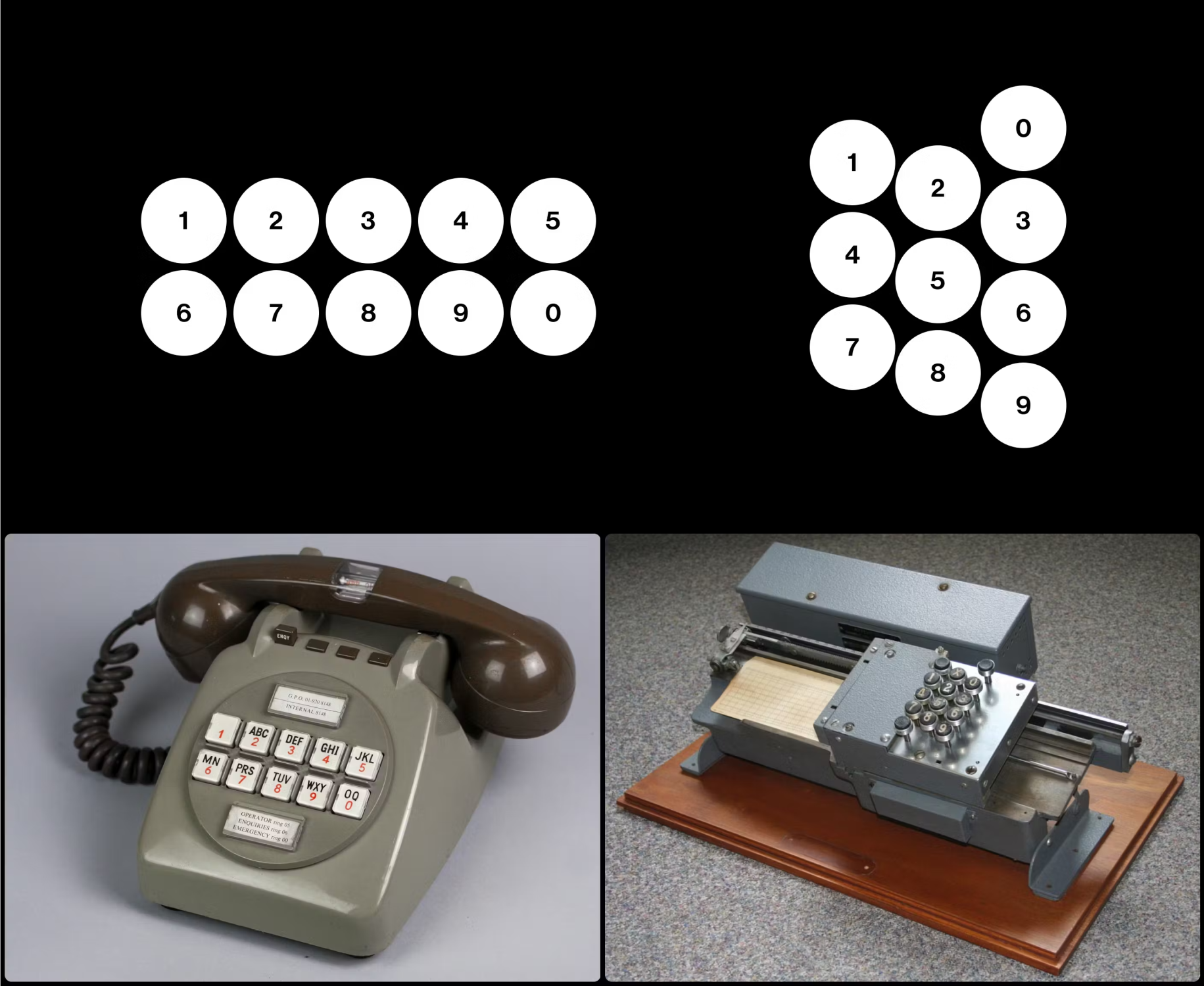
, like James White’s 1822 concept and Torchi’s 1834 prototype, to the practical adding machines of Schwilgué (1844) using a simple row of keys. It then outlines how the modern four-row layout emerged, notably with David Sundstrand’s 1914 ten-key adding machine, which set the foundation for today’s calculator-style numpad.
Everyday tools carry hidden histories, every time we punch in our PIN or dial a number, we engage with a design shaped by 19th-century inventors and mid-century ergonomics experts. Isn’t that cool and funny?! It’s great to understand “why 1 is top-left” question; a tiny decision by Bell Labs that now feels more baked-in than gravity. And yet the calculator’s layout stuck just because older systems used it. But, the diverging standards between calculators and telephones exemplify how different technological lineages, financial machines versus communication devices, settle on distinct conventions. In a broader sense, this narrative illustrates how small design choices, reinforced by cognitive ergonomics, endure over time, shaping user behaviour and industrial standards on a global scale.
Retool’s “ A History of Visual Basic ” by Ryan Lucas traces VB’s origins from Alan Cooper's Tripod demo in 1988 through its rise to dominance with Visual Basic 6.0
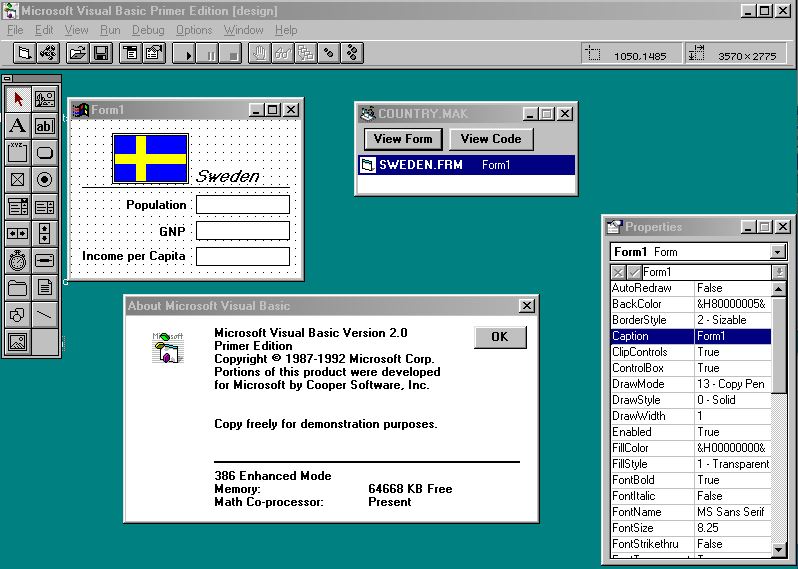
, highlighting how it enabled rapid GUI-driven app development on Windows. The narrative details VB’s sudden decline when Microsoft pivoted to .NET in 2002 with VB.NET, which alienated the familiar simplicity of classic VB and fragmented its developer base.
I do think Visual Basic captured the developer zeitgeist by making app-building feel like stacking Lego blocks, drag, drop, done. I can almost hear the collective sigh of relief from programmers trading boilerplate for GUIs. When VBNET came along in 2002, it felt like a friend threw a wrench in the works, sure, we got object orientation, but we lost the magic. So Retool’s retrospective illuminates a broader trend in software development: the perennial trade-off between accessibility and technical depth. Visual Basic excelled by abstracting Windows programming into intuitive GUI workflows, democratising app creation and shaping developer expectations. But its downfall, prompted by the abrupt shift to VBNET and the rise of web-centric languages, shows how incumbents can stumble when they misalign with emerging paradigms. The real story here is not nostalgia, but evolution: development platforms continually oscillate between abstraction and control, shaped by shifts in architecture, ecosystem, and user demands.