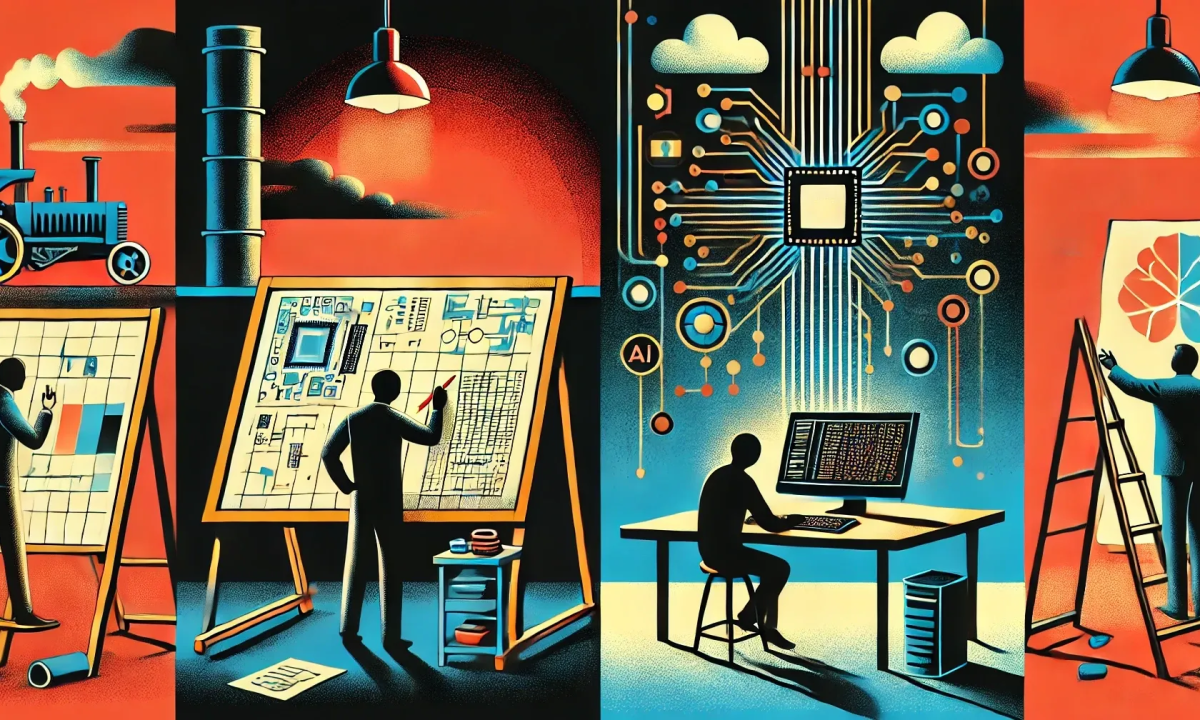
Welcome to March! This week I cover from hand drawn blueprints to AI designed chips; the way we create, compute, and communicate is shifting faster than we can comprehend. Let’s start with CAD, which went from an elite engineering tool to a 3D printer staple. Then a math duo cracked a 20-year-old group theory problem while governments still can’t crack the problem of digital sovereignty, relying on U.S. cloud infrastructure like it’s a rental they’ll never own. Meanwhile, AI is designing wireless chips we don’t even fully understand, and artists are exposing just how much data we unknowingly leave behind. The world isn’t just evolving; it’s rewriting the rules in real time. The real question: are we keeping up, or just watching the machines take over?
In this issue
6 piecesThis article traces the evolution of Computer-Aided Design (CAD) from its inception in the 1950s to its current state.
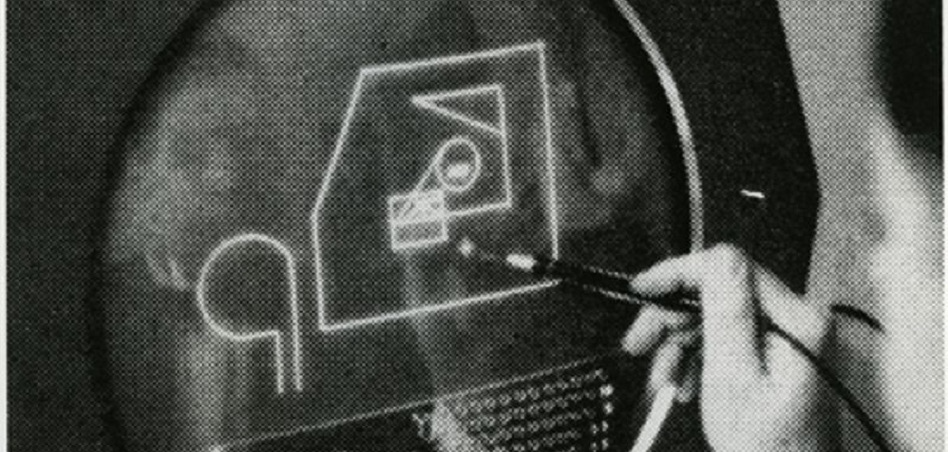
It highlights key milestones, including early developments at MIT, the creation of commercial systems by companies like Applicon and Computervision in the late 1960s, and the rise of software like AutoCAD in the 1980s.
I did Art and Civil Engineering back at secondary school and then Uni, so I was in the middle of drawing stuff by hand and then using Autocad. Sketching blueprints by hand, meticulously redrawing every minor revision - a normal day. That was reality before CAD. This transition from drafting tables (which I still have) to digital design wasn’t just a technical evolution, it was a cultural shift. Early CAD pioneers weren’t just engineers; they were visionaries who saw beyond the limitations of paper. But let’s be honest, CAD wasn’t always the sleek, user-friendly tool we know today. Early versions were clunky, expensive, and even required a proper mathematical co-processor to run - yes, I've been there! Yet, here we are, with 3D modelling software that runs on tablets, in the cloud. But here’s what fascinates me: CAD didn’t just digitise design; it democratised it. Once reserved for aerospace and automotive giants, today, even hobbyists can create professional-grade models from their bedrooms for their 3D Printers (it's like the second comeback for CAD).
After two decades of dedication, mathematicians Britta Späth and Marc Cabanes have proven the McKay conjecture,
After two decades of dedication, mathematicians Britta Späth and Marc Cabanes have proven the McKay conjecture, a pivotal problem in group theory that relates the properties of a finite group to those of its subgroups.
Twenty years! That’s how long it took to prove the McKay conjecture. Two whole decades of grinding away at a single problem, while the rest of us struggle to commit to a two-week gym routine. I think hey proved that persistence, obsession, and maybe a little bit of love can crack even the most stubborn mathematical mysteries. It’s poetic, really, two mathematicians, married, solving a problem together that had defied everyone else. But let’s talk about the proof itself. It's a beast that ties together representation theory, group theory, and finite simple groups. You know, the classification theorem that took hundreds of mathematicians decades to assemble? Yeah, that one. In the grand scheme of mathematics, this is one of those rare moments where a "holy grail" problem actually gets solved. And that’s something worth celebrating - if only we all understood it well enough to join the party...
Bert Hubert

Bert Hubert article argues against European governments and societies relying on U.S.-based cloud services, citing risks of legal overreach, data privacy violations, and potential political instability in the U.S. He emphasises the urgency for Europe to develop its own digital infrastructure to maintain sovereignty and security.
Imagine entrusting your nation's secrets to a neighbour who might, at any moment, decide to read them aloud in the town square. The convenience is undeniable, but at what cost? Legal frameworks that once offered a semblance of protection are now as sturdy as a house of cards in a windstorm, especially with recent political shifts undermining data privacy agreements. Few years ago there was a mandate for UK Cloud first (in the public sector), which ended by hyperscallers offering better deals, but now, with all the US mess, it might find its comeback to Europe and UK. So, it's high time we rethink this digital colonization. Europe boasts the talent and resources to develop its own cloud infrastructure, but why aren't we investing in it? Is it laziness, shortsightedness, or just the irresistible charm of Silicon Valley marketing? Whatever the reason, continuing down this path is akin to building a castle on quicksand: impressive until it sinks Let's not trade sovereignty for convenience. The cloud may be fluffy, but the storm brewing within is very real.
Researchers at Princeton Engineering and the Indian Institute of Technology have utilised deep-learning models to design millimeter-wave (mm-Wave) wireless chips.

These AI-generated designs, created within hours, exhibit unconventional structures that outperform traditional human-crafted counterparts. The AI approaches chip design holistically, treating the chip as a single entity rather than a compilation of individual components.
"Ah, you think Moore’s Law is your ally? You merely adopted the transistor count. AI was born in it, molded by it." - Okay, I butchered the Bane quote again, but stick with me. We’re at the point where AI is not just optimising designs, it’s creating things that human engineers don’t even understand. This is next-level weird. This is both exciting and terrifying. On one hand, AI is showing us how inefficient our own designs have been. On the other, we have no idea why its solutions work so well. Then there’s the practical side. What if these chips are impossible to manufacture at scale? What if a bug in the AI’s design logic creates a flaw no human can diagnose? And let’s not even start on security risks, how do you secure something you don’t fully understand? Talking about machines; where it is them talking Gibberlink.
The New Yorker article "The Artist Exposing the Data We Leave Online" goes into the work of artists who highlight the vast amounts of personal information

The New Yorker article "The Artist Exposing the Data We Leave Online" goes into the work of artists who highlight the vast amounts of personal information individuals unknowingly share in the digital realm. These artists use various mediums to visualise and critique the pervasive data collection practices of modern society.
Ahhhhh the unsung heroes pulling back the curtain on our naïve digital dance. We swipe, click, and share, leaving breadcrumbs of personal data without a second thought - until these artists come along and turn the invisible into something you can’t ignore. Through interesting visualisations and interactive exhibits, they’re holding up a mirror, forcing us to confront the fragmented reflections of ourselves scattered across the internet. It’s both jarring and necessary, a wake-up call that in the age of information, privacy is a myth, and ignorance isn’t bliss; it’s a commodity traded in the shadows. The real question is: now that you see the digital footprints you’ve left behind, will you change anything? Or are we all too addicted to convenience to care?
Last Week in AI
- OpenAI announces GPT-4.5, warns it’s not a frontier AI model | theverge.com
- Sora, OpenAI’s video generator, has hit the UK. It’s obvious why creatives are worried | theguardian.com
- How telecoms can thrive in the age of generative AI | weforum.org
- Generative AI Tool Marks a Milestone in Biology | hai.stanford.edu
- UK newspapers blanket their covers to protest loss of AI protections | theverge.com
