I don’t have a lot of nostalgia to share this week, but it’s an interesting edition, as this week has been quite full for me in terms of speaking events, in particular the one for Financial Services where I discussed how can we move from Intent to Operational Trust and Comprehensive Governance. So…. we start with a lawsuit between two influencers over a “neutral, beige, and cream” aesthetic is pushing legal boundaries. Then, remember cyber cafes? They were the internet’s answer to coffeehouses, where you’d surf, sip, and – shockingly – actually meet people. Do you know the latest Google’s research into multimodal models that visualise time-series data? Feels like a “why didn’t we think of this sooner” moment. And what about sci-fi body armour’s missed opportunities? Where cool aesthetics win over function – classic sci-fi! Finally, network topologies aren’t exactly cocktail party material, but HammingMesh might deserve an invite.
In this issue
4 piecesInfluencers Sydney Nicole Gifford and Alyssa Sheil are embroiled in a legal dispute that could set significant precedents in the content creation industry.
Gifford alleges that Sheil replicated her distinctive “neutral, beige, and cream” aesthetic across multiple platforms, including Instagram, TikTok, and Amazon Storefront, leading to a decline in Gifford’s earnings. Sheil counters that such aesthetics are widespread among influencers and denies the allegations. A Texas judge has allowed the lawsuit to proceed, indicating its potential to reshape legal interpretations of originality and copyright within the influencer economy.
I find this new trend quite amusing. Not the lawsuits, but the influencer one. Few years ago I did a #NowAboutThis video called "Influencers are just sales people" . In short, it was about the new wave of sales folks, the influencers. And if you think about it, if you copy a window or a product from some other brand, or even a campaign, then you might see yourself in trouble. Why can't this be the same for sales people - I mean, influencers? I understand there's a fine gap between originality and trend adoption, in particular with aesthetics and styles that sooner or later everyone adopts, because it sells better. I've been lucky enough to not have the #NowAboutThis copied or even taking inspiration from others :) The difference between industry norms and individual rights is going to be interesting, in particular when brands are now more focused on buying those rights than rather create content that inspires others.
The Vice article recounts the story of Cyberia , the world’s first internet café, founded in 1994 in London by Eva Pascoe.
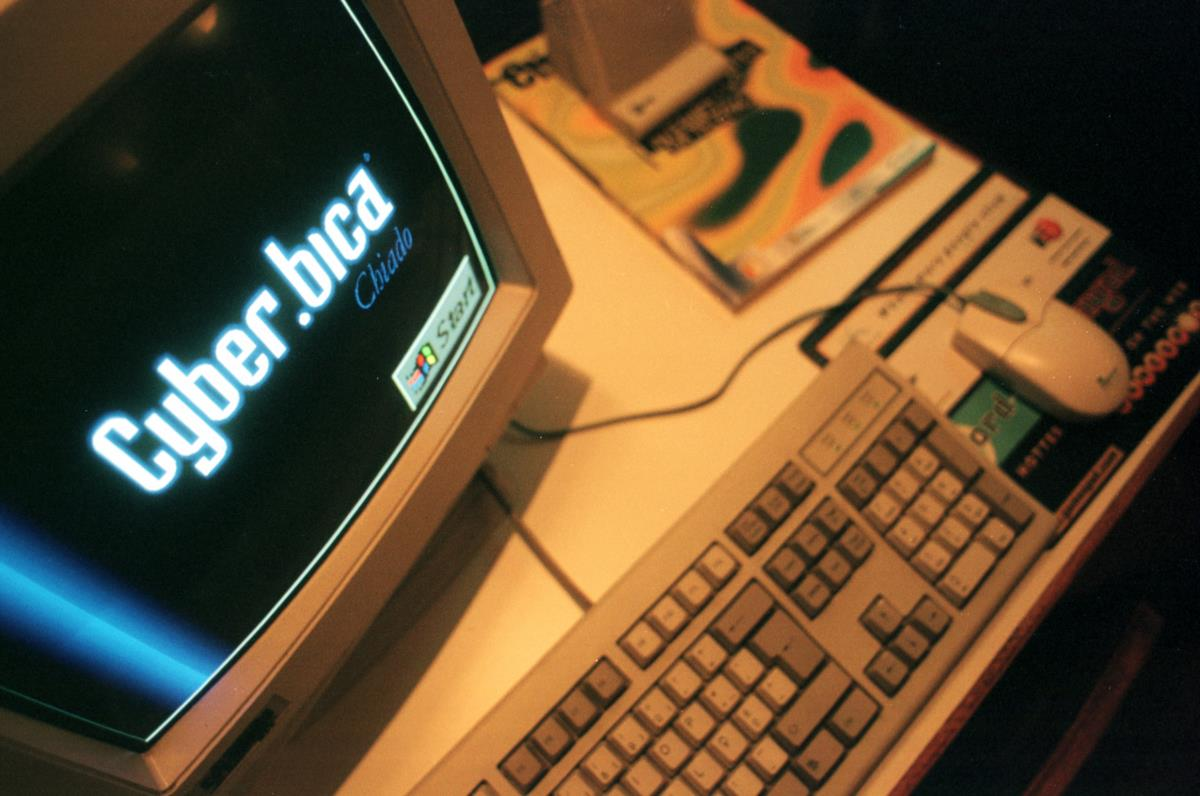
Cyberia was a trailblazer, merging early internet culture with social innovation, offering access to email and the web when few had it at home. It also aimed to create a safe, inclusive space, particularly for women, amidst the male-dominated tech scene. Cyberia quickly expanded globally and became a hub for creatives and tech pioneers. However, its utopian vision of the internet as a democratising tool contrasts sharply with today’s more complex online landscape.
Remember cyber cafes? I do! In Portugal, they were one of the few trends we adopted quickly in the ’90s. Cities like Lisbon had a handful where you’d pay by the hour, enjoy a coffee, and - here’s the shocker - actually meet people. I even know couples who first met at these cafes! It’s fascinating to look back at how they fostered knowledge sharing, community building, and even rivalries between spots. I vaguely remember Cyberia from a trip to London; I dropped by once and loved the vibe. Now, we call them co-working spaces, but sadly, the magic of spontaneous human connection seems to be missing.
This Google Research article highlights t he use of multimodal models to better interpret time-series data by leveraging visual plots instead of raw numerical values.

This approach boosts performance, demonstrating up to a 120% improvement in classification tasks, such as fall detection. The study reveals that visualising data simplifies reasoning for models, aligning with how humans process information. Importantly, this method enhances model capabilities without additional training, underscoring its practical value for healthcare, climate analysis, and other fields requiring time-series interpretation.
Back in June I posted a comparison between Arima vs Transformers for a Time Series LLM and this Google research is quite interesting. I like how their visual-first approach simplifies model reasoning and aligns with human intuition, avoiding additional training demands, but I think that Time-Series LLMs offer scalability and flexibility, capable of fusing structured and unstructured information for better decision-making. Their approach depends on effective data visualisation tools, which may not always be accessible or scalable for vast time-series datasets, whilst the Time-Series LLMs face issues like data sufficiency and risks of hallucinations, requiring careful grounding in real-world scenarios. But bottom line is good to see we're moving towards more context-aware and flexible time-series analysis methods.
The article in Communications of the ACM discusses the development of HammingMesh , a hybrid network topology designed to optimise large-scale deep learning workloads.

By combining the cost-effectiveness of torus networks and the performance benefits of switched topologies, HammingMesh provides high bandwidth at lower costs. The design addresses challenges like over provisioned global bandwidth and underutilised local bandwidth common in AI workloads, with efficient handling of node failures and job allocations. It offers a promising architecture for the increasing demands of sparse models and large-scale AI systems.
I know that network topologies aren’t exactly dinner table conversation, right? But this caught my attention, and it feels like a bridge between old-school efficiency and modern AI demands. The way it blends torus simplicity with the flexibility of switched networks is impressive, especially for managing sparse models like MoEs. The promise of high bandwidth at lower costs is great, but I wonder how scalable it really is as models and data keep growing. Also, integrating it into existing HPC systems might be trickier than simulations suggest. It’s an exciting step, but the real test will be whether it can evolve as fast as AI workloads do.
Last Week in AI
- Marco-o1: Towards Open Reasoning Models for Open-Ended Solutions | arxiv.org
- Advances in run-time strategies for next-generation foundation models | microsoft.com
- QwQ: Reflect Deeply on the Boundaries of the Unknown | qwenlm.github.io
- Anthropic: Introducing the Model Context Protocol | anthropic.com
- Podcasts are dead: GenFM Now Playing on ElevenReader | elevenlabs.io
- The Code of Practice for general-purpose AI offers a unique opportunity for the EU | euractiv.com