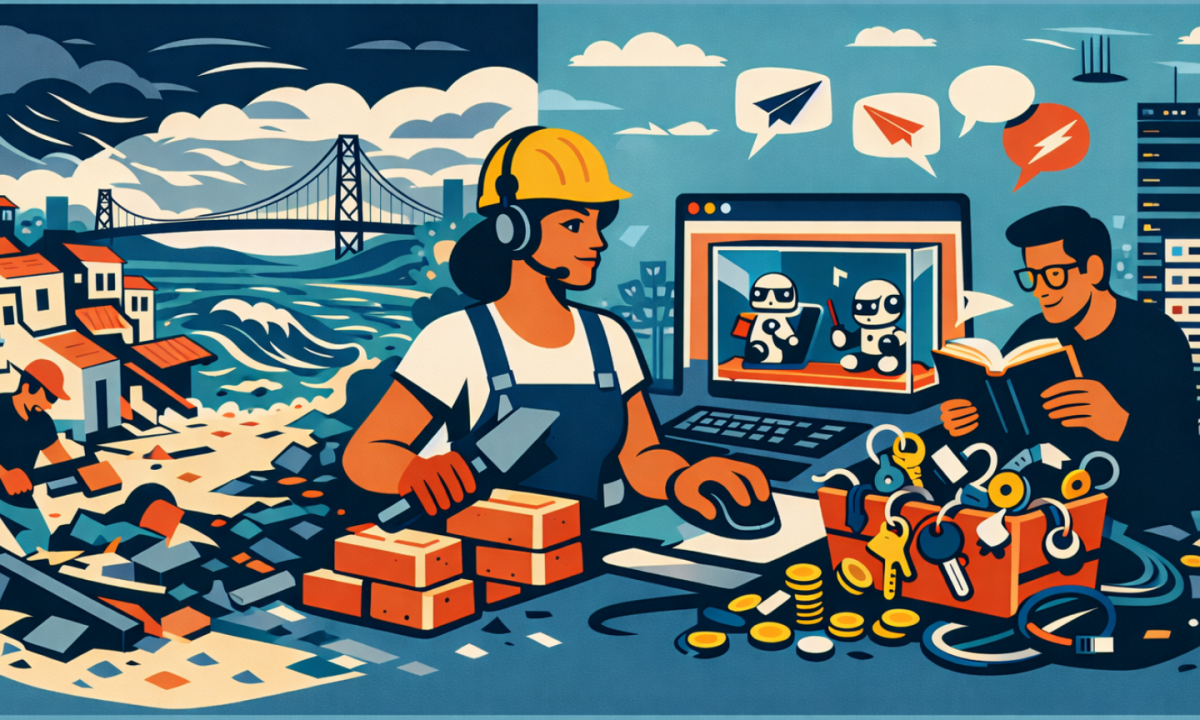
Storm Kristin passed by the area in Portugal where I have family and it was a disaster for everyone – government included. Fortunately nothing major happened to relatives, but several nearby cities got really destroyed. Now it’s time to help and rebuild. But, against that backdrop, this week’s #RBM reading rhymed: the browser is emerging as the pragmatic sandbox for agentic tools, like file-scoped access, strict CSP, workers and WASM, which is good enough to ship real workflows if you accept “Chrome with caveats”. Then, OpenClaw happened! It shows what a personal agent can do when it lives on your machine and chats over Telegram: powerful, customisable, and a minefield of keys, costs and governance you have to wire yourself. Moving on to research that keeps us honest: naive delegation hobbles learning, while explanation-seeking preserves understanding with only modest speed gains, so the game isn’t “use AI”, it’s “use it to think”. That pairs with Mollick’s framing: manage AI like a bench of keen juniors, which clear briefs, crisp “done,” staged reviews and you’ll bank compounding wins. And a needed brake: don’t outsource the parts that carry your voice or build your craft; automate drudgery, not identity.
In this issue
5 piecesPaul Kinlan argues that the web browser is a practical sandbox for agentic AI , combining file-system scoping, network control, and execution isolation.

Using Anthropic’s sandbox guidance as a frame, he reviews relevant browser primitives: input pickers, origin-private storage, and the File System Access API; tight Content Security Policy starting from “default-src ‘none’”; and sandboxed iframes, Web Workers, and WebAssembly to cordon off execution. He tests the thesis with Co-do, a browser-only file manager that scopes folders, locks network calls, and runs tools in Workers. He also catalogues trade-offs: CSP blind spots, cross-browser differences (Blink’s iframe csp attribute; Safari’s limited directory picker), permission fatigue, and risks like malicious file creation or third-party LLM exposure.
I like the pragmatism here: use the thing already built to run hostile code, which is the browser. The layered approach feels sensible enough and the co-do demo proves you can do useful work without a bespoke VM. But the safety story still leans on CSP nuance and vendor trust, which is a brittle combo. The double-iframe trick is clever and annoying in equal measure. Until local models are good enough or browsers ship friendlier sandboxes, this is “Chrome with caveats”. For many workflows, that’s still good enough today.
Federico Viticci describes experimenting with Clawdbot - now OpenClaw - an open-source, locally run personal AI agent accessed via messaging apps.

The agent lives on his M4 Mac mini, stores memories as Markdown, and can execute shell commands, write scripts, and install skills. Viticci reports burning through 180 million Anthropic tokens while testing, and shares examples of self-improvement via skills and MCP servers. He frames Clawdbot as a glimpse of agentic computing where assistants can act, not just chat. Its “gateway” supports iMessage, WhatsApp and Telegram, making interactions feel like texting a human aide. Because it runs locally, the system is customisable and inspectable, with integrations created on demand, including replacing a Zapier workflow using cron and API calls.
I've wrote about it already, from a security stand point, but here're some more thoughts... you’re stitching together Anthropic, Telegram, ElevenLabs, and assorted APIs; every integration is another failure mode, privacy surface, and invoice. Token economics matter: heavy experimentation implies variable, potentially high opex. Governance is user-assembled cron jobs, key storage, permissions... so auditability and rollback are weak compared to managed SaaS. Then the rebrands (Clawdbot -> Moltbot -> OpenClaw) hint at ecosystem flux that will ripple through docs and support. Is it good? Yes! Is it something you should try? Absolutely! Is is safe? Double No!
Anthropic reports a randomised controlled trial testing whether AI coding assistance accelerates learning or undermines

it. Fifty-two mostly junior Python users learned Trio, then took a mastery quiz. The AI group scored 17% lower than hand-coders (50% vs 67%), with the largest deficit on debugging. AI slightly sped completion by about two minutes, but not significantly. Interaction style mattered: high scorers used AI for explanations and conceptual questions; low scorers delegated code generation or relied on AI debugging. The study situates findings alongside prior evidence that AI speeds familiar tasks, arguing the learning context changes outcomes.
What stuck with me is how the “how” beats the “whether”. If you simply offload, your quiz score tanks; if you ask for explanations or probe concepts, you keep speed without binning comprehension. This implies product and policy levers: enable “learning modes” by default, bias prompt UX toward “explain then do”, instrument assistants to report explanation coverage, and reward review effort, not just throughput. Expect heterogeneous ROI: substantial productivity on familiar work, ambiguous gains during acquisition phases. Treat copilots like power tools with training requirements, not magic interns. Roadmap asks for longitudinal studies, senior cohorts, and tasks beyond Python; until then, pair AI with structured practice and explicit comprehension checks to preserve oversight capacity.
Ethan Mollick recounts an experiment where executive MBA students built startup prototypes in four days

using Claude Code and Google Antigravity, plus ChatGPT, Claude, and Gemini for research, positioning, pitching, and modelling. He argues the core skill is delegation: telling AI precisely what you want. He proposes an “Equation of Agentic Work” balancing Human Baseline Time, Probability of Success, and AI Process Time, and uses OpenAI’s GDPval study to illustrate savings when AI wins often enough and review time is bounded. He highlights that AI can quickly produce impressive outputs, even end-to-end creations like a retro adventure game, but real work demands clear intent and constraints. As AI talent becomes abundant and cheap, the scarce asset is knowing what to ask for; people who can define “what good looks like” and evaluate it will thrive.
This is essentially an operating model update! AI widens the span of control by converting scarce expert time into supervisory attention over abundant agent labour. The mechanism is managerial: raise Probability of Success with better specs; compress AI Process Time with faster evaluation; reserve human time for judgement. That implies concrete org moves, like standardising delegation artefacts as prompt templates, codifying “definition of done”, and instrumenting review steps. Incentives also matter: reward specification quality and evaluation rigour, not just throughput. Still, the direction should be treating AI like a team of junior analysts, which clear briefs, staged deliverables, checklisted acceptance, and rapid retries. Organisations that professionalise this will bank compounding productivity while preserving accountability.
Erik Johannes Husom argues that “outsourcing thinking” to LLMs risks weakening core human capacities, especially in personal communication,

valuable life experiences, and the slow building of tacit knowledge. Using Andy Masley’s “lump of cognition fallacy” as a foil, he agrees thinking isn’t finite but says what we think about matters. He contends machine-mediated phrasing alters meaning and erodes trust, urges disclosure of AI-assisted writing, and differentiates “functional text” (code, signage, documentation) from authorial communication where voice and relationship carry weight.
This weeks #RBM has been a lot about AI, so maybe next one I can bring some nostalgia posts :) Yet, I’m sympathetic to this core warning of the article: not everything should be delegated, and voice really does matter. The bit on repetition building intuition rings true; shortcuts often short-circuit craft. Still, I think he overstates how inevitably tools erase meaning; good editors, human or machine, can sharpen without puppeteering. Where he absolutely lands is on disclosure and intent: be honest about assistance, and decide what you refuse to automate. My rule of thumb? Automate drudgery, not identity. Keep the chores that shape who you are.
Last Week in AI
- AI must augment rather than replace us or human workers are doomed
- Cutting LLM Memory by 84%: A Deep Dive into Fused Kernels | towardsdatascience.com
- How IBM became an AI darling | archive.ph
- Introducing Prism | openai.com
- Inside OpenAI’s in-house data agent | openai.com
- Multi-platform SDK for integrating GitHub Copilot Agent into apps and services | github.com
- Introducing Agentic Vision in Gemini 3 Flash | blog.google