
These following weeks have been quite weird with Minneapolis and Davos, but that’s the new world order… Going back to what you need to Read Before Monday, we’re seeing the same motif across wildly different fronts: coordination beats cleverness. LLMs can finally surface messy, high-dimensional preferences – great for “hard to describe” markets – yet once every user has an agent, attention becomes the scarce resource and price signals or credits are the boring but necessary brakes. Also, we’ve met this before: the IBM 9020 kept planes apart by designing for operators first and making failover boring, it’s pragmatism over purity. Same vibe in prosthetics: AMI rebuilds the body’s paired-muscle loop to restore proprioception; such an elegant idea, now begging for hard numbers and rugged hardware. And Oxford’s magneto-sensitive proteins are properly weird in the best way, but still need in-vivo proof before they’re tools not demos. Through it all, I’m bullish on owning the venue: blogs compound insight while social is just distribution plumbing. Own your domain, ship steadily, design the market – and the system – for the human in the loop.
In this issue
5 piecesThis essay argues that large language models can elicit richer , high-dimensional preferences than standard questionnaires, improving matches in “hard to describe” markets such as dating or services.
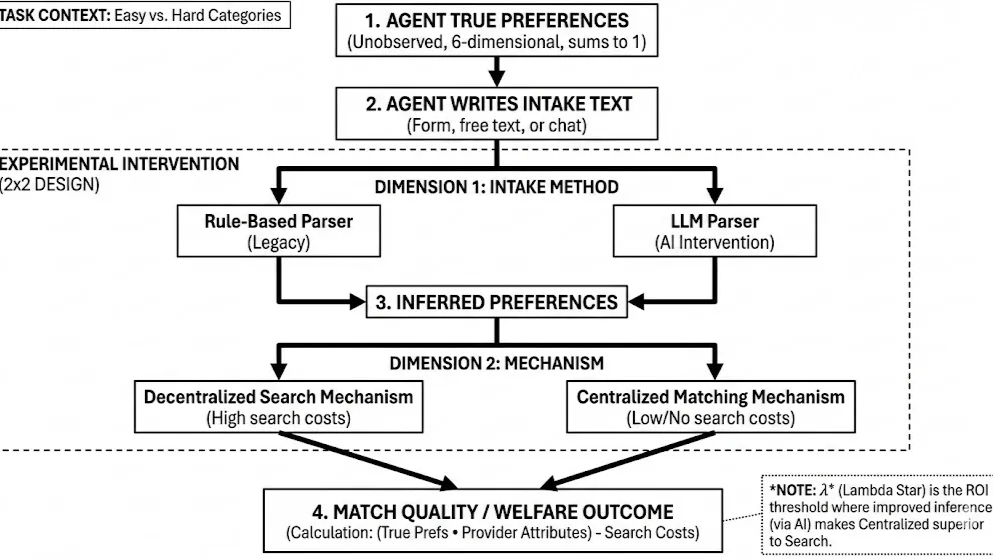
Drawing on matching-market theory (Hayek, Roth) and recent experiments, the authors claim LLM-parsed free text scales better than manual ranking and can shift platforms from iterative search to centralised clearing. In a simulated marketplace with six-dimension preference vectors, AI-assisted elicitation raises match quality and reduces the actions needed to reach acceptable outcomes. However, when everyone has an AI agent, coordination costs resurface as congestion. In the simulation, widespread agent-to-agent messaging floods provider inboxes, cutting response rates from 48% to 2% and reducing net welfare by 88%. The authors frame this as a “tragedy of the agentic commons.” Introducing money and prices on an exchange largely recovers welfare by compressing dispersed information and limiting message fan-out, echoing Hayek’s view that prices remain essential even when AI reduces transaction costs.
Great reading! It's the classic coordination problem with a technological accelerant; better preference elicitation expands feasible trade, nudging platforms from search to central clearing, yet adoption shifts the constraint from information scarcity to attention scarcity, creating a negative externality that price signals can internalise. That implies platform consolidation: markets with heterogeneous goods (weddings, bespoke services) become designable once tastes are machine-readable. Governance choices then matter; like who pays, who gets priority, and how strategic behaviour is deterred. An exchange with fees or credits could restore welfare, but distributional effects and seller liquidity need stress-testing... Right? Bottom line is that agents don’t remove institutions; they increase the return to good ones.
The article traces how US civilian air traffic control moved from fragmented, manual processes to IBM’s 9020 multisystem in the late 1960s.
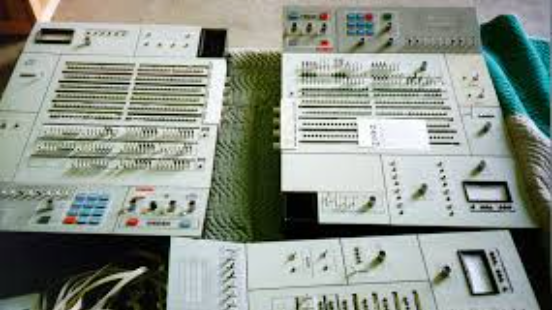
SAGE inspired, but wasn’t suitable for ATC; SATIN and the Air Force’s SCC were cancelled, pushing the FAA to launch NAS Enroute Stage A with IBM. The 9020 clustered multiple System/360s, with compute and I/O elements, that shared “storage elements,” a central console, and extensive interrupt-driven real-time software, chiefly a control program and Operational Error Analysis Program (OEAP), largely written in JOVIAL. The software stack; Input, Flight, Radar, Output, Liaison, handled teletype flight plans, radar correlation, separation rules and bulk outputs. Early 9020s went live from 1967; redundancy allowed seamless failover, even partitioning for training. Later, HOST on IBM 3083 rehosted much of the code, with UK CAA’s simplex 9020 lasting until 1990.
What a great reminder that “modern” distributed systems problems are older than we think. I love how the 9020 mixes duct-tape pragmatism, along side shared buses, crude locking, with disciplined redundancy and diagnostics. The OEAP feels like today’s orchestrators, just wearing core memory and tape. Downsides jump out: slow I/O everywhere, brittle ride-through, and lots of bespoke integration. Yet the design choices were laser-focused on controller workflow, not abstract elegance. That’s the bit to steal: build for the operator first, then get clever later. That’s how you keep planes apart.
This MIT Media Lab project page outlines the Agonist–Antagonist Myoneural Interface (AMI), a surgical technique that links paired muscles in an amputated limb so one stretches when the other contracts, recreating proprioceptive signalling to the nervous system.
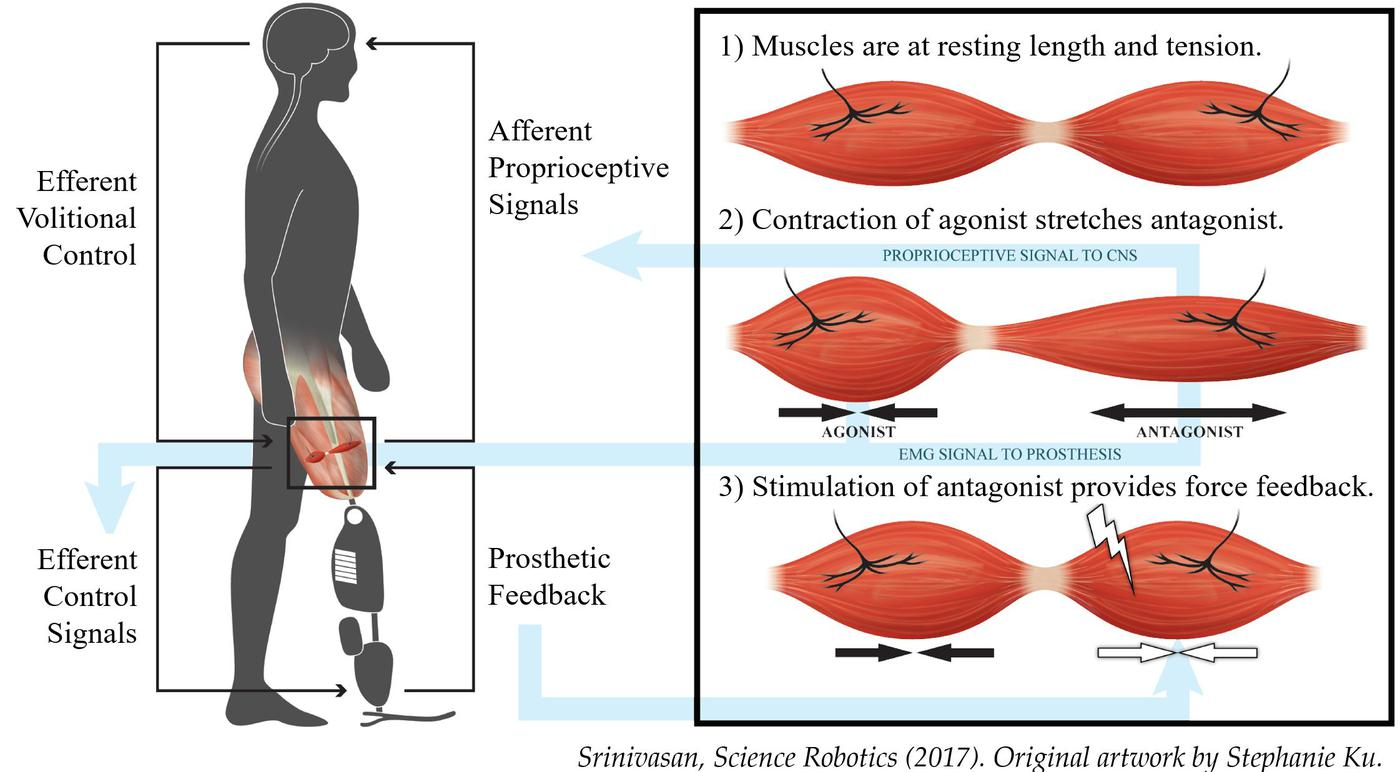
AMI electrodes feed and receive signals from a bionic limb’s onboard computers, enabling users to feel joint position, speed and torque. The first AMI patient reportedly experienced natural, reflexive gait behaviour on stairs and perceived the prosthesis as part of himself, aligning with the group’s “NeuroEmbodied Design” philosophy of bi-directional human–device integration. The overview claims improved intentional control compared with traditionally amputated patients, and highlights the possibility of creating multiple AMI muscle pairs to control multiple prosthetic joints.
Technically, AMI reframes prosthetic control as a closed-loop, biologically aligned system rather than a purely signal-processing problem. The muscle-pair construct yields a physically grounded state variable stretch that maps well to joint kinematics and torque, simplifying intent inference and feedback pathways. I think they credibly explain the mechanism and early functional observations, but offers limited quantitative evidence, device specifications, or failure-mode analysis (FMEA). Not an expert here, but my hesitation is the translation layer: more joints mean more surgery, more sensors. Still, restoring proprioception beats asking people to stare at their feet. If they can standardise the procedure and ruggedise the hardware, this could be a quiet game-changer.
Joan argues that the open web lost its intellectual scaffolding to engagement-maximising platforms , and makes a case for returning to the blog as durable “infrastructure for thinking”.

Using Diderot and Montaigne as framing, it contrasts feed-bound, algorithmic posts with stable, linkable URLs that reward nuance and cumulative argument. Blogs, the author says, create spaces where ideas can be revised, cross-referenced and built over time, rather than dissolved into fragmentary, provocation-driven updates. The piece contends discovery fears are overstated: search engines still index blogs well; RSS remains alive; newsletters bridge distribution while letting writing live at your own domain.
I've been running my blog (https://prt.sc) for decades now, so I’m very sympathetic to this! Social feeds turn every thought into a pitch; blogs let ideas breathe, contradict themselves, and get better. Even this newsletter you're reading, gives me the freedom to put some thought into the weekly 'findings' that I want to share with you, without continuously posting on the blog or on LinkedIn posts. So, the compounding point lands; fifty solid posts will outlast any lucky viral. Still, the practicalities bite: most people don’t have the time, habit, or patience to keep a site healthy - even being WordPress like mine. Discovery is also spiky; search helps, but you’ll probably need some feed presence and now focused on LLM access. My recipe to add to the article: own your domain, write steadily, syndicate lightly, and treat social as a pointer, not a home. Slow pages, stronger spine and we get there together :)
Oxford researchers report a world first: engineering a quantum mechanical process inside proteins to create magneto-sensitive fluorescent proteins (MFPs) that interact with magnetic fields and radio waves when illuminated.

Using directed evolution, they iteratively selected variants with dramatically improved magnetic sensitivity. The work, led by the Department of Engineering Science and published in Nature, reframes quantum biology from observation to purposeful design, with quotes from first author Gabriel Abrahams and senior author Harrison Steel underscoring the role of evolution-guided bioengineering.
I like the ambition here: stop admiring quantum quirks in biology and start engineering them. Using directed evolution to coax magneto-sensitive fluorescent proteins is both cheeky and smart - let the bacteria do the design work - while the MRI-adjacent imaging angle is the real hook: if you can tag and track gene expression with decent resolution, you’ve got a genuine wedge into biomedicine. Technically, the contribution is architectural: a bio-quantum transduction stack of engineered fluorophores, optical excitation, RF/magnetic modulation, and a readout instrument. But prototypes flatter. The engineering burden now shifts to hard numbers and hardening; characterising signal-to-noise, modulation depths, and interference from tissue and ambient fields; mapping safe RF/field regimes; establishing expression and clearance profiles; and demonstrating stable performance in living systems. Properly weird in the best way, but it only graduates from promise to product with quantified performance and robust, in-vivo proof.
Last Week in AI
- Bristol Myers partners with Microsoft for AI-driven lung cancer detection | finance.yahoo.com
- The AI Proficiency Report | sectionai.com
- Lightricks Launches Audio-to-Video Generation with Exclusive ElevenLabs Partnership | ltx.studio
- AI coding is now everywhere. But not everyone is convinced. | technologyreview.com
- Introducing Cowork | claude.com
- Bringing work context to your code in GitHub Copilot | developer.microsoft.com