
Ahhhh Xmas is just around the corner and that’s when #RBM stops for 2 weeks for balance 🙂 So lets make the most out of the next 2 editions – which the next one is going to be a resume of the year and the final of the year will be my predictions for 2026. Anyway, for this week we have a lot to cover 🙂 First we have an interview with Greg Kuperberg, which reminded me how much elegance you can wring from lousy hardware, hand-rolled assembly, video RAM tricks, and teenage grit producing PC classics that still feel crisp. Over on re/Palm, a Fisher-Price toy becomes a PalmOS 5 handheld through disciplined sleuthing, bus spelunking, tiny boot headers, and “ship what the pins allow” compromises. Meanwhile, higher education’s AI moment looks messy: budget cuts meet glossy licences, shortcuts masquerade as innovation, and the risk is credentials without competence. On the other side, newsrooms aren’t immune too, with UK journalists leaning on AI for the grunt work, but trust and governance lag, so adoption outpaces confidence. And finally, for anyone stuck in traffic during this season, a back-to-basics explainer lands the punchline: throughput, not speed, rules the road; lights and bottlenecks beat lane fantasies every time.
In this issue
5 piecesThis long-form piece profiles Greg Kuperberg’s short but striking early-1980s career writing three IBM PC arcade-style games - Paratrooper (1982), PC-Man (1982) and J-Bird (1983) - as a teenager, then pivoting to mathematics.

Kuperberg’s games stood out for smooth timing, physics-aware animation and direct-to-video-memory rendering, unusual on early PC hardware. The article culminates in a fresh, full interview where Kuperberg describes his methods, copy-protection lore, distribution through ComputerLand-type shops, and why he left commercial game development. They put Orion Software’s output alongside contemporaries on CGA-era PCs, contrasting technical limitations with Kuperberg’s craft (e.g., rotated maze, subpixel dithering). It frames a broader meditation on how “the spark” of technical curiosity forms, tracing Kuperberg’s path from BASIC at 10–11, through 8088 assembly with Edlin, to an academic career.
We all missed the nice change of pace here, with a nostalgia article that actually teaches something concrete. I like how the interview shuns myth-making; he’s upfront about cloning, timing mistakes and teenage tools like Edlin and graph paper. The technical bits (video RAM writes, physics-consistent motion) explain why these games still feel crisp. The wider “spark” thread lands too: BASIC on the desktop mattered; Python’s ubiquity lacks that frictionless entry. But this is a valuable primary-source snapshot of early PC game engineering practices under severe hardware limits! Kuperberg’s pipeline with the assembly language, BIOS avoidance, direct frame-buffer writes, tracks with performant patterns on 4-colour CGA. As a historical case study, though, it underscores how timing discipline, simple physics and careful input handling can outclass richer hardware.
This update documents porting PalmOS 5 to Fisher-Price Pixter “Color” and “Multimedia” toys using rePalm.
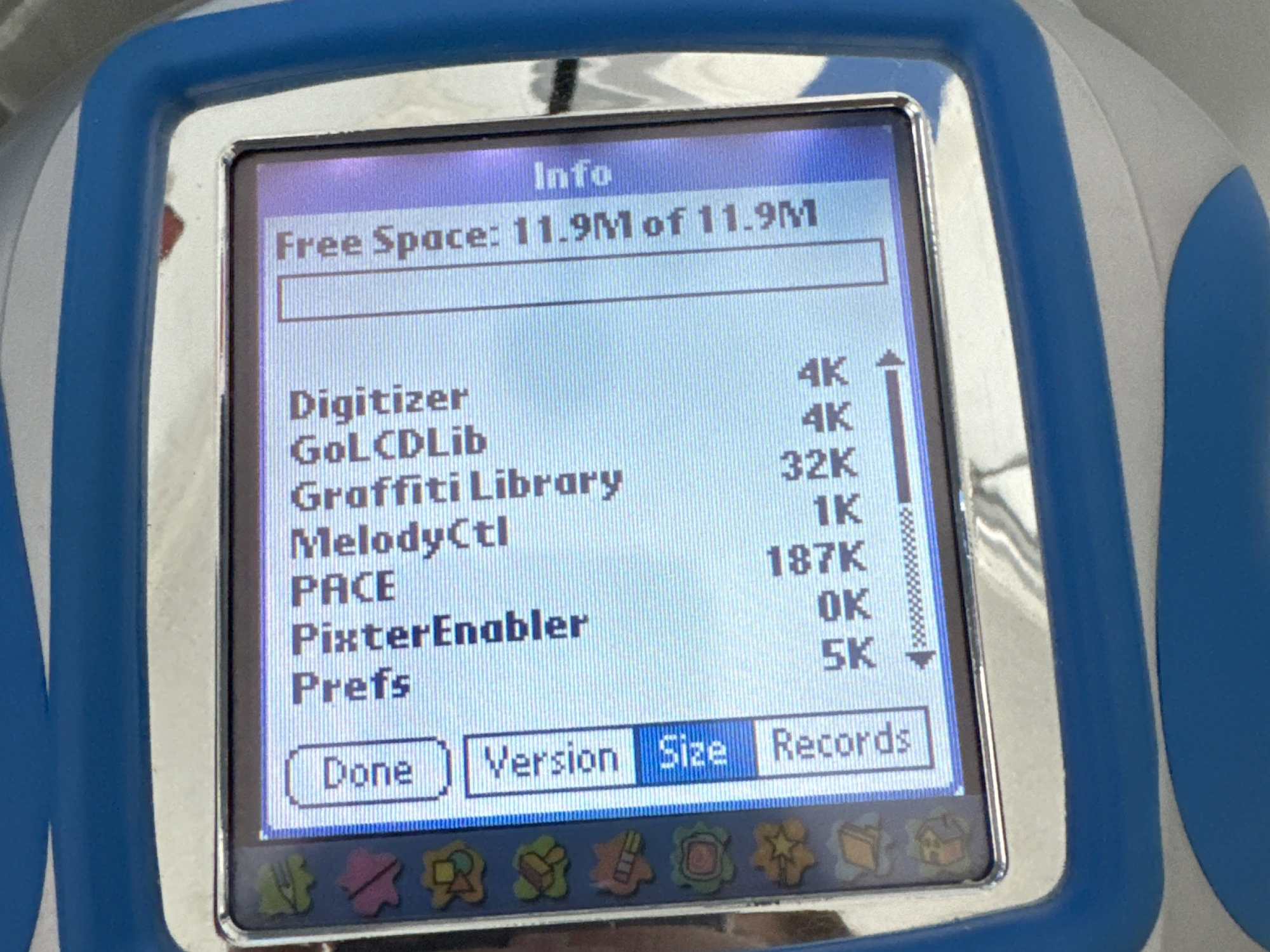
It explains how the Pixter cartridge exposes the memory bus with two chip-selects, enabling a custom board holding a PalmOS ROM and external RAM. A 44-byte header with a magic value, version, VM trampoline and jump address coaxes the Pixter OS to boot into PalmOS. Early bring-up used a homebuilt emulator before moving to hardware; the Color unit’s limited onboard RAM demanded extra memory via the cart, it then contrasts the Color (ARM7 SoC, 128KB RAM on board) with the Multimedia model (4MB SDRAM, audio DAC), detailing display quirks, bus-width constraints and performance trade-offs. Pixter Color works but is the slowest PalmOS device; nevertheless, it becomes the first primary-battery-powered PalmOS 5 handheld.
Oh! Second nostalgic post today, we must be lucky :) I didn’t expect a Fisher-Price toy to moonlight as a PalmOS 5 handheld, yet here we are, in 2025... The article blends proper engineering graft, with bus spelunking, emulator-first bring-up, tight boot headers, with just enough war stories to stay fun. I’m less sold on sweeping claims without measurements, and leaning on overclocks always makes me twitchy. What’s missing is instrumentation; latency budgets, memory bandwidth figures, thermal envelopes... to quantify UX and reliability. Still, it’s an inspired hack: audacious, well-documented, and surprisingly usable. Serious tech with a wink, nice work!
This essay by Ronald Purser argues that generative AI is accelerating the corporatisation of public higher education, replacing learning with automation and efficiency metrics.

Using the California State University’s $17 million OpenAI partnership amid proposed $375 million cuts as a case study, it claims universities are outsourcing pedagogy while students and staff face layoffs and programme closures. It describes a “technopoly” in which grading, lectures and assignments are increasingly generated or policed by AI, eroding curiosity, judgment and the human relationships central to education. Purser further contends that an industry–university feedback loop now normalises cheating and hollow credentials: students use AI to write assignments, professors use AI to teach or grade, and institutions buy licences to manage the resulting chaos.
This is fundamentally an incentives story. Admins face declining enrolments and deficits; AI vendors offer scale, speed and optics. Without guardrails, the path of least resistance automates low-trust processes and dilutes learning. This article persuasively surfaces leadership failures: technology procurement divorced from pedagogy, weak faculty consultation, and muddled accountability for integrity. However, governance should distinguish between use cases: augmentative tools under explicit disclosure, assessment redesign that privileges process evidence, and targeted automation of rote tasks. The choice, IMHO, is not AI or learning but incentives that reward real learning over throughput. If academia teams keep optimising for dashboards, they will degrade the product they’re selling - the trust in the degree - and invite regulatory and reputational blowback. If universities won’t defend learning, who will? That’s the uncomfortable question...
This Reuters Institute report analyses a 1,004-respondent, broadly representative survey of UK journalists (fielded Aug–Nov 2024) to map actual AI use, attitudes, and newsroom approaches

. It finds 56% use AI professionally at least weekly, with language tasks dominant: transcription/captioning 49%, translation 33%, grammar/copy-editing 30%. Substantive uses include story research (22% at least monthly), idea generation (16%), headlines (16%), fact-checking (12%) and first drafts (10%). Few generate audio (4%) or video (2%) monthly. Usage varies by age, gender, management responsibility and beat.
As a member of the UK Press, my first impression is that this is pragmatic, not panicky - yet! The numbers track with what I’ve seen anecdotally; language chores lead, deeper editorial work follows cautiously. The attitude gap is striking: lots of use, yet AI still “feels” threatening. That’s a leadership signal more than a tech verdict. The governance stats are the tell; training at 32% and bias protocols at 27% won’t steady nerves. I’d love longitudinal follow-ups tying adoption to quality and workload. For now, this reads as cautious normalisation with patchy guardrails. Treat this as operations, not innovation theatre; otherwise scepticism will persist and benefits remain confined to clerical tasks.
Great article that explains everyday traffic using simple throughput maths, stressing the difference between road speed and road capacity

. A single lane’s realistic maximum is pegged at about 1,800 cars per hour, roughly one car every two seconds, so exceeding that volume guarantees delay regardless of posted speed. Congestion emerges non-linearly once capacity is breached, and bottlenecks, not lane counts, usually set end-to-end flow. The author illustrates with traffic lights, where short green phases throttle corridors, and shows why “just add lanes” rarely fixes jams. It references Braess’ paradox, which by removing a link can improve flow, and compares modal throughputs: subways, bikes and even escalators can far out-carry car lanes. It closes with pragmatic remedies: faster, better-connected transit; bus priority; safer cycle routes; abundant, protected bike parking; and small e-mobility support.
I like how this strips traffic down to first principles: space, time, and queues. The “one car every two seconds” rule of thumb clarifies why faster limits don’t matter once lights and spacing dominate. The bit on marginal drivers and latent demand is bang on; it explains why new capacity so often evaporates. I’d have loved a few sourced charts to anchor the numbers, and the subway/bike comparisons skate past edge cases. Still, for explaining gridlock to sceptical drivers, this is sharp, clear and useful, good pub-chat ammo for this time of the year - at least here in the UK :)
Last Week in AI
- How AI Is Transforming Work at Anthropic | anthropic.com
- Smart Contracts red.anthropic.com | red.anthropic.com
- Microsoft drops AI sales targets in half after salespeople miss their quotas | arstechnica.com
- Qwen3-VL can scan two-hour videos and pinpoint nearly every detail | the-decoder.com
- Google, Nvidia, and OpenAI – Stratechery | stratechery.com
- Amazon CTO Werner Vogels predicts the renaissance developer era | aboutamazon.com