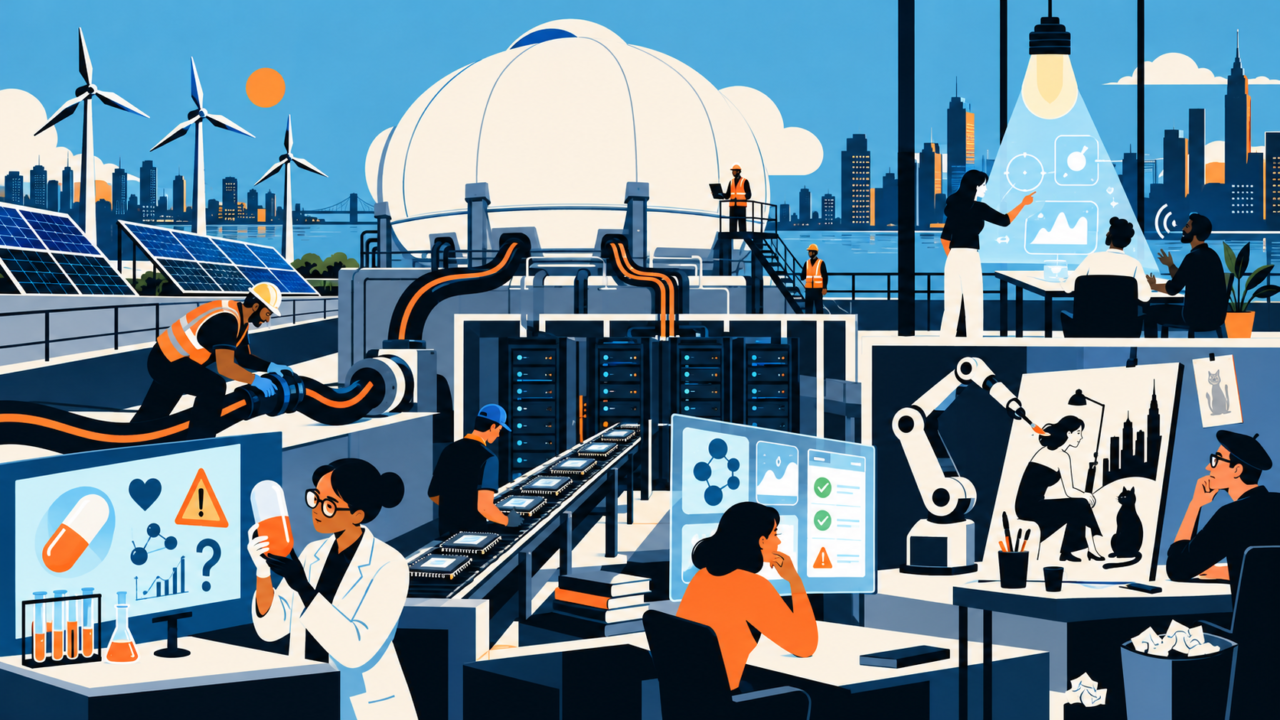
This week’s #RBM edition features why the AI’s grand ambitions still depend on electricity and people who know what they’re doing! We start with McKinsey’s technology outlook, which finds code and drug candidates arriving faster than organisations can validate them, while power, chips and skills constrain further expansion. On the electricity front, MIT Technology Review introduces Energy Dome’s Sardinian plant, which stores surplus renewable power using compressed CO₂: less efficient than lithium-ion, but potentially cheaper for longer storage, according to its maker. An enormous gas dome is an unusually literal way to put something in the cloud. Meanwhile, Nieman Lab finds ChatGPT putting real cartoonists’ signatures on invented New Yorker-style drawings, a generous approach to crediting people for work they never did. Again with MIT Technology Review’s, the examination of GLP-1 drugs brings more consequential uncertainty: evidence of possible benefits beyond weight loss is accumulating, alongside reports of side effects and unanswered questions about use in young children. Finally, the Lightbulb Computer offers a different sort of experiment, projecting interactive information onto everyday surfaces and responding to voice commands and pointing gestures. The working prototype puts computing into the room without requiring everyone to wear a headset, although consumer hardware and camera privacy remain unfinished business.
In this issue
5 piecesMcKinsey’s Technology Trends Outlook 2026 argues that AI’s expansion increasingly depends on physical infrastructure and deployment capacity

Its assessment of 14 trends combines investment and recruitment data with measures of research, invention and attention, plus interviews. McKinsey projects that five technology categories will more than double their funding in 2026, extrapolating from first-half activity rather than reporting completed annual investment. The article describes AI-generated code, drug candidates and materials arriving faster than organisations can validate them. It connects further expansion to electricity availability, specialised chips and workforce skills. McKinsey argues that adopting these technologies requires changes to operating models and legacy systems. The implications span software delivery, industrial automation and life sciences, where technical progress must translate into usable, secure deployments.
The drug candidate waiting for validation is the image I’d keep from this report. McKinsey describes a similar backlog between generated code and secure deployment, but my reading is that cheaper generation makes selection more valuable - the demonstration ends just where the expensive judgement begins. For a software team, I’d test that by capping work entering review while introducing faster generation tools. Measure time to accepted, working changes and the effort spent rejecting or repairing suggestions. If the team produces more code without delivering more useful software, the experiment has bought a larger queue. Calling that productivity would require a generous definition. But that suggests a less glamorous use for the next AI investment: helping teams reject unsuitable work before it consumes scarce review time. Better filtering could deserve priority over another increase in generation speed, provided it doesn’t quietly discard the valuable, unusual ideas too. I’d judge the next coding pilot by trustworthy changes reaching users and the rework they create. The output counter can look after itself.
Casey Crownhart profiles Energy Dome’s system for storing surplus renewable electricity using compressed carbon dioxide

MIT Technology Review shows the Energy Dome, where electricity liquefies gas drawn from an enormous dome, while heat from compression is stored. When demand rises, the liquid is reheated and expanded through a turbine. The system avoids the underground caverns required by some compressed-air installations. Crownhart cites a 200 MWh plant opened in Sardinia in 2025 and describes a design intended to supply power for up to 24 hours. According to Crownhart, Energy Dome estimates its systems cost 10% to 15% less than lithium-ion equivalents for eight-hour storage, although round-trip efficiency is about 70% versus roughly 90% for lithium-ion. Operational or contracted systems provide eight or ten hours, rather than the proposed 24-hour maximum. Expansion remains substantial: one operating commercial plant sits against a planned 30 GWh across five continents. The article also notes that a version paired with natural gas turbines produces greenhouse-gas emissions.
This is soooo cool! But seven football pitches is a striking amount of space to set aside for a battery. This Energy Dome has traded the geological lottery of underground compressed-air storage for an enormous object you can build above ground. That freedom could make a difference, especially in regions without the right caverns. It also means planning permission, suitable land and nearby grid infrastructure deserve as much attention as the turbine. The 70% round-trip efficiency looks distinctly ordinary beside lithium-ion’s 90%. I don't think that comparison settles anything. A storage plant intended to cover a long evening of low wind competes on delivered electricity, installation cost and how many hours it can run. The company's claimed 10% to 15% cost advantage at eight hours is interesting, but I'd want that compared on a full-project basis, including land and civil works. A cheap tank doesn't make a cheap site. The Sardinian plant is tangible evidence that the machinery can be assembled at commercial scale. Thirty gigawatt-hours across five continents is a different sort of claim. Energy Dome's future probably depends on repeating a large industrial project in places with different permitting systems, contractors and grid constraints. The turbine is easy to picture. The thirtieth planning application is where my imagination stalls.
ChatGPT has placed real New Yorker cartoonists' signatures on AI-generated cartoons without their permission
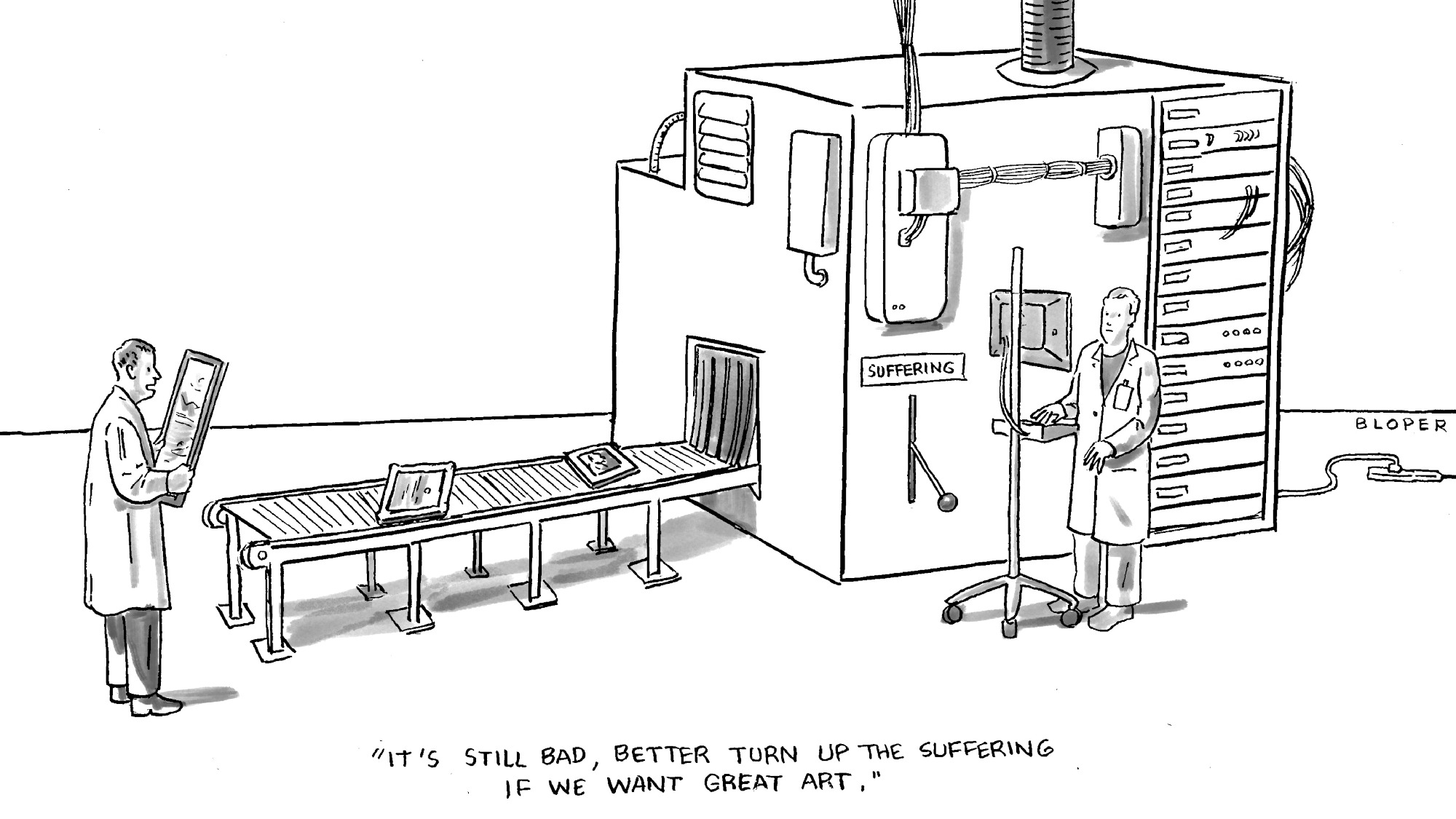
Andrew Deck reports that a viral drawing of Dolly Parton and Tim Curry carried Brendan Loper's pen name, "BLOPER", despite being generated from a fan's generic request; one social media post attracted 25,000 likes. Through online examples and his own testing, Deck documented signatures belonging to more than 15 cartoonists, including Emily Flake, George Booth and Saul Steinberg. Cartoonists interviewed describe signatures as assertions of authorship rather than decorative elements. Condé Nast signed a content licensing agreement with OpenAI in 2024, but The New Yorker says its cartoons were never authorised for model training; freelance contracts reviewed by Deck preserve artists' copyright. OpenAI introduced similarity warnings following Deck's notification, although falsely signed outputs continued. Cornell law professor James Grimmelmann distinguishes difficult copyright arguments from possible identity-based claims, which would require evidence of commercial use.
The full stop after "P.Byrnes." is the most telling character in Andrew Deck's investigation. Pat Byrnes has signed his cartoons that way since he was a teenager. In more than a dozen generated images bearing his name, the dot survived too. ChatGPT can miss the joke and still reproduce the part that tells a reader who made it. That's an impressively precise way to be wrong. When someone requests a New Yorker-style cartoon, the requested style is recognisable: a spare drawing, an awkward social scene, a dry line beneath it. A real artist's signature makes a different promise. It says this particular person chose to publish this particular thought. Emily Flake's analogy to being misquoted captures the harm better than most debates about style imitation. People may forget whether the joke was funny. They may remember who supposedly told it. The design implication seems straightforward. Generated images shouldn't acquire someone else's signature by accident, and a warning about stylistic similarity misses the precise failure here. After Deck's notification, ChatGPT began showing similarity warnings, yet signed outputs persisted. A creator shouldn't have to audit social media for punchlines they've never written. The small mark in the corner is doing far more reputational work than the rest of the picture.
Jessica Hamzelou examines the uncertain side-effect profile of GLP-1 medicines as evidence of further potential benefits accumulates
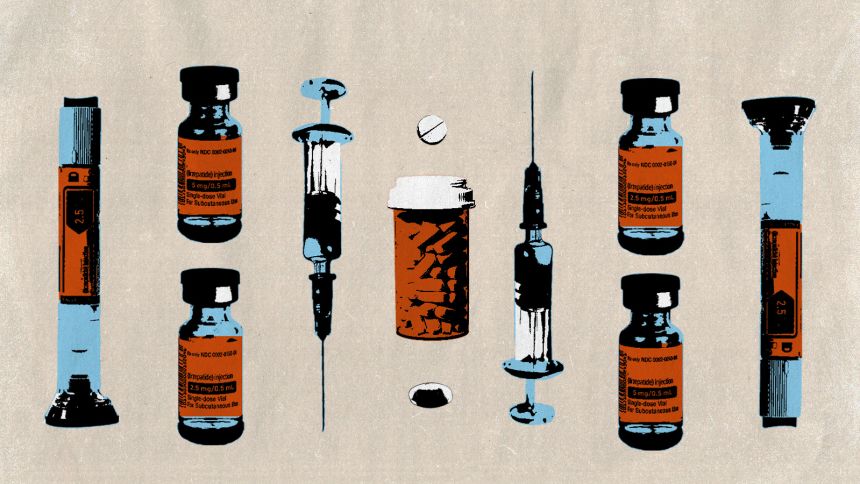
She distinguishes common gastrointestinal problems and links to pancreatitis and gallstones from disputed eye injuries and emerging reports of hair and nail changes. She also describes findings from Eli Lilly and Novo Nordisk, presented at a Boston meeting, suggesting treated participants scored two to three years younger on some measures of biological age than placebo recipients. Her account places these uncertainties against expanding exposure: a Gallup poll found 11% of Americans were taking GLP-1 drugs for weight loss, compared with 3% in 2024. US prescriptions to children aged eight to 11 with obesity rose 310-fold from 2019 to 2026, although prescribing remains rare. The World Health Organization's new guidance does not recommend drug treatment below age ten, citing insufficient evidence about growth, development and other possible harms. These questions become more pressing as use extends to younger patients.
Three hundred and ten times is a number built for a headline... But that's the reported increase in GLP-1 prescriptions for US children aged eight to 11 with obesity between 2019 and 2026. Jessica also adds the less photogenic detail: these prescriptions remain rare; without an absolute starting figure, the multiplier tells us how rapidly prescribing is changing while revealing little about how many children are being treated. The difficult part is the mismatch in timescales. Adult side-effect studies can record nausea or nail changes over relatively short periods. Understanding what a drug might mean for a growing child takes years. The WHO's new guidance declines to recommend medication below ten because evidence about growth, development and mental health remains thin. So, that caution doesn't resolve every clinical decision when a child already faces health problems. Yet, I'd favour following treated children through developmental milestones, documenting why treatment began, what prompted stopping it, and outcomes after discontinuation. Hair loss and nail changes make arresting headlines, but the unknowns that take years to emerge are harder to photograph. GLP-1 press releases arrive almost daily, and childhood isn't going to run on the industry's publishing schedule....
Lightbulb Computer, an alternative to screens and headsets that projects interactive information onto everyday surroundings

In a project essay published this September, designer Guillaume Ardaud proposes a shaped like an oversized lightbulb, the concept combines projection, computer vision, voice commands and pointing gestures, with an Edison-socket mount or portable base. Ardaud demonstrates a bulky working prototype in videos showing information projected during cooking, collaborative activities and interactions with physical objects. He says the demonstrations contain no editing or AI-generated effects. The design favours shared, visible interaction over individual eyewear, which Ardaud argues is constrained by comfort, computing power and the need for compatible personal devices. He envisages domestic applications ranging from controlling smart lights by pointing to querying bookshelves and displaying household calendars. He acknowledges that current hardware is not ready for a consumer product and identifies camera privacy as a design requirement, proposing on-device processing and physical safeguards. The project presents a direction for future human-computer interaction rather than a commercial launch.
We're back to finding weird projects across the internet, again :) Flour-covered hands are a better test of ambient computing than another floating dashboard! In Guillaume kitchen demonstration, the interface follows the job: a timer and recipe on the worktop, with no need to retrieve a phone while handling food. It sounds trivial until you consider how much interface design assumes a clean finger, a free hand and permission to interrupt whatever you're doing. The shared travel map is the more consequential demonstration - but rather cool. Two people can point at the same place, see the same information and follow each other's gestures. Nobody needs to narrate what's happening on their private display. I'd like to see this approach explored on repair benches, in classrooms and around workshop tables, where physical surfaces already organise collaborative work. The computer becomes another participant in an existing activity. Yet, there's an interesting social trade-off here; a device that sees an entire room and projects information onto its surfaces needs to distinguish between what people want to share and what they'd prefer to keep to themselves. He proposes hardware safeguards, although these remain design intentions rather than demonstrated protections. Getting the interaction right will require understanding the room's occupants as carefully as its geometry.
My Week in AI
- Bringing local models and sandboxed tools to Windows and GitHub Copilot 1 | commandline.microsoft.com
- Gemini at Work 2026 Introducing Gemini agent | cloud.google.com
- Anthropic launches critical infrastructure program and free OSS Scanner for open source | siliconangle.com
- NVIDIA Commits $1 Billion to U.S. Science and Quantum Computing | thequantuminsider.com
- AWS, Upstage and Ollama agree on a decision-model API. OpenAI hasn’t signed on | thenewstack.io
- Reverse engineer anything with agents, from app behavior down to native binaries. | github.com