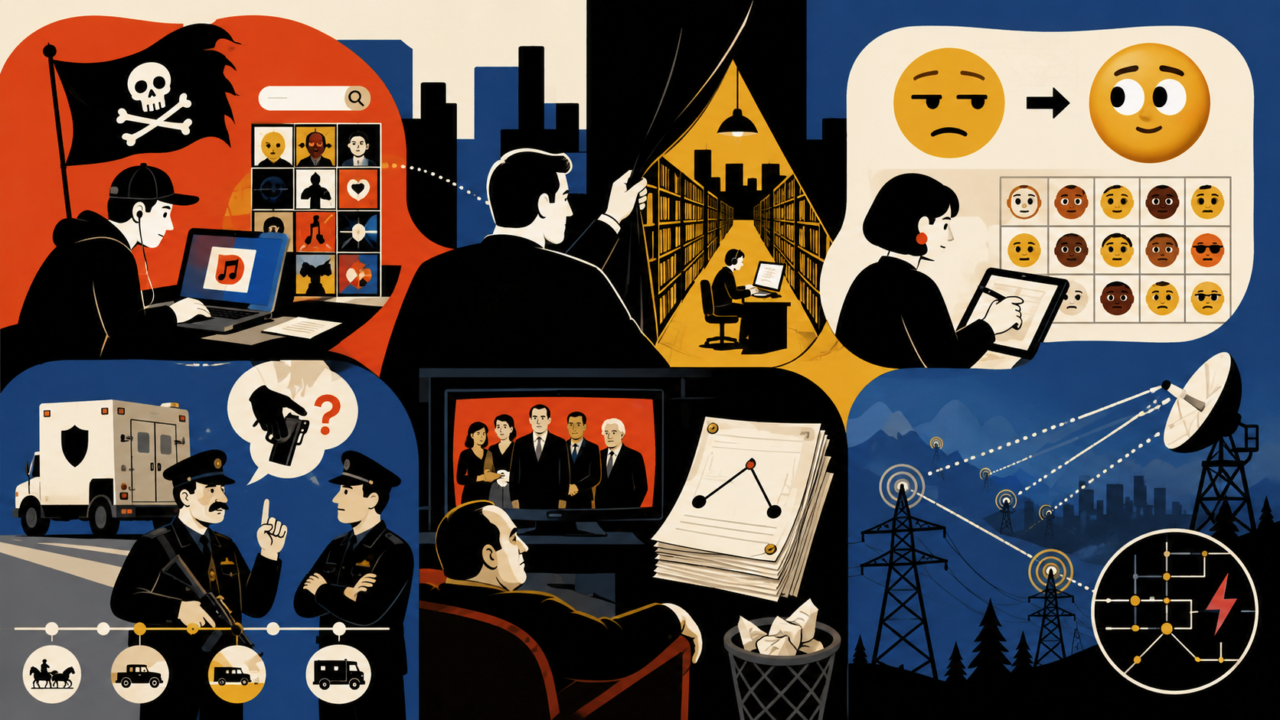
This week’s #RBM is just a reminder that the interesting story is usually hiding behind the obvious one… We start with music piracy, that wasn’t really about stealing music, it was about building a catalogue and search experience the industry couldn’t match. Google’s emoji redesign turns out to be less about shiny graphics than making tiny faces communicate more clearly. Cash-in-transit guards have spent a century arguing over when to put a hand on a gun, proving that operational habits can outlive the evidence behind them. The Sopranos became great by refusing to behave like a screenplay textbook. And the Pacific Northwest’s power grid only worked because an invisible microwave network spent decades quietly preventing local faults from becoming regional disasters.
In this issue
5 piecesHBO’s The Sopranos achieved its exceptional quality through an unusually realistic depiction of human behaviour rather than tightly engineered plotting
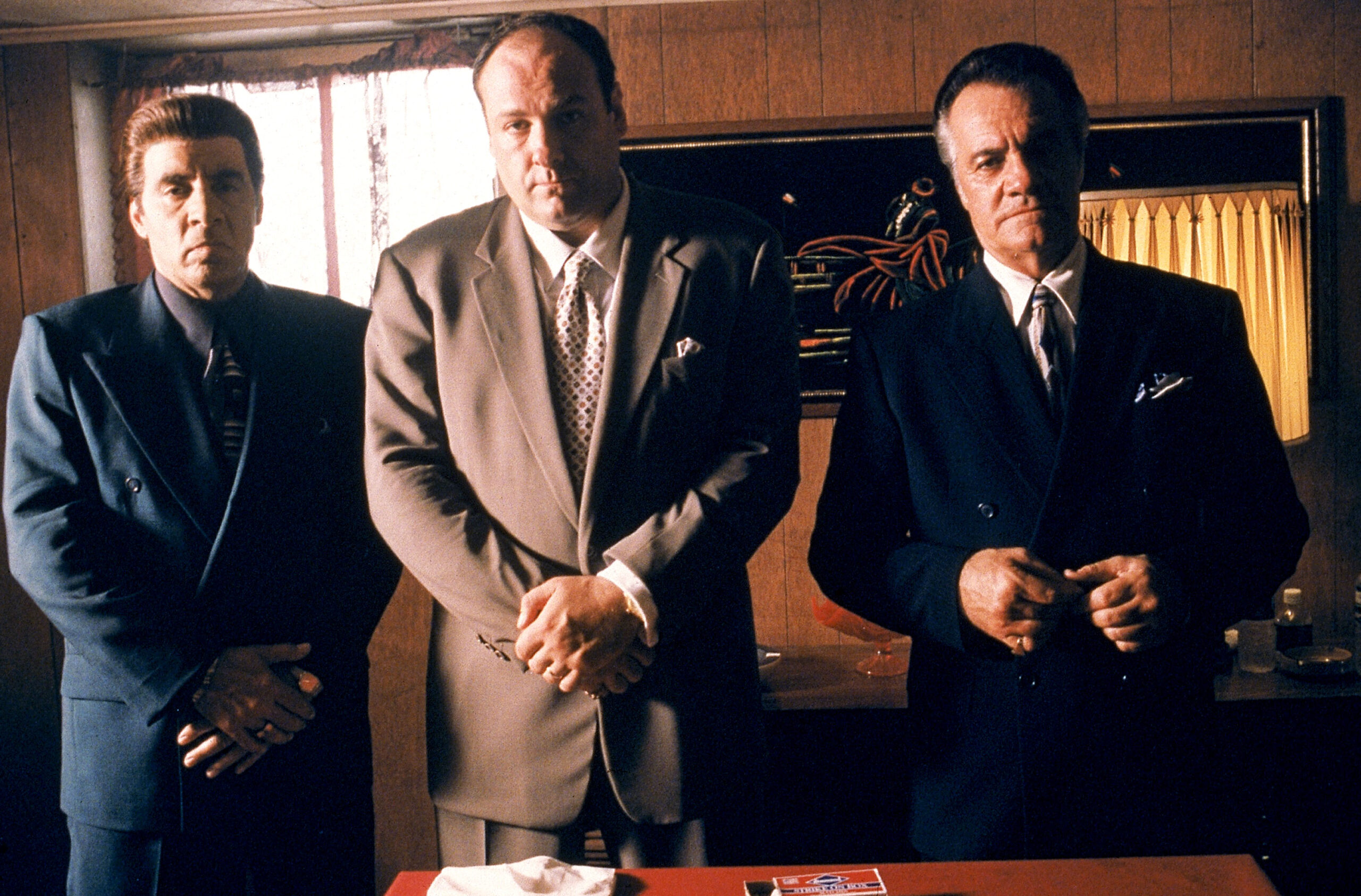
Using examples from across the series, Richard contends that the show’s characters behave like recognisable people with inconsistent motivations, unresolved lives and shifting relationships, instead of existing primarily to advance a dramatic arc. Richard contrasts this approach with contemporary prestige television, which he believes increasingly prioritises intricate story construction and audience satisfaction over psychological authenticity. He also reflects on the practical challenges of writing for television, where multiple creators, actors and production constraints limit authorial control, arguing that The Sopranos turned those limitations into strengths through its commitment to believable characterisation.
Paulie Gualtieri’s line about having “no arc” is the claim that stayed with me because it cuts directly against decades of screenwriting advice. We’re taught that satisfying stories require transformation, revelation and carefully engineered payoffs. Richard argues that The Sopranos became extraordinary by trusting that people often drift, repeat themselves and carry contradictions for years. That feels much closer to real life than most television is willing to admit. He’s right to focus on character over mechanics. Many modern dramas become puzzles for viewers to solve, with every conversation positioned as setup for a later reveal. The Sopranos had mysteries, but they were rarely the point. The interest came from watching intelligent, damaged people rationalise behaviour they barely understood themselves. And yes, The Sopranos is my number one series! Yet, a series can easily become shapeless if writers mistake realism for the absence of structure. David Chase and his team earned the freedom to leave threads unresolved because the emotional logic remained coherent even when the plot refused to provide neat answers. Ambiguity and patience are commercially risky when audience attention is measured minute by minute. That creates incentives for stories that explain themselves instead of trusting viewers to sit with uncertainty.
Eden DaSilva examines the rise and fall of private music piracy communities such as Oink and What.CD

The article argues these communities succeeded because they combined comprehensive catalogues, meticulous organisation and active communities at a time when legal music services were expensive, fragmented and inconvenient. It traces how Nine Inch Nails adapted to piracy by changing release strategies, embracing digital distribution and treating widespread sharing as evidence of industry failure rather than consumer immorality. It concludes that streaming has solved access for listeners but has largely failed to improve artists’ economics, replacing one set of intermediaries with another while losing much of the community, curation and discovery that characterised private trackers.
This is about piracy as distribution, but the more interesting story is infrastructure. Oink and What.CD weren’t merely collections of stolen files. They solved search, metadata, quality control, preservation and discovery in ways the commercial industry simply hadn’t managed. That’s why people loved them. Consumers rarely wake up wanting to break copyright law, they usually want the easiest path to the music they care about. And when legal services became more convenient than piracy, behaviour changed almost overnight. Now, what feels understated is how much unpaid governance powered these communities; upload rules, moderation, naming conventions, interviews and reputation systems weren’t accidental. As thousands of volunteers built an extraordinarily disciplined catalogue, just because they valued the collection itself, and reproducing that level of stewardship inside a venture-backed subscription business was always going to be difficult. Sure, Spotify eventually solved access at enormous scale, but it standardised the experience around convenience rather than curation. That trade-off still shapes how music is discovered today. Now the irony is striking; an illegal community demonstrated the product design that the legitimate industry eventually copied, yet the economic model that emerged still leaves many creators dissatisfied.
Jennifer Daniel explains the redesign of its entire emoji library into Noto 3D, covering 3,977 emojis

Google has published an article by arguing that emoji have evolved from literal pictograms into emotional shorthand, requiring designs that convey nuance while remaining instantly recognisable. The article describes user research, AI-assisted accessibility improvements and the decision to release the complete 3D models as open source for anyone to reuse. The article explains that Google tested how subtle visual changes affect comprehension, finding that users consistently preferred full-body animals over floating heads and that seemingly minor alterations could change interpretation. Jennifer also describes an AI-powered contrast tool to improve visibility of darker skin tones in dark mode and positions open-sourcing the 3D models as an extension of Google’s long-standing Noto philosophy of shared digital language.
Sure, emojis aren’t decorative assets anymore, they’re interface components for human emotion - some... But treating them as a living language instead of a static icon set feels overdue, especially when billions of people use them every day without consciously thinking about the design decisions underneath. What I kept looking for was evidence that 3D actually improves communication rather than delight. Preferring full-body animals or avoiding props because they reduce comprehension are concrete findings. The jump from flat to 3D, though, still feels driven as much by platform identity as measurable usability. If designers spend less time hunting visual edge cases and more time refining expression, that’s a worthwhile productivity gain... #JustSaying
Edwin Torres traces the documented history of cash-in-transit employees gripping or drawing firearms before any specific threat appears

Edwin calls these practices the “preemptive grip” and “preemptive draw”. Using newspaper archives, industry books, government records and employment documents, he argues that they are established occupational practices extending from the early armoured-vehicle industry through the late twentieth century. Edwin documents sharply different official and public responses. Victoria amended its rules in 1973 to permit the practice, whereas Ontario maintained restrictions despite objections from guards, unions and armoured transport companies. A 1995 National Labor Relations Board decision reproduced a Wells Fargo handbook describing preemptive handling as routine procedure. The history concerns security policy, labour conditions and public legitimacy as much as individual firearms conduct.
Wells Fargo’s handbook is the detail that changes this from occupational folklore into institutional history. A procedure written into company policy carries more weight than photographs of guards posing beside armoured trucks. It shows that at least one major operator treated preemptive firearm handling as ordinary work, including a fallback grip where local rules prohibited drawing. This practice wasn’t invented by a handful of reckless modern employees, and the evidence spans several countries, employers and regulatory regimes. Yet, the article also exposes a recurring mistake in security debates: longevity is often mistaken for validation. A tactic can survive for decades because organisations copy precedent, workers fear being caught unprepared and managers lack decisive evidence either way. Visible readiness may reassure employees and deter some attackers, yet it also transfers risk into customer premises, pavements and crowded public spaces. Regulators then inherit the externalities while companies retain the operational benefit. The decisive case rests on outcomes, training controls and accountability. Historical continuity earns the practice serious examination.
Bonneville Power Administration built a telecommunications network alongside the Pacific Northwest electricity grid

Early carrier-current systems carried telephone calls and protective-relaying signals over transmission lines, but growing traffic and electrical interference made them unreliable. Lightning could erase pilot signals, causing fail-safe relays to disconnect healthy sections and turn local faults into wider outages. The Bonneville Power Administration responded in 1950 by commissioning Philco to build a large microwave network for dispatch calls, telemetry, remote control and fault location. It eventually supported 61 radio sites across 1,300 route-miles and fed data into the computerised Dittmer Control Center. The network shows how regional power pooling, rural electrification and industrial growth depended on a separate communications system engineered to operate through severe weather and equipment failures.
Concrete microwave towers beside transmission lines repeat a familiar infrastructure pattern; the quiet control network eventually becomes as important as the machinery everyone can see, and the Bonneville Power Administration built dams and high-voltage lines, then discovered that neither could operate reliably without timely information moving between distant substations. Ouch! So, protective relaying wasn’t office telephony with higher stakes, and a missing tone could open breakers across the network, as lightning could damage the power system while simultaneously confusing the communications layer meant to contain the damage. That coupling turned bandwidth, latency and route diversity into electrical-engineering concerns. Microwave links helped calculate a transmission fault’s position to within about 1,000 feet by comparing when its electrical disturbance reached two stations. The radio network was therefore doing more than carrying instructions. It made the physical grid measurable at regional scale. This history also explains why modern claims about software transforming energy deserve scrutiny. Utilities were combining telemetry, remote switching, synchronised measurements and computer-assisted scheduling decades before cloud dashboards arrived. RODS even established a 15-minute scheduling cycle from a PDP-10 connected through a private, hardened network. Bonneville’s enduring lesson is that resilient systems require communications designed as part of the primary machine.
My Week in AI
- Introducing LM Studio Bionic the AI agent for open models | lmstudio.ai
- How Far Behind the Frontier are Leading Open Weight Models on Cyber? | aisi.gov.uk
- Agent Harness Engineering | addyosmani.com
- How Cursor deploys AI inside the enterprise | latent.space
- Redeploying Claude Fable 5 | anthropic.com
- How to Govern Autonomous Agents in Enterprise AI Factories | developer.nvidia.com