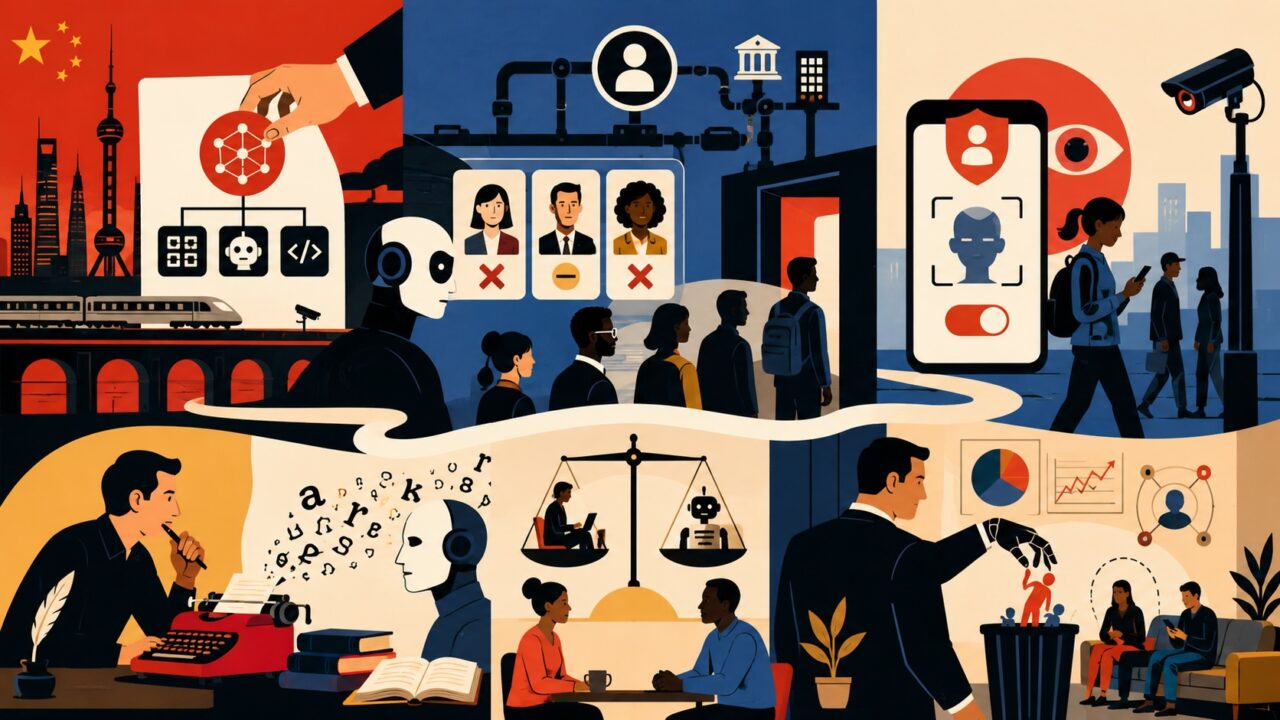
This week #RBM theme is about the future that is being sold as automation, but the real fight is over control, trust and accountability. We start with China’s new internet rulebook shows regulation becoming infrastructure, with platforms, AI agents and algorithms pulled into a single compliance surface. Then Stanford HAI’s work on AI hiring tools shows what happens when opaque systems become labour-market gates: bias stops being a local HR problem and starts moving through shared vendor pipes. FIRE’s warning on age verification makes the same point from another angle, where child-safety policy risks creating a new identity layer for ordinary speech. We also have Martin Puchner’s essay on AI and literature is the useful counterweight, arguing that language has always been a technology and writers should test the machine rather than worship or panic about it. Finally, Chris Hillman then brings the whole thing back to customers and employees: AI can raise the floor, but firms that strip out human judgement and call it efficiency will spend years buying synthetic personalisation to replace the relationships they destroyed.
In this issue
5 piecesChina’s Cyberspace Administration of China released a draft revision of the Measures for the Administration of Internet Information

The article traces the rules back to a 2000 regulation signed by Zhu Rongji, when China had about 20 million internet users. Geopolitechs says the draft expands the framework from 27 articles to 94 articles and shifts its focus from internet content providers to platforms and AI. The draft formalises the Cyberspace Administration of China’s lead role, restructures approval for internet services, tightens foreign-linked and cross-border services, and raises penalties. The article is relevant to platform operators, AI providers, foreign internet firms and investors using variable interest entity structures. It also says large platforms would face compliance departments, outside oversight, complaint handling, annual social responsibility reports and rules covering algorithms.
Geopolitechs gets the institutional story right, where the important move isn’t another China internet crackdown headline; it’s the tidying up of a messy stack of platform, content, AI and telecoms controls into one higher-status rulebook. That matters because engineering teams can handle bad rules better than moving rules. A stable map, even a hostile one, changes planning. The piece is also good on foreign-linked services. The draft’s bluntest idea is that regulators may care less about the shell company and more about who controls the service, who gets the money and what the product does inside China. That’s the bit that should make VIE lawyers cough into their tea. Corporate form becomes a debugging layer, not the system of record. With training data provenance, generated-content labelling, recommendation opt-outs, worker consultation and external oversight all sound neat in a regulation, but in a real platform, they touch data lineage, model monitoring, abuse queues, identity systems, audit logs and incident response. The cost lands in architecture before it lands in legal. Anyway, the orgs best placed to survive this are the ones that already own compliance machinery at scale. Smaller AI apps and foreign services face the ugliest bargain: build for China’s governance stack from the star..
Stanford HAI contributors describe a large-scale study of AI hiring tools used across 150 employers and 11 sectors

Their dataset covers 3.4 million people, 4 million applications and 1,700 job postings. Rishi, Sarah, Kathleen, Dan and Percy say one third-party vendor’s screening tool produced racial disparities in recommendations for Black and Asian applicants. The article connects individual rejection to market concentration in hiring technology. The authors say 90% of U.S. employers use AI screening tools and many depend on a small set of vendors. They argue independent research is needed because these systems are widely adopted, consequential and opaque. The article is directly relevant to HR software buyers, regulators, job platforms and employers using third-party screening.
So, the rejection pipeline has one nasty deployment property: scale turns local bias into shared infrastructure! The article’s most concrete issue is almost absurdly simple. Pool the vendor’s decisions into one giant hiring process and adverse impact disappears. Split the same decisions by job posting and discrimination shows up. That is exactly the kind of metric trick a dashboard can make respectable. This study gets the systems point right; a hiring model used by many employers stops being a tool and becomes a labour-market massive gate, where ten per cent of applicants who made four applications through the same vendor were rejected everywhere. That doesn’t prove every rejection was wrong, but it does show how correlated decisions can follow a person around like bad credit. Sure, HR teams love to describe vendor scores as guidance, then design workflows where the score quietly decides who gets oxygen. If a manager never opens the “do not recommend” pile, the vendor has become the first interviewer. Procurement picked the architecture of opportunity. Now, the safety question is about failure modes in a sociotechnical system: shared models, opaque labels, weak feedback loops and high personal stakes...
Online age verification is becoming identity verification, with privacy and speech costs that affect adults as well as children
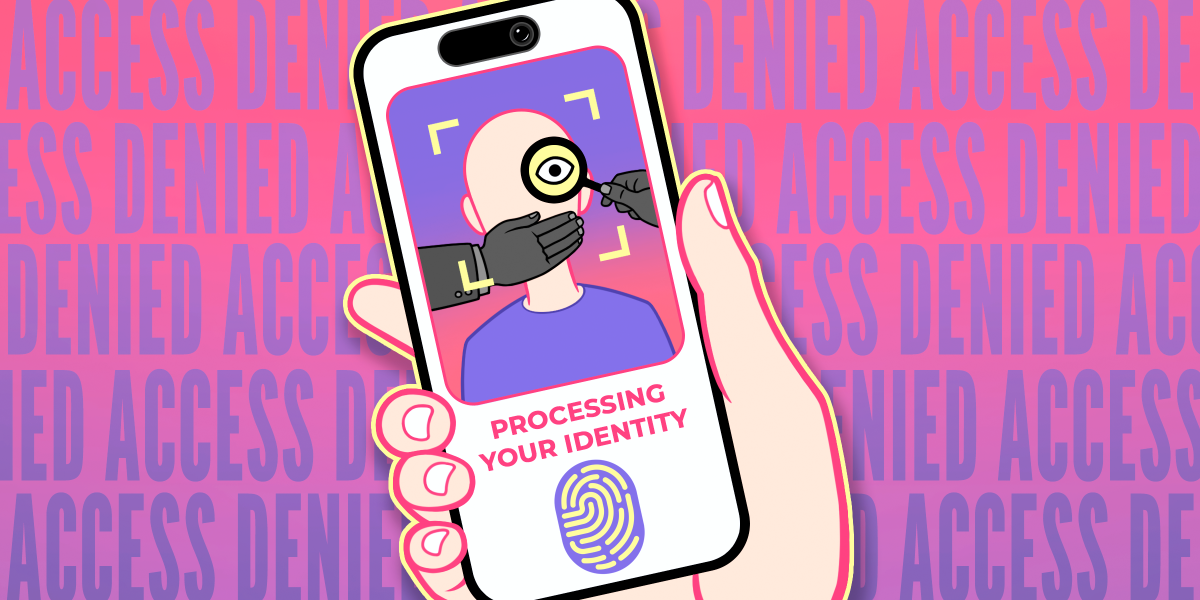
Sarah McLaughlin use Australia’s under-16 social media ban as the main example, saying government research found roughly seven in 10 children were still using social media months after the ban began. She says the policy pushes platforms towards biometric checks, government ID scans and third-party verification tools. Sarah extends the warning to the UK and United States, where social media, adult-content, app-store, video game and AI chatbot rules are expanding. She says the UK’s stated “Australia-plus” approach could create stronger enforcement, including possible VPN restrictions. For U.S. readers, Sarah frames state and federal proposals such as KOSA as steps towards mandatory identity checks before online speech.
I think the commercial winner in this story is easy to miss: whoever sits between the user, the platform and the state. Sure, age verification creates a new tollbooth market, and tollbooths attract vendors. Yet, Sarah is right to dig deep on that trust gap. A third-party checker doesn’t become benign because the policy goal involves children. The most useful phrase in this piece is the simplest one: age verification is identity verification. Period. It compresses the whole debate into a product requirement, and somewhere, a system has to decide who you are, how old you are, how confident it feels, how long it keeps the evidence and what happens when it gets the call wrong. That is a lot of state-shaped product logic to add before someone posts about football, addiction, politics or sex. The article slightly overstates the inevitability of the worst implementation; as in, there are privacy-preserving proofs and data-minimising designs, at least in theory. The problem here is incentives, where regulators want auditability, platforms want liability cover and vendors want reusable identity rails, with users wanting to get back into the app. Guess which preference loses... Once the state mandates proof at the gate, a compliance industry forms around the gate. Then the gate expands from social media to app stores, adult sites, games and chatbots. VPNs become politically awkward because they puncture the model.... We'll have to see how that plays out then.
Writers’ resistance to AI is understandable but blocks a better account of language, creativity and literary work
Martin Puchner describes this resistance as strongest in North America and weaker in India, China and Korea, based on his teaching and lecturing. He says writers often criticise AI for predictability and recombination, even though recent arts and humanities thinking has also questioned lone-genius accounts of human creativity. Martin uses reader-response criticism, post-structuralism and cultural history to argue that literature has tools for thinking about AI. He discusses Wolfgang Iser, Stanley Fish, Jacques Derrida, Mary Shelley and Frankenstein as ways to examine readers, language, training data and artificial agents. Martin also describes building RAG-based literary chatbots, including one shaped by Frankenstein’s four-book “super-canon”, and says students need both pre-AI writing skills and AI sparring partners.
Frankenstein keeps doing some useful work because every age finds a new machine inside it. And Martin’s version is clever: Mary’s creature is first given language, then shaped by a tiny corpus of four books, which makes the novel look like an early sketch of retrieval-augmented generation. That’s a lovely move. Also, slightly dangerous. Once you see every canon as a knowledge base, the humanities start sounding suspiciously like product management. New media usually arrive as insults before they become instruments. Print cheapened manuscript culture. Photography offended painters. Word processors offended anyone who enjoyed carbon paper and suffering. AI is now doing the same to writers, except the insult feels intimate because the medium is language itself. I do think that Martin’s strongest claim is that language isn’t a magic human property, it’s a technology that already rewired us. That doesn’t make chatbots people. It does make the simple human-versus-machine line feel too cosy. The serious question is what kinds of readers, tutors and collaborators we are building, and who gets to define their corpus, memory and incentives...
AI will automate transactional work but cannot reproduce the human relationships that create trust, loyalty and repeat business
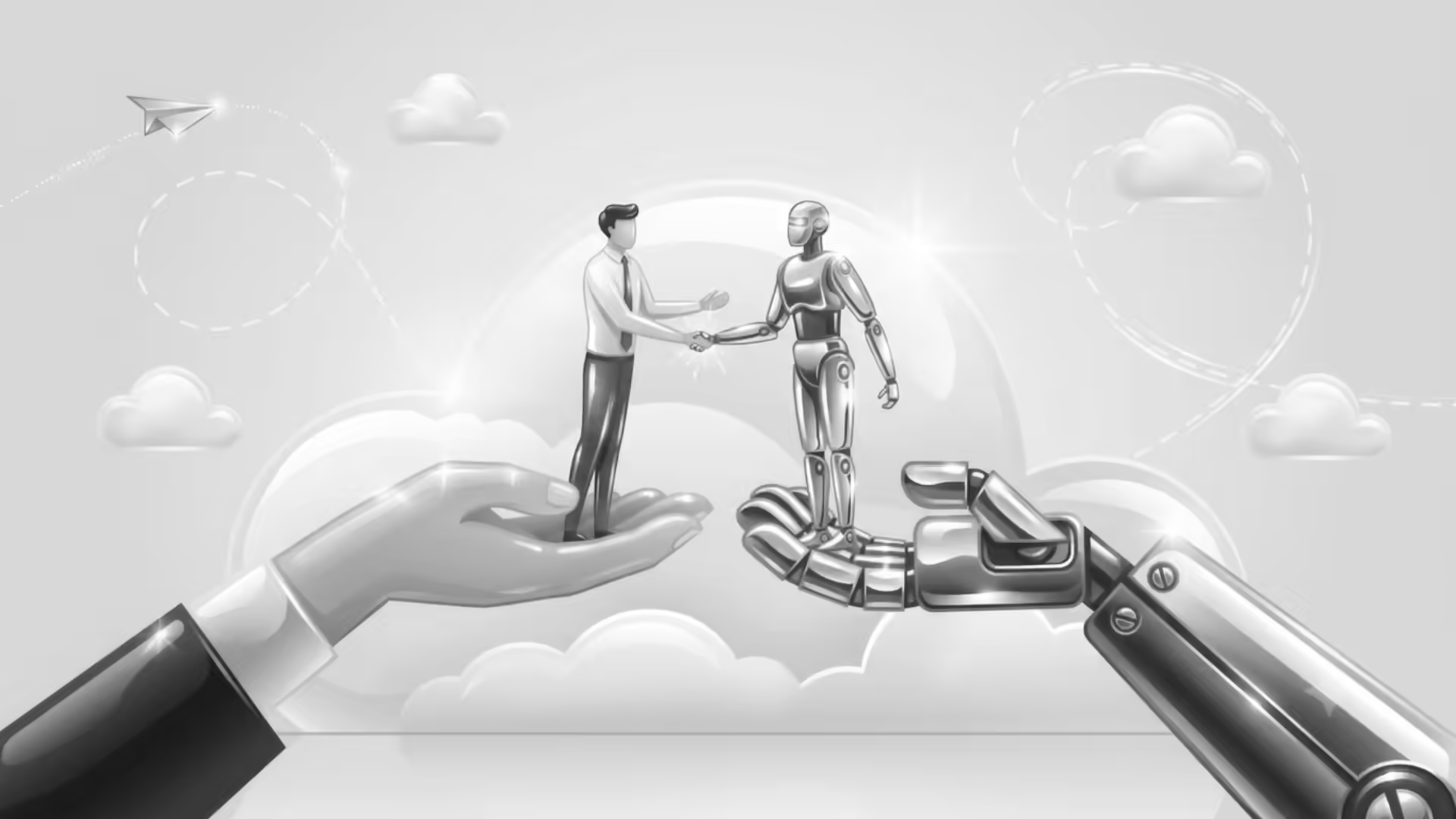
Chris Hillman argues that when a restaurant that moved bookings online, yet kept its reservation team, shifts them into guest research and personal welcome moments. He uses the story to argue that technology should remove friction while humans handle recognition, care, and judgement. Chris develops the case through hospitality, banking, retail, and employee experience. He contrasts service with hospitality using Danny Meyer, Will Guidara, and Apple Store examples, then criticises banks for closing branches using transaction-volume data that missed relationship value. Chris says AI raises the performance floor but can lower the ceiling, making employee care and customer connection more valuable as competitive advantages.
Branch dashboards are excellent at counting vanished conversations. They’re much worse at explaining why a customer stayed for twenty years, why a small business owner trusted one lender, or why a grieving widower didn’t move his accounts after a bad rate rise. Chris is strongest when he sits in that gap between measured activity and lived value. Anyone who’s worked near data has seen the same trick. The report is accurate. The decision is stupid. Sure, automation can clear the booking queue, summarise the customer record and spot the service history. Good. The useful question is whether the saved time gets reinvested in human judgement or harvested as headcount reduction. Most orgs say the former in keynotes and do the latter in spreadsheets. This is all about operating design; Apple removed commissions, the restaurant protected the reservation team, Southwest put employees first before asking them to care for customers. Those are structural choices, not vibes. They change incentives, roles and management attention. The next advantage belongs to orgs that use machines to give people better context, then give those people permission to act.
My Week in AI
- Nemotron-Labs-TwoTower Diffusion Language Modeling with Pretrained Autoregressive Context | arxiv.org
- Sakana Fugu One Model to Command Them All | sakana.ai
- Long-Context Isn't the Answer | humanlayer.dev
- Microsoft commits $2.5 billion and 6,000 employees to new AI implementation unit | cnbc.com
- OpenAI’s apparent failure to visit key site raises questions over UK investment | theguardian.com
- SkillOpt turns AI agent skills into trainable assets | microsoft.com