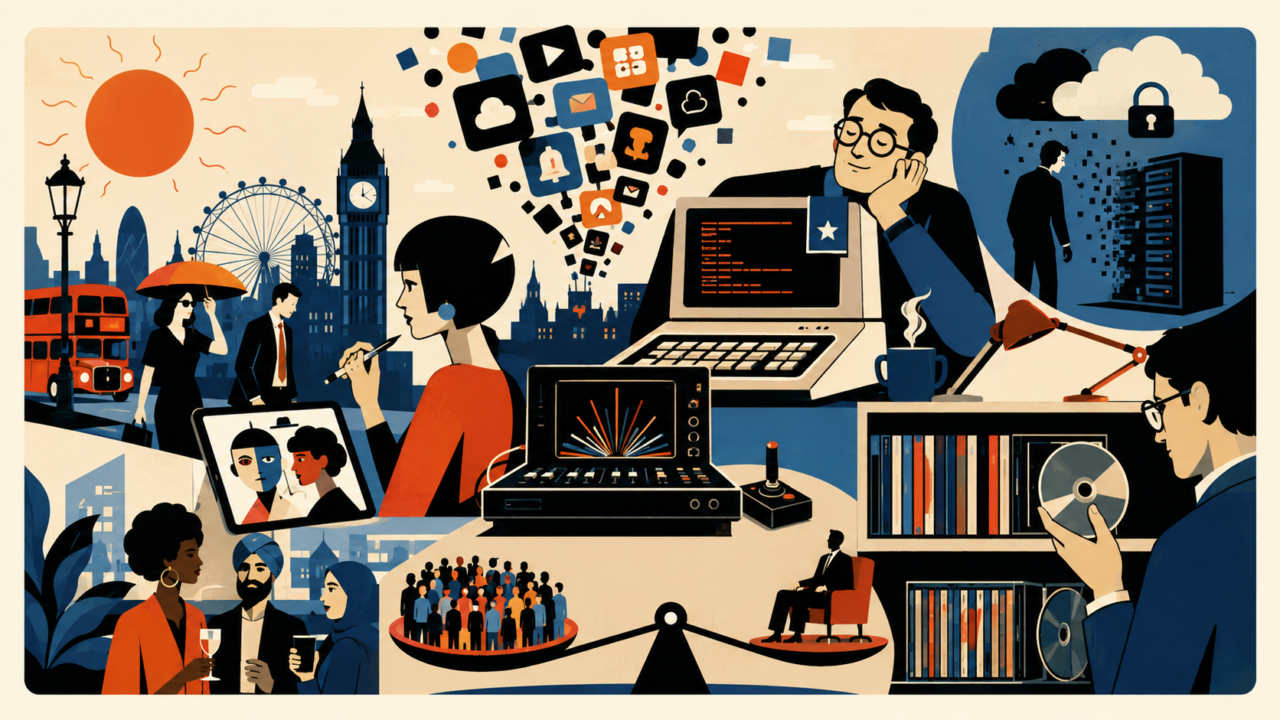
Welcome to another scorching week in London, and this #RBM edition the software is abundant, the media is vanishing, the humans are stylised, the consoles do not play games and a decades-old word processor still has better manners than most modern apps. Robert J. Sawyer’s WordStar loyalty is not just nostalgia, it is a defence of tools that protect thought instead of constantly asking to be managed. Tereza Tizkova’s software abundance argument shows what happens when making things gets cheaper and judging them gets louder: expertise survives, but the comfortable middle gets squeezed. Pixar’s believable people remind us that realism is often a trap, and that the right abstraction can feel more alive than a failed imitation. Atari Video Music is the charming failure in the room, a product that saw a future before anyone knew where to shelve it. Cem Dervis’s defence of physical media brings the week back to control: the cloud is convenient until the licence changes, the server closes or the thing you bought quietly stops being yours. At the end good technology does not just add capability, it decides who holds the power when the novelty wears off…
In this issue
5 piecesWordStar for DOS is still preferred writing tool because it supports creative composition rather than page formatting

Robert says WordStar’s control-key commands, designed by Seymour Rubinstein and Rob Barnaby, keep touch typists on the home row and reduce interruptions. He compares WordStar with WordPerfect, Microsoft Word, MultiMate, Sprint, XyWrite and other tools, finding WordStar better suited to drafting and revising prose. Robert’s wider point is that writing software shapes thought by deciding whether the machine or the writer controls attention. He describes WordStar’s bookmarks, block marking, cursor movement, printable and non-printable comments, and customisation as aids to non-linear composition. For software teams, the article is a case study in interface design, user muscle memory and the cost of forcing creative workers through tool-imposed workflows.
The year was 1993 and I was doing a course and being certified into WordStar - I think it was version 7 ?!.. And this was a word processor should behave more like a handwritten manuscript than a typewriter. Sure, it sounds backwards until Robert walks through the mechanics. Ten bookmarks. Deferred block moves. Visible private notes that never print. Cursor movement that keeps fingers on the home row. He’s really describing stateful thinking, not nostalgia. Everything was keyboard based back then, I also had to knew the commands by heart and maybe that's what helped me and drove me to write even more. Hence these newsletters, maybe ... I get that creative work is full of half-made decisions, temporary markers and sudden returns to an earlier thought, and a tool that demands ceremony at each of those moments taxes the user at exactly the wrong time. Any engineer who has lost a line of reasoning to a modal dialog should recognise the complaint, even with VI... A control-key grammar can be superb once internalised, but it also builds a wall around the fluent user. WordStar still survives because its interface became part of our cognitive process, whilst modern software often sells collaboration, cloud sync and AI assistance as upgrades to writing.
AI-written software lowers entry barriers, changes the status of engineering work and pushes software markets towards abundance
Tereza links recent layoffs at Block, Atlassian, Salesforce, Snapchat and Direct to a broader shift: if anyone can make software, outsiders feel more able to judge it. She says this will compress pay for merely competent engineers while increasing rewards for specialists with reputation, taste or distribution. She extends the argument from jobs to products and says abundant software weakens customer commitment, makes mid-tier SaaS vendors vulnerable and shifts value towards aggregators that control trust, identity and distribution. Barry Schwartz’s paradox of choice is used to explain why more alternatives can reduce satisfaction. For founders and technical leaders, the article frames software as a commodity layer and outcomes as the business customers actually buy.
Tereza gets the market psychology right before she gets to the market mechanics. Cheap creation changes how buyers behave. Once a team believes it can build a passable internal tool in an afternoon, every vendor invoice starts looking negotiable. That alone is enough to make a lot of middling SaaS feel exposed. Her article is also good on status; software engineering has benefited from a useful mystique: hard language, hard tooling, hard hiring filters, and vibecoding punctures that mystique at the edges. I don’t think it erases expertise, but it does invite the same exhausting chorus designers and marketers already know: everyone has feedback, few people can ship the work well. Yet, software isn’t just a screen that does a tasks, iit is permissions, audit trails, support contracts, procurement, migration risk and the grim little spreadsheet where someone records who owns the thing after its maker leaves. Water is a neat metaphor for abundance, but companies still pay heavily for plumbing, testing and someone legally accountable when it floods the basement.
Pixar’s route to believable computer-animated humans came through stylisation, not photorealism

Animation Obsessive Staff traces Pixar’s progression from object-led shorts such as Luxo Jr. to Billy in Tin Toy, the limited humans in Toy Story and Geri in Geri’s Game. It names Craig Good, Bill Reeves, Eben Ostby, Ed Catmull, Jan Pinkava, Tony DeRose, Karen Prell, Brad Bird and Ralph Eggleston in explaining the technical and artistic shift. The article’s wider theme is that Pixar solved a technology problem partly by borrowing from puppet traditions. Jan drew on Jiří Trnka’s Czechoslovak stop-motion work, treating Geri as a digital puppet rather than a simulated actor. The lesson matters beyond animation because it shows how realism can fail when audiences know the subject too well, while controlled abstraction can give designers more room to create credible movement, weight and personality.
Geri’s Game quite changes the deployment target; as Pixar stopped treating the human as a failed simulation and started treating him as an engineered performance object. That is a very different brief. It gives the animators permission to simplify anatomy, exaggerate timing and let weight do more of the persuasive work. Sure, audiences are brutal at spotting bad humans because we spend our lives reading faces, posture and gravity. A lamp has less baggage. A toy has even more freedom. Billy in Tin Toy is impressive because the problem was monstrous, but he sits in that awkward zone where technical effort makes the remaining faults louder. Plastic skin. Stiff motion. A baby who feels slightly assembled. Jan’s move is the clever one. He didn’t chase the actor. He reached back to Jiří and the puppet stage, where a figure can be plainly artificial and still feel alive. So, systems become more reliable when their abstraction matches their strengths, ie force a platform to impersonate a medium it can’t yet sustain and every seam becomes visible. This piece slightly tidies the story after the fact. Geri needed serious software advances, including Tony’s subdivision surfaces and better cloth. Taste alone didn’t save him; constraint, used deliberately, can look like mastery.
Atari Video Music, officially the C-240, is the 1977 Atari device that turned stereo audio into abstract television visuals
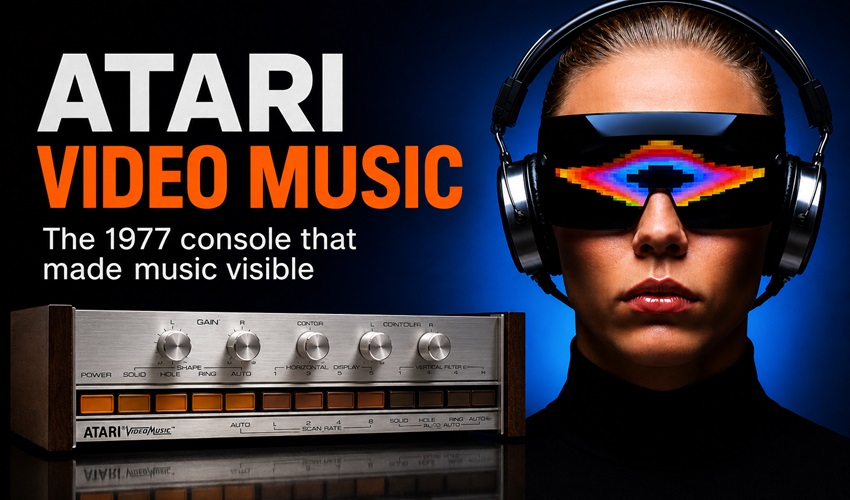
Generation Amiga says it was an analogue machine rather than software, using circuitry to interpret sound and produce animated colour patterns on a CRT. The article places it between hi-fi accessory, domestic light show and experimental consumer gadget, rather than a normal game console. GA argues that the C-240 matters because it treated the television as a reactive surface before software visualisers became common. The article explains its gain, colour, contour and display controls, its hi-fi-style metal and wood design, and its later pop-culture visibility in Daft Punk’s Robot Rock video behind Thomas Bangalter. For product teams, the piece is about category confusion, timing and selling an experience that lacks obvious repeat use.
What a nice piece of history! This wood-style side panels do more work than they first appear to.. they tell you Atari knew this thing couldn’t sit beside a joystick and survive the comparison. It had to pass as hi-fi. That is the small professional detail I like most in the piece: the product’s design is already arguing for its category. Generation Amiga gets this oddness right; with the C-240 selling mood, not utility. I’ve seen plenty of modern products make the same move with better silicon and worse honesty. They promise ambient intelligence, presence, delight or vibe. Yet it slightly romanticises the gadget by treating later familiarity as proof of early wisdom. Audio-reactive visuals did become ordinary, but the domestic product still had a thin reason to return. A game gives mastery. A stereo gives fidelity. A visualiser gives atmosphere, and atmosphere is a difficult subscription model before subscriptions even enter the room. Atari had the technical ability to make screens react, but the market soon rewarded cartridges, characters and replay. Distribution pulled the company back towards games. Today's new categories often look ridiculous because the old nouns do all the selling. Console, stereo, television, toy, appliance: the C-240 fitted none of them cleanly.
Digital media purchases often provide licensed access rather than ownership, making films, games, books, music and cloud files dependent on platform rules

Cem uses examples from Amazon, Sony, Disney+, Warner Bros. Discovery, Microsoft, Google, Nintendo, Steam, Netflix, Spotify and others to show how digital content can be removed, edited, delisted, region-blocked or tied to accounts and servers. Cem’s broader claim is that physical media gives buyers a separately held copy with clearer resale, lending, archiving and offline-use rights. He contrasts Blu-ray bitrates with streaming compression, cloud storage with local backups, and subscriptions with one-off purchases. For technologists, the article is a long case file on platform dependency: content ownership becomes fragile when access, identity, licensing and enforcement sit inside someone else’s infrastructure.
These scratched DVD drawers are my least glamorous backup strategy, there also with the dusty floppy disks, but Cem makes it look almost radical... right? His force comes from accumulation; one removal is an accident, ten look like a pattern and by the time he reaches Steam licences, Kindle deletions, Funimation digital copies and live-service games that die with their servers, “buy” has started to sound like a user-interface label with legal small print attached. What he gets right is ownership issue, because he treats it as infrastructure, not sentiment. Access now depends on accounts, payment systems, regional rights, moderation policies, authentication servers and whatever strategic pivot arrives after the next earnings call. Example; I bought FIFA 2017 - yes.. - and now I wanted to play it with my kids on the xbox and no dice, couldn't because it wasn't available. It's no longer in the store and I own nothing now. Cem underplays the bargain people knowingly make. Streaming / digital owning is convenient, searchable and cheap enough until it isn’t. Physical media also shifts work back to the user: storage, backups, hardware, format drift, moving house with boxes of plastic rectangles. Real ownership has admin. Ask anyone with a NAS and a mild personality disorder.... mine is just there and I have several others to built... Platforms love licensed access because it turns culture into a managed service. It also turns trust into a balance-sheet variable. Once customers understand that their library is conditional, the product has to compete against a shelf, a hard drive and a growing suspicion that the cloud is just someone else’s revocation engine.
My Week in AI
- The state of the AI economy | exponentialview.co
- Santander AI Open Source | github.com
- When AI builds itself | anthropic.com
- AI and Liability | schneier.com
- Cybersecurity in the post-mythos era Keep calm and carry on! | cephalosec.com
- Self-Harness Harnesses That Improve Themselves | arxiv.org