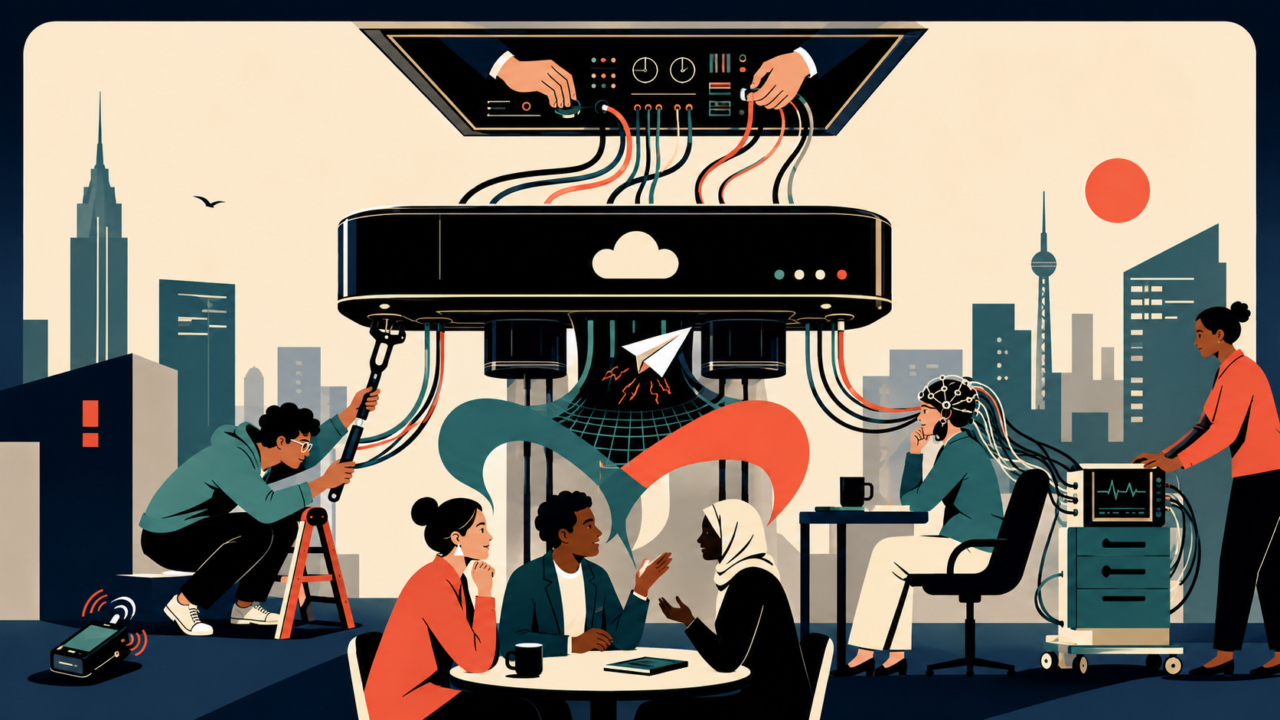
This week’s #RBM came from my Obsidian second brain (yes, finally got the time to implement a proper structure that left my MSFT OneNotes behind) and it had a useful common thread: systems that look self-organising usually have a hidden control plane, and someone is quietly paying for the mess. Open source keeps modern software upright while its maintainers absorb demand, risk and pager pain without anything resembling a market signal. Brain-computer interfaces are moving from lab spectacle to domestic infrastructure, but the wires, carts and care labour are still very real. McKinsey’s transformation piece dresses collective action in boardroom language, yet the point is sound: local incentives will eat any grand programme that does not change who owns the work. The Signalist makes the case that conversation is not office garnish, it is part of how teams detect weak thinking before it ships. Stratechery’s Anthropic piece lands in the same territory with sharper teeth: AI vendors are not neutral utilities, they are policy, telemetry and commercial power bundled behind an API.
In this issue
5 piecesAndrew Nesbitt argues that open source libraries defy standard economic models

They are non-rival, non-excludable goods with no price, contracts or liability, yet npm hosts over five million packages and commercial software depends on them. Andrew compares open source with public goods theory, price signalling, the tragedy of the commons, supply and demand, division of labour, and firm incentives. He says familiar explanations only cover parts of the system. Career signalling, cheap internet coordination, user innovation and corporate complement strategy all fit some cases, but leave the one-maintainer dependency tier largely unexplained. Andrew’s practical concern is that funding formulas, sponsorship markets, bounties and criticality scores rely on weak proxies for value, maintainership risk and security responsiveness.
I find the npm’s strangest trick is that demand has almost no plumbing back to supply... right? A library can jump from a thousand downloads a week to ten million and still be maintained by the same tired person with the same unpaid evening. That’s the claim that should make every CTO sit up straighter. Open source isn’t just cheap procurement with better stickers, it’s actually rather a production system where usage, risk and responsibility are wildly separated. This still underplays one grim enterprise consequence: vendors are very good at turning this fog into someone else’s problem. A cloud provider can consume the commons, wrap it in support, sell the managed version, then point customers back to the original maintainer when the low-level package goes sideways.... Lovely work, if you can route the pager elsewhere! So, stars, downloads and criticality scores are telemetry with a costume on, and it's useful, sometimes. Reassuring, too often. The real procurement test is whether a security report reaches a living maintainer with time, context and authority.
Nicholas Card and colleagues reports a long-term trial of an intracortical brain-computer interface
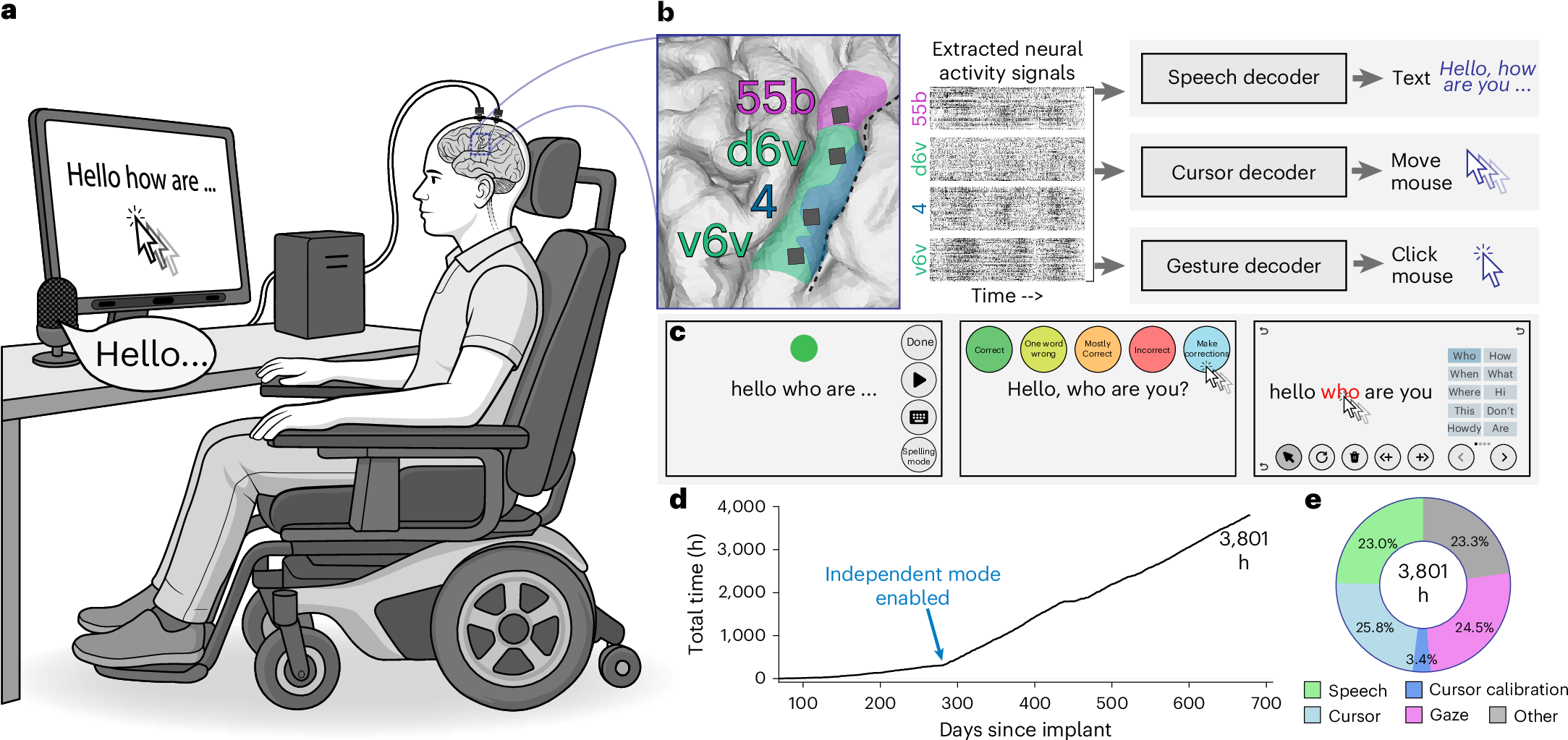
This Nature Medicine article details the report of the long trial on a 45-year-old man with amyotrophic lateral sclerosis, paralysis and severe dysarthria. The system used four 64-electrode arrays and three real-time decoders for speech, cursor movement and clicks. Over nearly two years, T15 used it at home for more than 3,800 hours without researchers present. Nicholas and colleagues frame the result as evidence that high-performance intracortical BCIs can move beyond short lab sessions into daily life. T15 produced 183,060 sentences, nearly two million words, averaged 56 words per minute, rated 92% of sentences at least mostly correct, and maintained full-time employment. The study also states its limits: one participant, percutaneous wired connections, trained care-partner setup and a bulky multicomputer cart.
The glamour in brain-computer interfaces has moved from demo velocity to domestic mess. T15 used the system for work, messages, video calls and browsing across 3,801 hours and that matters! I’m used to BCI stories that feel like lab theatre with a patient attached, but this one has chores: setup, fatigue, corrections, privacy mode, software updates and the dull victory of showing up almost every day. Yet, the paper leaves out the uglier deployment boundary. “Independent” still means trained care partners, wired percutaneous connectors and a cart full of research computers. The patient gets agency, but the architecture still drags a clinical trial around the living room. The most interesting technical detail is that a speech motor cortex implant also drove cursor control. One cortical target becoming keyboard and mouse is exactly the kind of simplification a future device needs. Sure, safety is the catch; a transformer decoder that writes words from attempted speech is also a system that can mishear, overfit, drift or expose intimate data. With accuracy above 99% in prompted tasks, it does sounds superb, yet real conversation produced a mixed stream of correct, corrected and mostly correct sentences.
CEOs have an undelegatable role in transformations because collective-action problems block shared outcomes
Kurt, Mathew, Meagan and Michael say only 30 percent of transformations deliver the value leaders expect, and identify five barriers: negotiated settlements, hoarding habits, local priorities, reliance on a trustworthy few and finite programmes. The article says CEOs should set full-potential aspirations, build a shared fact base, reward stretch targets, widen leadership ownership and absorb transformation disciplines into daily routines. It links these moves to McKinsey research on shareholder returns, capability-building and employee involvement. For senior leaders, the argument is that transformation failure often comes from rational local behaviour rather than open resistance.
This article is right to start with incentives rather than speeches, as most transformations don’t die because everyone hates the strategy. They die because the rational move for each team is to sandbag targets, guard bad news, protect budget and keep the hero squad busy. Anyone who has sat through a green-against-all-evidence steering committee knows the smell. This McKinsey's useful contribution is naming those behaviours as collective-action problems. That’s cleaner than the usual culture fog. A CEO really does have a job no transformation office can fake: changing what gets rewarded, what gets seen and who is allowed to say the plan is red. Alan clapping the red-light project is a tiny moment, but it’s the whole management system in miniature. The sceptical bit, for me, is the evidence wrapper; where vendor research with neat outperformance numbers always needs a raised eyebrow, especially when the cure involves buying the kind of operating discipline consultants sell. The logic may still hold, but the pudding is thinner than the confidence. For a CTO, the lesson is painfully practical; transformation dashboards work only when they connect to decisions, capacity and consequences. Otherwise they become executive observability without incident response. Lots of lovely telemetry. No one owns the outage.
Jakub Skoczeń argues that conversation often produces understanding that solo thought cannot

Jakub says serious work culture treats conversation as an overhead after thinking, while discovery often depends on saying ideas aloud, receiving immediate listener feedback and converting vague impressions into claims that can be tested. He draws on cognitive science to frame dialogue as part of thinking itself. Jakub connects this to modern work design, where remote work, asynchronous communication, default headphones and generative AI reduce informal exchange. He says these choices can keep output metrics healthy while weakening trust and understanding. The article’s sector relevance is strongest for teams treating AI chat as a replacement for colleagues, since Jakub argues models provide sentence-level precision but need prompting to disagree.
I find that the oddest claim here is that the best thinking partner might be someone who doesn’t know the answer - not your AI-knows-it-all.... That feels wrong in a workplace trained to route every question to the resident expert. The useful colleague often isn’t the oracle. They’re the person whose frown makes a sloppy sentence collapse before it becomes a bad decision. Jakub gets the mechanism right; speaking turns fog into syntax and a listener supplies pressure, timing and resistance. That is different from typing a prompt into a model and receiving a plausible wall of text. AI can make you clearer. It doesn’t reliably make you less self-serving. By default, it’s more mirror than sparring partner. The article overstates the magic of spontaneous conversation a touch. We know that some hallway chats are discovery engines, with plenty are latency spikes with shoes. My problem at the office is sorting productive friction from ambient interruption, then designing for the former without pretending I should be reachable all day.... The smell of marketable version of this argument is “bring people back to the office”. The better version is more precise: preserve high-quality disagreement wherever the team works. Remote teams can do this, but they have to name it, schedule slack around it and stop treating every gap between meetings as wasted inventory. AI tools need the same treatment. Ask them to argue. Ask them to find the weak premise. Ask twice.
Ben Thompson argues that Anthropic’s conflict with the U.S. government over Fable 5 and Mythos 5 fits a longer pattern around model capability, safety controls and institutional power.

Ben says Anthropic released Fable after previously describing Mythos Preview as too dangerous for public release, then faced an export-control directive after a reported jailbreak raised national security concerns. Ben connects the dispute to three imperatives for frontier labs: moving closer to users, collecting real-world usage data and controlling how their models are used. He says model labs risk commoditisation as open source models improve, so they have strong incentives to own the user touchpoint. He also contrasts Anthropic’s position with Satya Nadella’s argument that companies should own their own AI learning loops.
So this Fable launch was treated like a vendor risk assessment that wandered into political theory. A model is released, a jailbreak is reported, the U.S. government intervenes, data retention changes, and a proposed invisible downgrade appears for people building rival frontier systems. That isn’t just product strategy; it’s control-plane strategy with a panic halo. Ben is strongest on the economic logic. Frontier labs can’t live forever as expensive API suppliers while open models chase them down and software companies sit between them and the customer. They need the interface, the workflow and the feedback loop. The bit worth sitting with is nastier: Ben thinks Anthropic’s power comes from sincerity, not cynicism. The company can believe it is uniquely serious about superintelligence risk and still make decisions that pull customers, data, competitors and governments into its preferred operating model. That’s the superpower. Not hypocrisy. Conviction with margin expansion attached. Now this is where procurement needs to grow teeth; when a model that can silently degrade, retain sensitive traces or redefine acceptable use is no longer a neutral component, it’s infrastructure with a worldview. The risk isn’t merely lock-in through APIs; it’s lock-in through policy, telemetry and model behaviour you can’t fully observe.
My Week in AI
- Audit websites for AI Agent Experience (AX) readiness | github.com
- GLM-5.2 Built for Long-Horizon Tasks | z.ai
- High-performance code intelligence MCP server | github.com
- Microsoft eyes DeepSeek for enterprise AI | axios.com
- Securing internal systems against increasingly capable and imperfectly aligned AI | deepmind.google
- Midjourney goes from generating cat images to full-body ultrasound scans | theverge.com