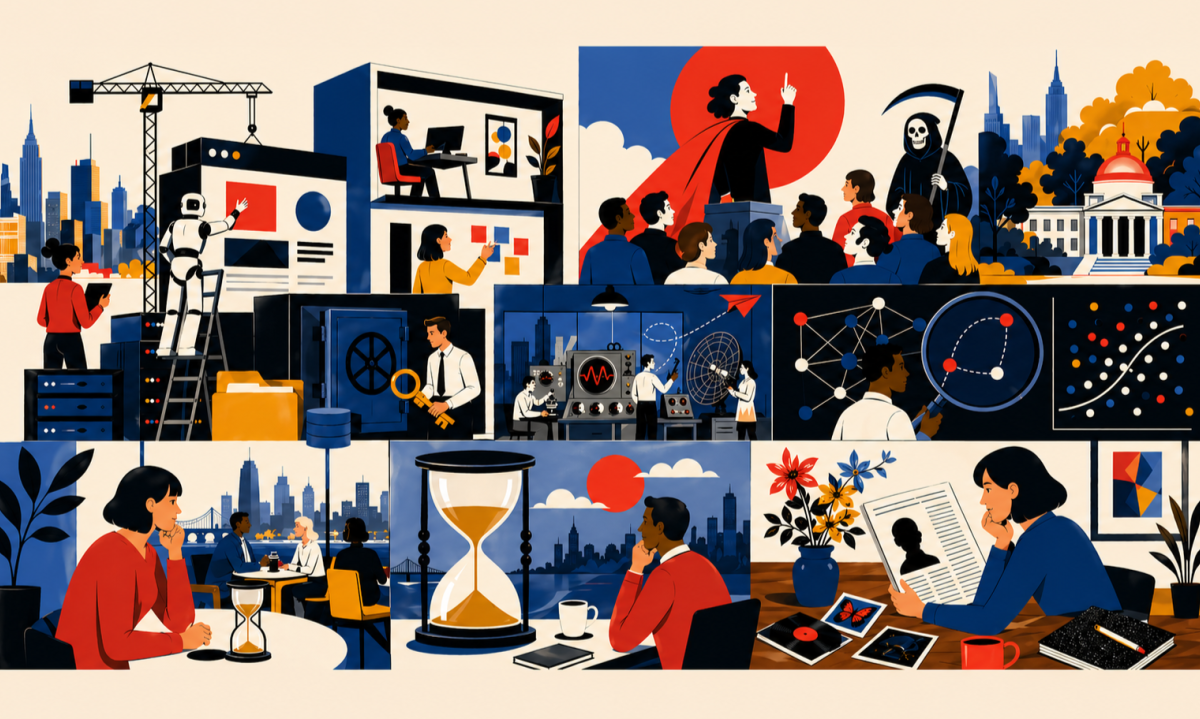
We’re one week away from some great news for those that have been following the #RBM here 🙂 But, whilst we wait, here’s the slow reading before tomorrow, as this week’s articles accidentally form a neat little argument about infrastructure, hype and patience. AI might be able to build the website, migrate the content and even fiddle with the WordPress theme, but the boring machinery still matters: permissions, memory, workflows, archives and all the strange decisions a business quietly stores inside “the website”. Longevity campaigners want death promoted to policy enemy number one, which is ambitious, morally tidy and missing the rather important bit where effective anti-ageing treatments actually exist. Bell Labs reminds us that serious invention needs room to look wasteful before it looks brilliant, which is exactly the kind of patience modern dashboards are designed to murder. In machine learning, mathematics hasn’t died either; it’s just been moved from oracle to investigator, called in after scale has done something weird and profitable. And finally, creativity may need less algorithmic sameness and more odd inputs, even obituaries. Especially obituaries. Curiosity takes time. Time is usually the first thing we claim to value, then quietly remove from the calendar.
In this issue
5 piecesChris Reynolds, writing on jazzsequence, argues that AI-generated websites do not make CMSes obsolete.
The article responds to claims from WordPress veterans and agencies that tools like Claude Code can replace WordPress by building and maintaining sites faster. Reynolds accepts that simple landing pages, portfolios and blogs may not need a CMS, but says that argument predates AI and should not be treated as a new revelation. The broader implication is that AI changes the interface and workflow around publishing, rather than removing the need for durable content systems. Reynolds frames WordPress, Drupal and newer systems such as EmDash as long-term infrastructure for permissions, APIs, workflows, extensibility and content history
I disagree! Just because I think that CMSes are still and will be a thing. I was thinking of telling my agent to post for me in a website, but I've lately seen how a coding agent actually can build a wordpress theme, create or migrate content and even manage it. Is it perfect? Of course not! Do we need everything AI at the moment? Not at all! For some, a content management system is still the best thing to deliver content. But, the counterintuitive bit here is that AI may strengthen the case for a CMS rather than kill it. Reynolds gets that right because the boring machinery of publishing still matters: permissions, workflows, APIs, content models, revision history, and the dull miracle of letting a non-technical person press Save without invoking an agentic séance. WordPress is the named battlefield, but the real issue is institutional memory. A CMS is rarely just a page editor. It is where years of decisions, mistakes, forms, redirects, taxonomies and strange little business processes accumulate. Reynolds’ 24-year archive makes that unusually visible, but plenty of organisations have quieter versions of the same problem. They just call it “the website”. Cloudflare’s EmDash example is the tell. Even the “spiritual successor to WordPress” still looks like a CMS because humans still need handles on the machine. The CMS isn’t dead. The lazy CMS sales pitch is :)
Jessica Hamzelou, writing for MIT Technology Review, profiles the Vitalists, a movement of longevity enthusiasts who argue that death is “wrong” and that humanity has a moral duty to defeat it.

The article centres on Nathan Cheng addressing around 80 people at the Vitalist Bay Summit in Berkeley, part of a two-month residency exploring drug regulation, cryonics and other tools in the fight against death. It presents Vitalism as a deliberate rebranding of the longevity movement, created by Cheng and Adam Gries to avoid associations with supplement marketing, anti-ageing clinics and broader transhumanist ideas. Its implications are political as much as scientific: Vitalists want longevity to shape budgets, policy, culture and national priorities, even though the effective anti-ageing treatments they seek do not yet exist.
The gap between the headline and the evidence is the whole story here! The Vitalists want death treated as a moral error, yet the article is admirably blunt about the awkward bit: the effective anti-ageing treatments they want do not yet exist. That’s a fairly large hole in the launch deck. Hamzelou gets the important thing right by separating this from the usual wellness slop. Vitalism is not just another supplement label with shinier typography. It is a political project. Cheng’s argument is simple enough to sound unanswerable: life is good, death is bad, therefore society should prioritise defeating death. Neat. Too neat. The hard part is not agreeing that dying is unpleasant. The hard part is deciding what proof, safety, access and opportunity cost look like before the movement starts rewriting budgets. Death may be bad. Hype with a halo is still hype.
Areoform, writing for 1517 Fund, argues that Bell Labs worked because Mervin Kelly created a research culture built around radical autonomy, taste in people and long time horizons.

The article uses Bell Labs’ wartime and post-war output, including work on the British Magnetron, the Bazooka, anti-aircraft computing, acoustic homing torpedoes, proximity fuzes, SONAR, pulse code modulation and Nike missiles, to show what happens when driven researchers are trusted rather than micromanaged. The article’s wider claim is that modern institutions have the money to recreate Bell Labs but not the organisational nerve. It contrasts Bell Labs with contemporary corporations, universities and grant-driven research, arguing that bureaucracy, paperwork, managerial oversight and short-term optimisation have displaced the freedom to waste time and resources.
This piece gets one big thing right: great research needs room to look inefficient. Bell Labs’ magic, as the author tells it, wasn’t just money or clever hiring; it was the willingness to give serious people serious problems and then resist the managerial itch to poke them every fortnight for a dashboard update. That’s rare. It was probably rare then. Today’s tech giants have had more money than early AT&T, yet none has built another Bell Labs. Apparently, the harder problem is taste. Who gets freedom? Which problems deserve years? How much apparent idleness can an institution tolerate before someone with a spreadsheet starts twitching? Mervin Kelly is doing a lot of work in this story. Maybe too much. Modern technology companies love research branding, but their incentives often pull towards product cycles, platform advantage and defensible moats. Basic research becomes acceptable when it can be routed through hiring, PR, patents or cloud consumption. Bell Labs, in this telling, was less a lab than an institutional contradiction: commercially funded patience.
Henry Kvinge, writing in The Gradient , argues that mathematics has not become irrelevant to machine learning

, but its role is changing. Instead of mainly providing theoretical guarantees or handcrafted architectural rules, mathematics may increasingly explain empirical phenomena after they appear, guide higher-level design choices, and connect deep learning with fields such as topology, algebra and geometry. The article frames scale as disruptive, but not fatal, to mathematical insight. It surveys how intrinsic dimension, curvature and topology can help analyse hidden activations, weights, loss landscapes and robustness. Then explains how symmetry, equivariance, representation theory and category-theoretic ideas can shape architectures and interpret model behaviour.
Usually, the people selling “just scale it” have not killed mathematics; they’ve changed its job description. Kvinge’s most distinctive claim is that maths may become less like an architect’s blueprint and more like physics after the experiment: a way to explain strange empirical regularities once the machine has already surprised us. That feels right. Annoyingly right. Deep learning has repeatedly made theory look overdressed for the occasion, particularly when more data, more parameters and more compute produce capabilities that existing explanations didn’t predict. But, if mathematics becomes post-hoc explanation, who funds it when the product already ships? A team chasing latency, margin and model leaderboard position may not pause for topology unless it exposes a failure mode, cuts compute or satisfies a regulator. AlphaFold3 is the useful irritant here. If a non-equivariant architecture can succeed on data with obvious symmetries, then the old instinct to bake every known structure into the model gets harder to defend. Still, compute is not infinite. Nor is trust. In domains where errors are expensive, the case for mathematical structure returns quickly...
Keith Sawyer, writing for The MIT Press Reader , argues that reading obituaries can boost creativity by exposing readers to conceptually distant information.
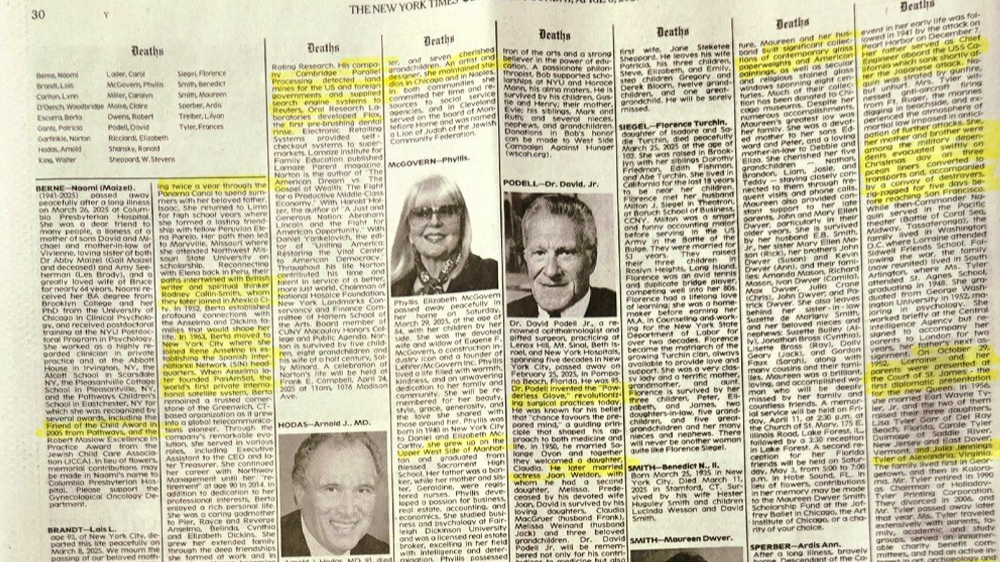
Drawing on creativity research by Yoed Kenett, Sarnoff Mednick and Dedre Gentner, Sawyer says original ideas often emerge from remote associations between unrelated concepts. He presents obituaries as a practical antidote to search engines and habits that mostly reinforce what people already know. Sawyer uses examples from New York Times Sunday obituaries, including Berta Escurra and Norton Garfinkle, to show how lives can combine broadcasting, aerospace, mysticism, oral hygiene, database search and entrepreneurship. The method is simple: read slowly, ask why, and look for structures that might transfer into one’s own work.
What a perfect way to finish this edition, on reading slowly :) “Read the obits” sounds charmingly low-tech, and the article’s most distinctive claim is genuinely useful: creativity may improve when we feed the mind distant, unrelated material rather than another personalised drip of the already-familiar. That’s a clean jab at modern information habits - even for those that receive this newsletter everyday for the past 2 years. I do think that creative work often comes from making odd connections, and - even - obituaries are unusually dense packets of career pivots, accidents, migrations, inventions and obsessions. Curiosity takes time; time is usually the first thing we pretend to value, then remove it. Anyway... obituaries won’t make anyone a genius! They might make the next idea less obedient...
Last Week in AI
- Amazon, Meta, Microsoft, Salesforce, and Stripe Join the Universal Commerce Protocol Tech Council | finance.yahoo.com
- Copilot's agentic capabilities in Word, Excel, and PowerPoint are generally available | microsoft.com
- Introducing GPT-5.5 | openai.com
- Introducing the new hosted agents in Foundry Agent Service: secure, scalable compute built for agents | devblogs.microsoft.com
- What’s new in Gemini Enterprise | cloud.google.com
- Toward a transparent supply chain for AI | research.ibm.com