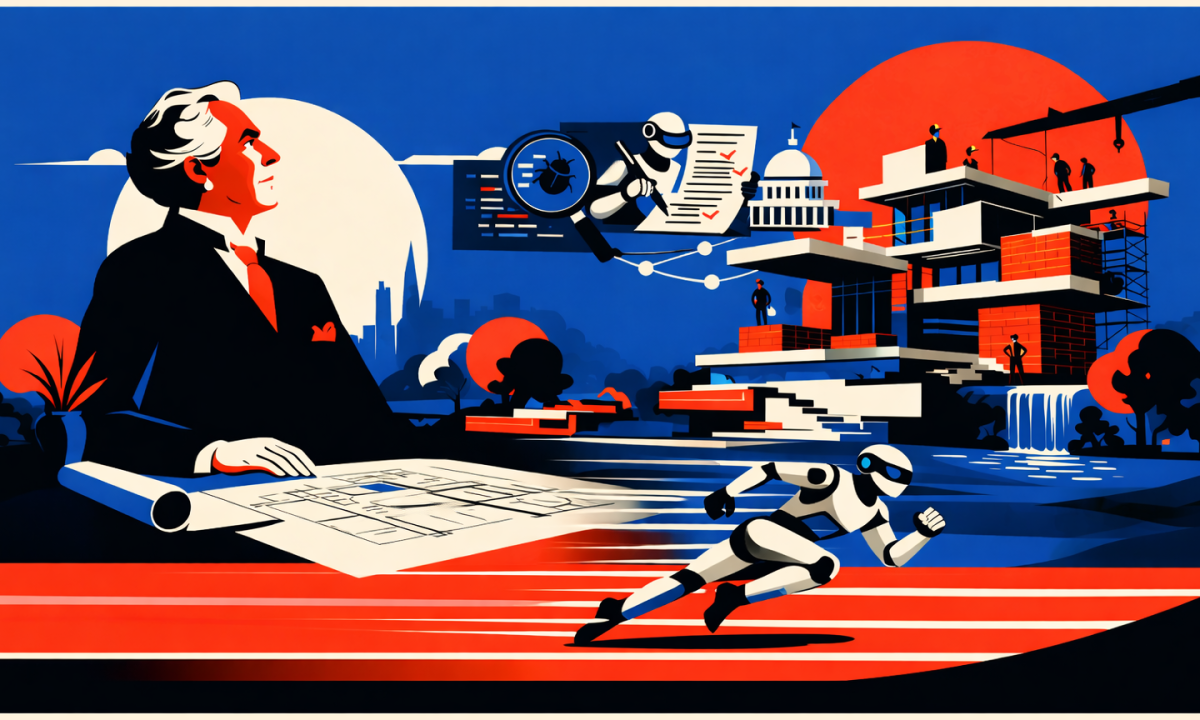
Lots happened this week, and I do not have room for all of it! So, lets start with Glasswing, because it is the clearest sign yet that the AI story is speeding up again. Anthropic’s claim is blunt: frontier models are now good enough at finding serious software vulnerabilities to change the security picture. The same pattern shows up elsewhere. FurtherAI argues that document extraction improves when systems can check and correct their own work, not just parse more aggressively. France’s government open data team is testing MCP as a controlled interface between AI assistants and public data, which looks useful until trust and provenance become the hard part. Microsoft’s future-of-work research lands in a similar place: AI is not just making tasks faster, it is changing how people coordinate, judge, and learn, and the gains are not spreading evenly. Even the Frank Lloyd Wright essay fits. Big visions, however elegant, still depend on power, hierarchy, and self-belief to become real.
In this issue
5 piecesAnthropic’s Project Glasswing announcement says frontier AI has crossed a threshold in cybersecurity.
The company claims its unreleased Claude Mythos Preview model can now find and exploit software vulnerabilities at a level that rivals or exceeds almost all human experts. Anthropic says the model found thousands of high-severity vulnerabilities, including in every major operating system and web browser. It points to examples such as a 27-year-old OpenBSD flaw, a 16-year-old FFmpeg flaw, and a chained Linux kernel exploit. The company presents Project Glasswing as a defensive coalition rather than a product launch, bringing in major technology firms, infrastructure operators, and open-source institutions.
This has spread quickly through the security world, and the reaction is easy to understand. The issue is not just that the models may be better at finding flaws. It is what that does to the rest of the workflow. Security teams are going to hear one thing: patch queues just became more dangerous. If Anthropic is even roughly right, the bottleneck stops being “can we find serious bugs?” and becomes “can we verify, prioritise, and fix them before someone else does?”. That is a harder operational problem. Anthropic is also packaging the threat, the response, the coalition, and the benchmark lead in one announcement. That is convenient. The market angle matters too. The biggest winners may not be the model labs alone, but the companies that control patching, endpoint telemetry, cloud distribution, and enterprise trust. Security history is full of clever detection that never turned into action. Cisco, Microsoft, Google, AWS, and CrowdStrike did not join this effort for the optics. They joined because whoever turns AI-assisted defense into a working system gets influence over the stack.
FurtherAI argues that loss runs are unusually difficult insurance documents because the problem is not just OCR.
The harder part is reasoning across inconsistent layouts, repeated or missing identifiers, subtotal rows, and claims split across multiple tables and pages. The company says its system improved row-count accuracy from 80% to 95% by adding a self-correcting agent loop that checks extracted claims against document totals and revisits suspicious sections. It frames this as a shift away from prompt tuning and toward feedback-driven extraction. FurtherAI describes three tools in the loop: claim extraction, page-level visual inspection, and validation against summary counts and financial totals. It also presents internal benchmark results from difficult real-world loss runs, arguing that row-count accuracy matters more than totals alone because a system can match the sums while still missing claims that matter in practice.
The most interesting point here is not that extraction is hard. Everyone in enterprise AI says that. The sharper claim is that an average first pass, combined with a decent checking loop, can beat weeks of hand-tuned prompts. That is right, as I've seen it working at projects we do at Hitachi Digital Services. Anyone who has dealt with messy business documents knows the failures are usually structural, cumulative, and faintly absurd. Loss runs expose brittle systems very quickly. They do underplay an important limit: validation against document totals is useful, but it depends on the source document containing reliable internal checks. Once those summaries are missing, wrong, or inconsistent, the self-correcting loop has much less to work with. And the benchmark is still a vendor grading its own system on data drawn from client workflows. Even so, the real moat here may be less “we have AI” and more “we have the feedback signals, tooling, and domain constraints.” That is worth taking seriously, but not on faith.
Andrew Deming argues that Frank Lloyd Wright is best understood neither as a saint nor a fraud, but as a figure whose work and life expose a deeper American tension around individuality, democracy, and order.

The essay traces that argument through Wright’s Prairie and Usonian houses, Broadacre City, Taliesin, and Fallingwater. It treats beauty as central to his democratic ethic rather than as ornament. Deming also connects Wright’s scandals, grief, and self-mythology to the same force of conviction that shaped the buildings.
Deming gets the central point right. Wright’s most unsettling quality is not the ego, the affairs, or even the leaks. It is that he treated beauty as a democratic necessity. That is a much bigger claim. The essay is strongest when it argues that Fallingwater and Taliesin are not side notes to Wright’s reputation but expressions of the same worldview: individuality as moral force, structure as liberation, beauty as nourishment. That works for me. Wright was not designing tasteful containers for rich clients. He was trying to reorder consciousness through space, which can read as civic ambition or extreme arrogance, sometimes both at once. Fallingwater matters here. So does Broadacre. One was built and remains extraordinary. The other was expansive and easier to admire in theory than in practice. Markets, land, and infrastructure have a way of tearing through idealism. Deming knows that, but his attention stays on the moral drama more than the practical consequences.
Data.gouv.fr has announced an experimental MCP server designed to help AI chatbots interact with French public data.

The post explains MCP, presents the work as a bounded experiment, and avoids claiming too much for it. The current server is read-only and limited to open public data. The team says future tests around editing or publishing data on data.gouv.fr would be handled cautiously and with sovereign models. The server includes seven tools covering dataset search, metadata access, resource listing, direct querying, file parsing, and usage metrics. The post also makes clear that language models can be wrong, and warns that unofficial MCP servers may present themselves as connected to Data.gouv.fr when they are not.
This is where governments start exposing interfaces to AI agents. The gap between the promise and the evidence is the whole story, and to their credit they seem to understand that. Data.gouv.fr is not pretending chatbots have solved public-data usability. It is saying: here is a protocol, here is a limited experiment, let us see where it fails. That is the right approach. The strongest part is that it identifies the real bottleneck. Open data is often not hard to access because the files are hidden. It is hard because the path from “I have a question” to “I found the right dataset, resource, and schema” is tedious. An MCP layer could help with that. Search, metadata lookup, resource listing, and direct querying are exactly the functions that make a static catalogue more usable. What the post plays down is governance. Read-only sounds safe until you remember that people will still treat a fluent answer as authoritative, even when the warning says the model may be incomplete or wrong. Then there is the spoofing issue around unofficial MCP servers. Public institutions do not want to be absent from AI interfaces, but they also cannot afford to give up trust, provenance, and publishing workflows too quickly. So they experiment at the edge: narrow permissions, public code, and plenty of caveats. The real question is not whether MCP can expose tools. It can. The question is whether states can keep that interface legible, auditable, and public once AI assistants become the front door.
Microsoft Research argues that generative AI is accelerating workplace change beyond earlier waves of digital transformation because it is starting to participate directly in creation, decision-making, collaboration, and learning, rather than simply speeding up existing tasks.

The post, by Jaime Teevan and nine co-authors, draws together findings from the New Future of Work report and argues that the biggest gains come when organisations treat AI as a collaborator. It also says adoption and benefits remain uneven across sectors, regions, and demographic groups.
Every major tech wave arrives with the same two promises: work will get faster, and the gains will spread. The first usually happens early. The second usually takes much longer, if it happens at all. This Microsoft piece follows that pattern, though to its credit it mostly acknowledges the problem. What it gets right is the level at which change is happening. This is not just about saving a few minutes on admin. AI is changing how people coordinate, judge, learn, and hand work off to each other. That is a more serious claim than “Copilot saved me an hour,” and it is closer to what companies are actually struggling with. Managers are not just buying speed. They are redesigning who decides what. “Uneven benefits” sounds mild. In practice it may mean fewer entry-level paths, weaker apprenticeships, and more value flowing to workers and firms that already have strong data, tooling, and management. The article notes a 16% decline for workers aged 22 to 25 in highly AI-exposed roles, then moves on quickly. That should be treated as a warning. Markets will reward companies that combine AI with trust, oversight, and workflow redesign. Others will buy the tools and inherit the confusion. The future of work will not be decided by abstract productivity gains. It will be decided by who captures them, who gets trained through the shift, and who gets left behind.
Last Week in AI
- GitHub Copilot CLI combines model families for a second opinion | github.blog
- Build AI skills for tomorrow | skills.google
- Scaling managed agents: Decoupling the brain from the hands | anthropic.com
- Copilot CLI now supports BYOK and local models | github.blog
- Codex use cases | developers.openai.com
- OpenAI’s Stargate shrinks further as UK data center “paused” | sherwood.news