This week my focus has been on the whitepaper “Skills are all you need” that I’ll publish soon. Meanwhile here’s what’s interesting: creativity seems to work better when people stop optimising for looking smart and start shipping rough ideas; starting with Docker, which is a good reminder that the most “obvious” infrastructure usually sits on top of years of ugly systems work; Anthropic’s labour-market piece is useful mainly because it tracks actual AI use rather than jumping straight from capability to job-loss theatre; Sam Henri Gold makes the best case I’ve seen in a while for constrained computers that still expose the full system, because there’s a big difference between hitting technical limits and hitting product limits; and Uber’s AI stack shows where this is all heading inside serious engineering orgs: away from magic-tool hype and towards plumbing, governance, orchestration, and a lot of expensive but necessary scaffolding.
In this issue
5 piecesSharif Shameem argues that creative work improves when people tolerate looking foolish long enough to generate weak ideas that later become strong ones.

He frames the problem personally: he can still write, but now hesitates to publish because his standards and self-consciousness have risen. To support the point, he draws on Richard Hamming’s comments about early recognition, examples of young teams and researchers, and a story about deliberately voicing bad cake-message ideas until a good one appeared. The piece positions embarrassment as a practical constraint on experimentation rather than a character flaw. Shameem extends the argument through an evolutionary analogy, suggesting progress depends on producing many unfit attempts and letting selection do the filtering. He concludes that the real failure for many thoughtful people is not oversharing, but undersharing: excessive self-selection leads to safe, bland work and fewer interesting outputs. His proposed remedy is simple; make sharing the goal, even when the work feels half-baked.
This one lands because it names a very recognisable trap: getting better, then becoming weirdly less brave. I like the piece because it does not romanticise genius; it makes creativity sound more like tolerating mess for longer than your ego wants. That feels right to me. Creative systems fail when they over-optimise for reputational safety too early. In engineering terms, that means pruning the solution space before enough exploration has happened. His examples; young teams, bad cake ideas, evolutionary dead ends... support a common mechanism: useful novelty often emerges only after many low-quality iterations have been generated and discarded. I agree with the stance. The strongest practical insight is not “be less self-critical” but “change the optimisation target”. When the target is cleverness, people self-censor. When the target is output, variation increases, and better work has a chance to surface. The caution is that exploration without later selection becomes spam, and the piece only lightly acknowledges that trade-off. Even so, the article is usefully hype-resistant: it frames creative quality as a by-product of tolerated awkwardness, not polished confidence. That is a grounded and operationally useful view of how good work often gets made.
Docker has been a decade-long answer to the practical problem of building, shipping, and sharing applications reliably.
This ACM article argues that the familiar “build and run” experience hides years of difficult systems work underneath. It frames Docker not as a simple packaging trick, but as an engineering stack refined through sustained technical problem-solving, whilst signalling a retrospective tone, with the authors looking back on how that simplicity was constructed. Docker is still being positioned as relevant to current development practice, especially as AI coding changes software workflows. Rather than treating containers as settled infrastructure, the article seems to argue they must keep evolving with developer needs. That gives the piece two layers of interest: it is both a historical account of how Docker became usable at scale and a claim that containers still matter in modern tooling.
This looks like one of those pieces where the useful bit is not “Docker changed everything” but “it took far more systems grind than most people realised”. I like that instinct! Good infrastructure often gets mistaken for obvious infrastructure once it works, and that is a bit of a curse. The core promise appears to be that Docker’s familiar workflow only became durable because substantial technical challenges were solved behind the scenes. That is the right frame. In infrastructure, the visible interface often captures attention while the hidden compatibility, isolation, portability, and operational mechanics do the hard work. That said, the AI-coding hook may risk overstretching the argument if it is used mainly to refresh the relevance of an older platform story. Containers remain important, but “important” is not the same as universally sufficient for every emerging developer workflow.
Anthropic introduces “observed exposure” , a measure of AI displacement risk that combines theoretical task feasibility, actual Claude usage, work-related context, automation intensity, and task time shares.

The article argues this is more useful than capability-only estimates because AI adoption still covers only a fraction of what large language models could theoretically do. Using O*NET, Anthropic Economic Index data, and prior task-feasibility estimates, it identifies programmers, customer service representatives, and data-entry roles among the most exposed occupations. The piece then tests whether higher exposure is already showing up in labour outcomes. It finds that more exposed occupations are projected by the BLS to grow slightly less through 2034 and are more likely to be held by older, female, more educated, and higher-paid workers. But it reports no systematic rise in unemployment since late 2022 for highly exposed workers, while finding tentative evidence that hiring into exposed jobs has slowed for workers aged 22 to 25.
The article’s main contribution is not a dramatic conclusion but a better measurement frame. Anthropic is arguing that labour-market analysis should track revealed workplace use, not just technical possibility. That is a sensible correction. The distinction matters because economic disruption depends on adoption, workflow fit, regulation, and implementation costs, not merely on whether a model can complete a task in principle. On the evidence shown here, the economy still appears to be in an early diffusion phase: theoretical coverage is wide, observed coverage is much narrower, unemployment effects are absent, and only younger workers show a tentative hiring slowdown in exposed occupations. It is appropriately modest about what can be inferred so far, and that restraint improves its credibility. The caveat is institutional: this is a vendor-owned study using vendor usage data, so any broad labour claims should be treated as informative rather than definitive. Even so, the framework is useful because it identifies where pressure may surface first and avoids the lazier “AI replaces jobs” generalisation. It points instead to a more plausible near-term story of selective exposure, uneven adoption, and hiring frictions before headline unemployment moves.
Sam Henri Gold argues that many computer reviews act as permission slips , telling buyers which device fits their current role rather than asking what they might grow into.

Using the hypothetical “MacBook Neo” as the focal point, he pushes back on sensible reviewer advice that a low-cost machine with 8GB RAM, limited I/O, and an A18 Pro chip is unsuitable for serious creative or developer work. His core evidence is autobiographical: he learned obsessively on an underpowered 2006 iMac and found its limits educational rather than disqualifying.
The piece gets at something a lot of sensible tech advice misses: the first useful machine is not always the “right” machine, it is the one that lets obsession get a foothold. That feels dead-on. I especially like the distinction between hitting resource limits and hitting product limits. One teaches you how computers work; the other teaches you what a company decided you’re allowed to do. This is really an argument about platform access, not entry-level laptop shopping. Gold’s case is that the decisive feature of a cheap computer is not benchmark headroom but whether it exposes the full software and system surface area. That is why the MacBook Neo matters in his framing: despite weak specifications, it still appears to offer the complete macOS contract, including native APIs, system behaviour, and the ability to tinker beyond the browser. In infrastructure terms, that makes it a constrained general-purpose machine rather than a tightly managed appliance.
This article presents Uber’s engineering AI rollout as a deliberate platform effort , not a loose collection of coding assistants.
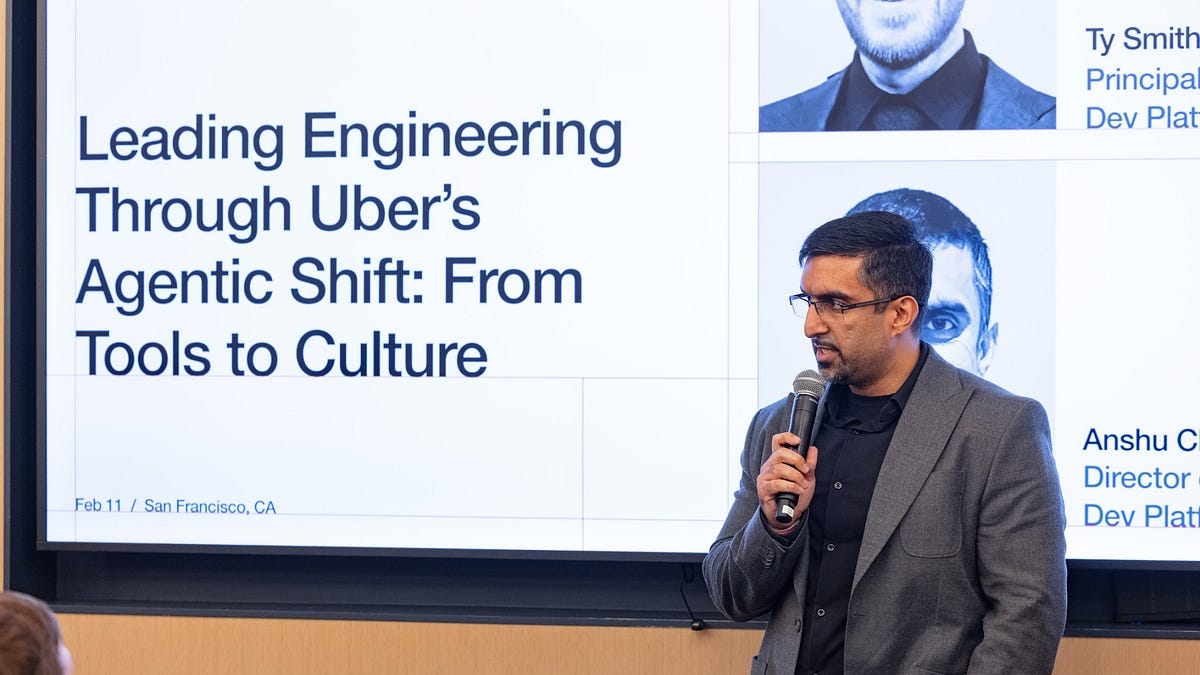
It says Uber built an internal stack spanning Michelangelo-based model access, company context sources, support for external tools such as Claude Code and GitHub Copilot, and specialised agents. The article also highlights internal products including an MCP Gateway, Agent Builder, Agent Studio, and the AIFX CLI, all aimed at making agents usable, discoverable, governable, and easier to update. It argues that AI is reshaping developer workflow from mostly IDE-centred coding toward orchestrating several agents in parallel, and frames Uber’s stated goal as reducing toil through upgrades, migrations, and trivial fixes, while freeing engineers for more creative work.
What jumps out here for me is that Uber seems to be treating AI like plumbing, not magic.. and that feels sane! Logical! The interesting bit is not Claude Code or Cursor on their own; it’s the boring internal scaffolding that makes them usable at company scale. I buy the logic of using AI for migrations, upgrades, and other grindy work. That’s exactly where patience goes to die. Still, the article also gives the game away: more agents mean more cost, more noise, and more platform overhead. So this is not some cheap shortcut - it’s a trade. Once an organisation routes source access, internal documentation, background execution, and policy through its own gateway and CLI, switching models may be easier than unwinding the operating model built around them. Uber looks more serious than most firms about productionising AI for engineering.
Last Week in AI
- Advertising was always going to come for AI chatbots. The real question is how | reutersinstitute.politics.ox.ac.uk
- Defense official reveals how AI chatbots could be used for targeting decisions | technologyreview.com
- How Oracle is de-risking its AI boom | sherwood.news
- How We Hacked McKinsey’s AI Platform | codewall.ai
- NemoClaw: NVIDIA’s Open-Source Enterprise AI Agent Platform Link: | nemoclaw.bot
- Powering Frontier Transformation with Copilot and agents | microsoft.com