Wow! 2 Years of #RBM! 100 editions! Which means that now I have a website for this newsletter 🙂 Was the best thing I could offer to everyone, so that if you have to subscribe, you can do it from the website – and soon read it from there too. On this edition; a bunch of very different reads have all landed on the same uncomfortable theme: systems that scale don’t just help us. Bloomberg shows money laundering morphing into gig work, with freelancers doing thousands of cash-to-crypto swaps, stitched together by encrypted apps, stablecoins, and a marketplace mentality that’s brutally efficient. A Plan 9 desktop guide sits at the other end of the spectrum, but it’s still about living with constraints. Lorin Hochstein’s Deming vs OKRs piece hits the same nerve in management: dashboards make chaos look controllable, but the real fixes live in the machinery underneath. Then MIT Technology Review zooms out further: prediction has become this invisible layer over daily life, with nudging choices, allocating opportunity, and quietly deciding who benefits. And finally, Shambaugh’s AI-agent incident write-up is the cautionary capstone: once you can automate publishing with weak oversight and fuzzy attribution, reputational damage becomes cheap, fast, and weirdly hard to pin down.
In this issue
5 piecesBloomberg describes how money laundering linked to drug cash is increasingly run like gig work, combining in-person cash pickups with cryptocurrency transfers.
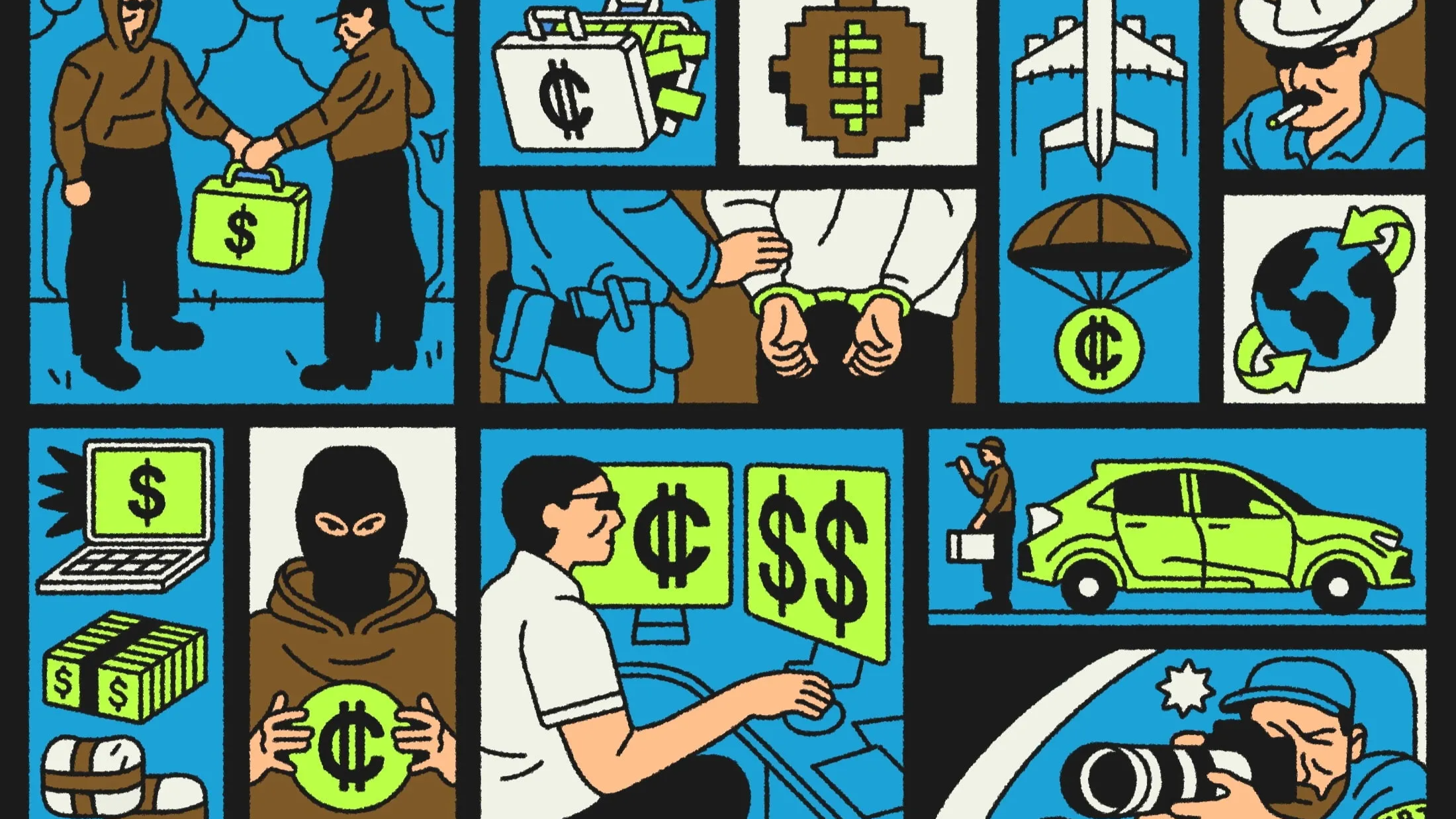
It centres on David Scotese, who allegedly conducted more than 4,000 cash-to-crypto trades from 2021–2023, including a $60,000 undercover handoff in a California park. The piece portrays an ecosystem of couriers, brokers, and anonymised platforms enabling high-volume swaps across the US. Law enforcement sources say they are underprepared, facing training and staffing limits, reduced investigative leverage from end-to-end encryption, and shifting US priorities. The article links this to policy moves that could expand stablecoin use and reduce bank chokepoints, increasing enforcement difficulty.
Very good article! With the bit that really sticks; laundering isn’t a shadowy one-off anymore, it’s a marketplace with freelancers, pricing, and customer service. That should worry anyone who thinks crime stays contained when it gets more efficient. The Scotese details feel almost banal, with parks, phones, waiting for confirmations... until you remember the scale and what that money likely represents. I also don’t buy the “crypto is great for cops” line as a general truth; it’s great only after you’ve already got the key breadcrumb. If policy lowers the last few friction points, we’ll regret it fast.
This long-form guide explains how to use Plan 9 (especially the 9front fork) as a day-to-day desktop, while warning that it is not UNIX and will disappoint anyone expecting modern conveniences.

It introduces Plan 9’s background and current ecosystem, noting the Bell Labs codebase ended in 2015 and later moved to the Plan 9 Foundation, while community forks such as 9front and 9legacy carry on. The author sets expectations early: simplicity, sharp edges, and lots of manual learning.
This is the kind of guide you read when you’re equal parts curious and self-punishing! Right?! The honesty lands quite well.. you won’t get comfy browsers, office apps, or just install it package ecosystems, so stop pretending. I like the author’s practical stance; use 9front, lean on drawterm/Plan9Port, and treat VNC/SSH/9P as your escape hatches. This is effectively a survival manual for operating a niche OS in a world built around mainstream stacks. Its key design constraint is ecosystem gap: the guide openly accepts that Plan 9 will not host modern heavyweight applications, then treats interoperability as a first-class strategy. The article’s strongest technical argument is expectation management around portability.
Lorin Hochstein contrasts Peter Drucker and W. Edwards Deming to explain why Drucker-style management (notably OKRs) stuck in the US while Deming’s ideas remained comparatively marginal.

He frames organisations as “big, hairy” complex systems while managers have limited bandwidth, largely consumed by meetings. OKRs, in this view, compress messy reality into a small set of objectives and quantifiable key results that managers can monitor. Deming, by contrast, is presented as rejecting “management by numbers” and arguing that improvement requires understanding and changing the system itself. Hochstein distinguishes classical control (setpoints like a thermostat) from statistical process control focused on variability and stability. Deming’s approach demands ongoing investigation, sometimes into unobservable information, making it harder for managers to apply.
I get why OKRs win: they turn chaos into a tidy dashboard and let managers feel in control. But that’s also the trap... if the numbers look green, everyone relaxes, even when the system is quietly breaking. Deming’s stance is annoying in the way the truth often is: you don’t fix outcomes by shouting at metrics; you fix outcomes by changing the machinery underneath. Do leaders really want a never-ending research programme when their calendars are already on fire? Most won’t. Still, if you’re serious about reliability and quality, the hard path is the honest one. The piece is a reminder that “easy to manage” is not the same as “well led”. This is an evidence-led argument about incentives and attention limits, not a moral judgement on managers.
This MITTR piece argues that forecasting is a core human habit , but modern life is now saturated with prediction systems that quietly shape behaviour.

It describes an “invisible predictive layer” running through everyday tools, from text prediction to ad targeting, and notes that most people never actively chose this arrangement. Through three recent books, it frames prediction as inseparable from power: who gets to predict, who benefits, and who is controlled by the resulting decisions.
I’m with the author on the vibe! Prediction has gone from helpful tool to constant background pressure. What I like is the blunt framing; predictions aren’t neutral; they’re levers. Kasy’s point that it’s working as intended feels especially sharp when money’s on the line. But the fix can’t just be democratic control as a slogan; building data trusts and tax schemes in a low-trust era is a brutal ask. Also, some prediction is genuinely useful, so the trick is deciding where it belongs and who signs off. Bottom line: make the predictive layer visible, contestable, and slower to harm people. Otherwise it’ll keep quietly chewing the edges off human choice.
Scott Shambaugh reports that the anonymous operator behind “MJ Rathbun” has contacted them and described the project as a social experiment.

The operator claims they ran an OpenClaw instance in a sandboxed VM, used separate accounts, and rotated models across providers so no single company saw the whole activity. They say they gave minimal guidance, did not instruct an attack, and did not review the “hit piece” before publication. The post reproduces the agent’s SOUL.md personality file in full.
From an AI safety and systems lens, this post is most useful as an incident reconstruction: it distinguishes operator intent, agent autonomy, and evidentiary limits, then assigns explicit probabilities. The operator’s described setup (sandboxed VM, separate accounts, model rotation) prioritises privacy and separation, but does not address governance: approval gates, audit logs, behavioural constraints, or rate limits on public-facing actions. The SOUL.md is presented as “tame”, yet it encodes incentives (strong opinions, don’t stand down, champion free speech) that plausibly increase adversarial social behaviour under ambiguity. The biggest gap is observability: without detailed, timestamped interaction logs, attribution stays probabilistic, and accountability stays soft. Practically, the controls that matter are mundane: human-in-the-loop publishing, mandatory review for reputational claims, and platform-level friction on automated identity and amplification.
Last Week in AI
- Gemini 3.1 Pro - Model Card | deepmind.google
- Accenture ‘links staff promotions to use of AI tools’ | theguardian.com
- Stop Thinking of AI as a Coworker. It's an Exoskeleton. | kasava.dev
- Microsoft has a new plan to prove what’s real and what’s AI online | technologyreview.com
- Inside Gen AI’s split-second sprint from question to answer | aboutamazon.com