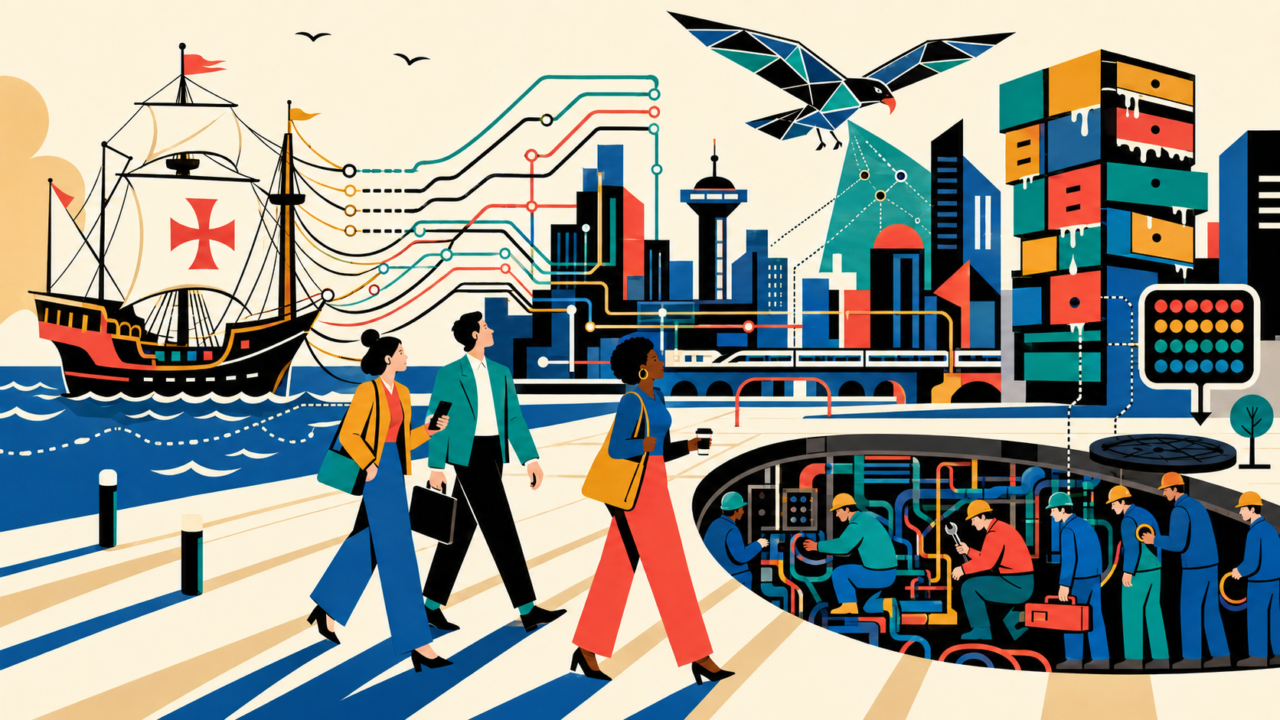
Another eclectic week, with a lot to discuss and read; like somewhere between Vasco da Gama, Win16 memory segments and Claude Mythos, humanity’s greatest talent is building a clever network and then acting surprised when it needs governance… So, this week we have Anthropic’s Project Glasswing pointing to real defensive leverage, but critical infrastructure turns model capability into governance debt fast; detection is glamorous, remediation is where optimism queues. The MIT Technology Review usefully punctures the AI jobs apocalypse by asking for labour-market proof, though lagging data can miss the quieter squeeze on junior roles and contractors. OS/2 Museum’s Win16 archaeology shows that clever abstractions always leak eventually, and developers inherit the ritual as “the API”. Alvaro Videla’s LLM arithmetic piece does the rare honest thing: it lowers the claim, separating readable internal structure from a dependable calculator. Finally, Crowley’s Vasco da Gama essay widens the frame: networks change the world, but they rarely arrive innocent.
In this issue
5 piecesAlvaro Videla explains Rune’s investigation into what happens inside an LLM when it performs arithmetic using only tokens, activations, matrices, and logits
The article’s central claim is that the strongest supported result was not behaviour-preserving arithmetic inside the residual stream, but activation-derived tool arguments: internal readouts could recover operation and operand structure, then route calculation externally under a no-parser rule. This matters because it separates several claims often blurred in AI discussions: rendering an answer, reading a variable from activations, causally changing behaviour, and safely writing corrected state back into a model. Alvaro reports strong scoped results across arithmetic benchmarks, including 11,736 locked examples and 0 fires on a constructed hard-negative suite, while stressing that the final route was Llama-specific and did not transfer as-is to Qwen.
I've meet Alvaro more than a decade ago, when I was living in Zurich and he's really great. Also, we did an extensive chat with him for the Tech Talks London, 5 years ago. He could've sold a grand story about models secretly doing maths in vector cathedrals, but instead, it lands on something narrower and more useful: activations can supply calculator arguments under a no-parser boundary. Less magic. More engineering. Beautiful! decoded variable isn’t an API, and Alvaro gets right that interpretability claims need a ladder: readable, causal, writable, deployable. Those rungs are too often mashed together in the usual “we found a neuron for X” theatre. Here, the failed residual-JIT dream is not brushed away; it becomes the point. Llama behaves like Llama. Qwen’s failed transfer is the cold shower. If internal geometry doesn’t line up across models, then this isn’t a portable abstraction yet; it’s model surgery with a good lab notebook. Useful, but not casual. The architecture lesson is punchy: transformers may encode number-like structure without owning a stable calculator inside. That’s weird and valuable. It’s not sorcery. As always, excellent claim discipline, promising mechanism, no free lunch.
OS/2 Museum’s Michal Necasek explains how 16-bit Windows memory management worked

The article argues that early Windows functioned partly as a sophisticated overlay manager, keeping active memory segments in RAM while moving, discarding, and reloading others as needed. Its evidence comes from Windows segment handling, the New Executable format, GlobalAlloc, GlobalLock, GlobalUnlock, compiler switches, and loader-patched function prologs. The article’s wider implication is that much Win16 complexity came from emulating protected-mode ideas on hardware without enough native support. Necasek compares Windows with 16-bit OS/2, where 80286 protected mode reduced the need for explicit locking, special exported window procedures, and stack-walking tricks. For software engineers, the piece is a reminder that platform APIs often preserve old hardware compromises long after the hardware context has faded.
Windows keeps repeating this pattern: hide an ugly constraint, expose just enough abstraction, then make developers live with the leak for years. Michael's article is valuable because it doesn’t treat Win16 memory management as quaint trivia. It shows the machinery. Gears, springs, suspicious smoke. The strangest detail is the function prolog that appears to waste instructions until the Windows loader quietly patches it into something essential. That’s marvellous and slightly cursed. The code is harmless until it isn’t, and the operating system depends on a choreography between compiler switches, NE exports, stack frames, segment handles, and programmer obedience. Elegant? In places. Forgiving? Absolutely not! The underplayed point is organisational, not technical. A platform that needs secret-ish compiler switches, exported window procedures, lock counts, and stress tools like Shaker is also creating an ecosystem tax. Every compiler vendor, library author, and application developer has to internalise the ritual. OS/2 looks cleaner in comparison because the 286 hardware carried more of the burden. Yet Windows carried the market...
David Rotman argues that the panic over AI destroying white-collar jobs is not yet supported by labour-market data.

The visible preview says there is scant evidence that AI has had a large-scale impact on the US labour market. It cites analysis of US Bureau of Labor Statistics data showing unemployment is lower in occupations most exposed to AI than in less-exposed occupations. The article’s implication is not that AI will have no effect, but that current public debate has outrun the evidence. Rotman stresses that economists look for worker movement from threatened jobs into safer ones, such as manual labour, and says the data does not yet show that shift. For leaders, the piece warns against mistaking layoffs, weak hiring, or anxious headlines for proven AI-driven displacement.
David gets the first-order argument right: the data doesn’t yet match the panic. The AI jobs debate has become a fog machine for everyone’s favourite theory, whilst founders see inevitability, executives see margin expansion and pundits see the end of work before lunch. The counterintuitive claim is the one worth pinning to the wall: US occupations most exposed to AI apparently have lower unemployment than less-exposed ones. That doesn’t prove safety, but it punctures the lazier version of the apocalypse story. If AI were already chewing through white-collar work at scale, we’d expect some clearer labour-market signal. The article underplays the messier middle; labour markets are lagging instruments. A graduate who never gets an entry-level analyst job won’t show up as a displaced analyst. A contractor whose copywriting work quietly dries up may not look like a knowledge-worker exodus. A software team that hires three juniors instead of ten is a real shift, even if nobody gets fired. Markets love narratives, and “AI did it” is becoming a convenient one. It flatters boards, excuses restructuring, and gives investors a story cleaner than over-hiring or weak demand. The danger isn’t just hysteria. It’s bad diagnosis. If leaders believe AI has already solved the labour problem, they’ll cut before they redesign work. If policymakers dismiss all concern as panic, they’ll miss the quieter transition.
Anthropic has expanded Project Glasswing, giving more organisations access to Claude Mythos Preview for defensive cybersecurity work

The New Stack says the programme now includes 150 partners across 15 countries. Its central claim is that controlled access to Anthropic’s AI model can help detect critical software vulnerabilities at scale, especially where a successful attack on codebases could be catastrophic. This is a scaling-up of AI-assisted software security rather than a general release of Claude Mythos Preview. Its sector relevance is clear: Anthropic is positioning the model as a tool for selected partners to find serious vulnerabilities before attackers do. For engineering and security leaders, the article points to a shift from manual vulnerability discovery towards AI-supported detection across larger software estates.
The most revealing detail is not Claude Mythos Preview itself; it’s where it’s going. 150 partners across 15 countries already looked less like a cautious lab pilot and more like a distribution strategy with a safety label on the box. Yet, our Hitachi announcement gives that strategy sharper consequences: this is now being pointed at software and products for social infrastructure, including energy. This is important because critical infrastructure is where AI-assisted vulnerability discovery stops being a model demo and starts becoming an operational risk question. Security teams need leverage. Modern codebases are too large, too old and too interconnected for heroic manual review to carry the load alone. If a model can help defenders find critical vulnerabilities before attackers do, sitting on that capability forever would be hard to justify. But some of the hard questions remain mostly unanswered. Who gets access? Who audits the results? What classes of vulnerability can Claude Mythos Preview reliably find? What is the false-positive rate? What happens when it finds more serious issues than teams can responsibly triage and patch? Detection is the glamorous bit. Remediation is where optimism goes to queu
Roger Crowley argues that Portugal, more than Columbus’s Spain, pioneered the early modern globalisation that linked oceans, markets, cultures and empires
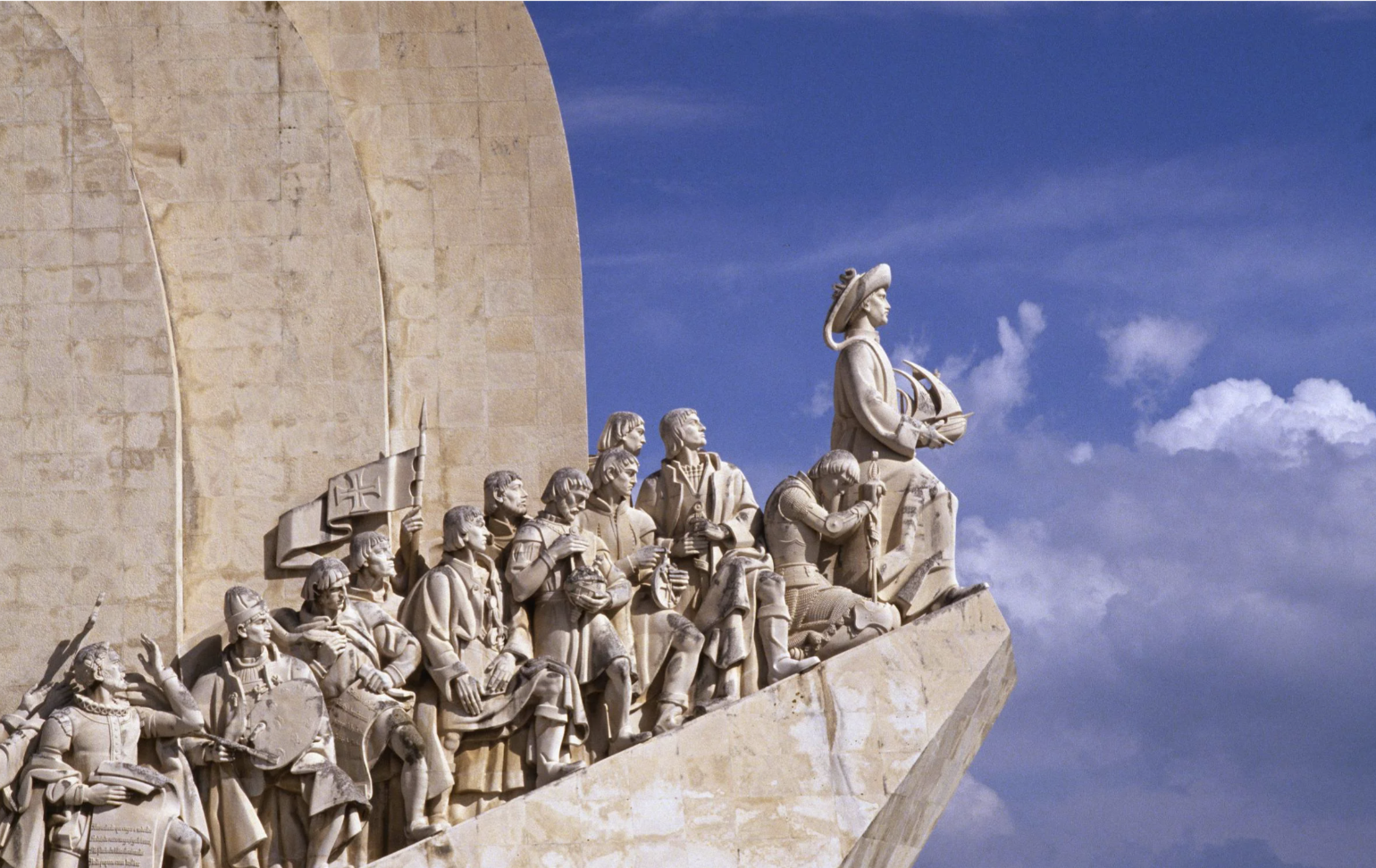
He presents Vasco da Gama’s 1497–99 voyage to India as the culmination of decades of Portuguese Atlantic experimentation, driven by geography, poverty, religious ambition, gold-seeking, maritime skill and a desire to bypass Islamic-controlled Mediterranean trade routes. Roger’s wider argument is that Portugal’s commercial dominance lasted little more than a century, yet reshaped the world through maritime linkages, commodity exchange, crop transfers, technology movement, cultural hybridisation, slavery and disease. The essay frames Portuguese expansion as both connective and destructive: a creator of global trade networks, and an exporter of violence, coercion, exploitation and irreversible disruption.
The 10th of June is the day of Portugal and Portuguese spoken countries, so this article comes in handy :) If you think about it, Portugal’s advantage was not size; it was position, desperation and a working theory of chokepoints. A small, poor kingdom with a long Atlantic edge learned how to turn geography into leverage, then converted leverage into monopoly ambition. Sure, the East didn’t need discovering. Europe needed an exit. That punctures the old heroic map-room version of the story and replaces it with something sharper: globalisation began, in part, as a workaround for European confinement. Roger gets right that the Portuguese model was networked rather than territorial. Forts, bases, sea lanes, trading cycles, intelligence, artillery, chokepoints. Not empire as a coloured blob on a school atlas, but empire as infrastructure. That’s the useful lens for readers who think about platforms, logistics or supply chains today. Control the nodes and you can shape the market without owning the whole map. The article does not ignore slavery, violence or disease; the darker ledger is clearly there. But the prose still gives the system a certain kinetic glamour. Crops move, bullion flows, images circulate, cultures hybridise. Then comes Elmina. Then half die in transit. Vasco da Gama didn’t build a benign world of exchange. He helped open a world where trade, coercion and information moved together.
My Week in AI
- When AI builds itself | anthropic.com
- Dreaming: Better memory for a more helpful ChatGPT | openai.com
- NVIDIA/cosmos: NVIDIA Cosmos is an open platform of world | github.com
- Nous Research ships Hermes Desktop, a native agent app for all platforms | github.com
- A guide to /goal | x.com
- Replit shows how vibe coding is getting its own financial stack - and a path to profit | thenewstack.io