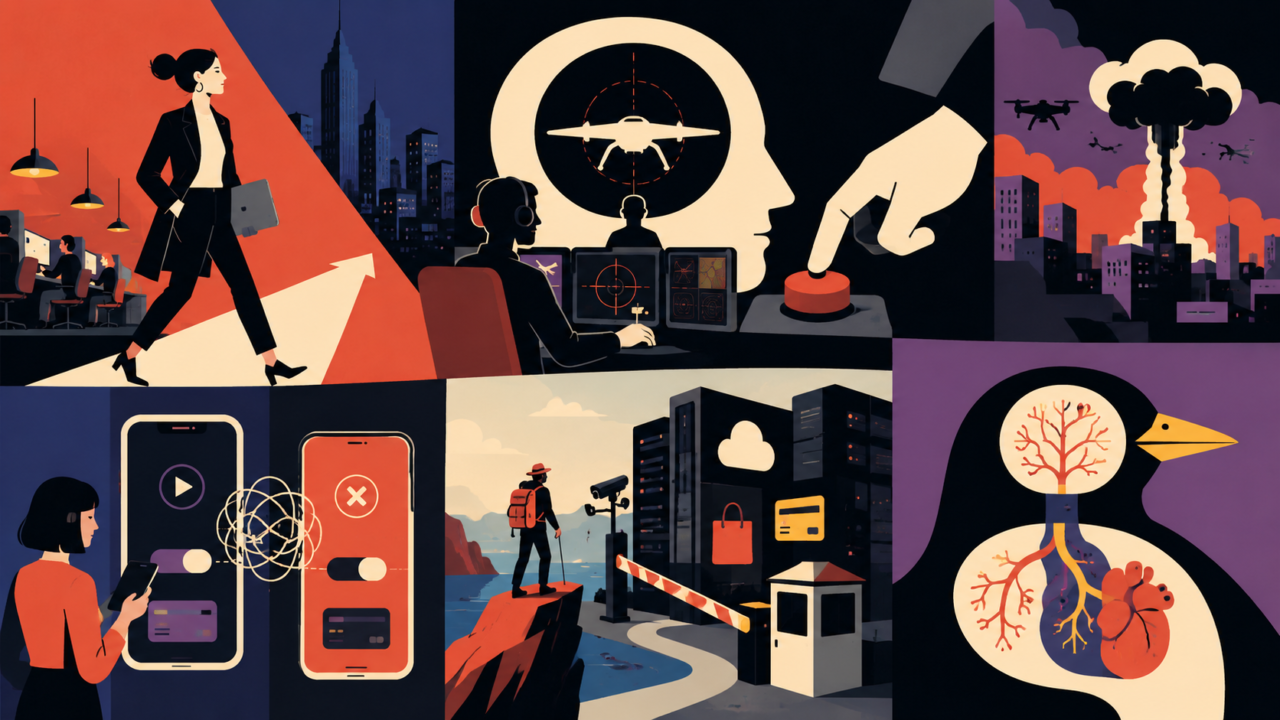
This week’s #RBM feels like watching modern systems quietly betray their own marketing! Elena Verna says the real status move now is abandoning management to become an AI-augmented IC shipping actual work; MIT Technology Review argues “human in the loop” warfare may reduce humans to liability-shaped approval buttons; a debugging story about a self-cancelling streaming subscription showed how two perfectly functional platforms can combine into total nonsense; and John Perry Barlow’s old cyberspace frontier dream reads differently now that the frontier is owned by clouds, payment rails and app stores. Even Quanta’s bird-eye piece fit the pattern: evolution removed retinal blood vessels for cleaner vision, then built an absurd metabolic workaround to compensate.
In this issue
5 piecesSenior career status is shifting from managing people to becoming a high-impact individual contributor

Elena Verna defines a HI-C as an IC, often an ex-leader, who can deliver business value end-to-end without direct reports. Verna uses her own move at Lovable from building a growth team to operating inside Product as an IC to illustrate the claim. She says AI enables this shift by making people “average” across adjacent skills, allowing one person to prototype, test and ship faster. The issue will be organisational: fewer coordination layers, less dependence on middle management, and compensation flowing towards people directly creating measurable impact. She argues this works best where information is ungated and trust is high.
This new career flex is demotion without the demotion: leave the VP ladder, keep the leverage, and do the work yourself. Verna gets something important right; a lot of management inflation has been status theatre with OKRs, decks and meetings standing in for actual customer-visible progress. AI does change the economics of prototyping. A capable growth operator can now draft, analyse, code, test and iterate far beyond their old functional lane. But the article slightly over-romanticises the solo operator / mercenary: “One person can do a team’s work” sounds glorious until that person owns the hidden mess too: incident response, maintainability, compliance, stakeholder fallout, customer confusion, and the joyless archaeology of their own clever shortcuts six months later. The real sting is aimed at middle management...Fair.... Some layers exist to reduce risk; plenty exist to preserve themselves. The practical test is going to be simple: can the organisation reward senior ICs without turning them into unofficial managers with worse titles? If yes, HI-C becomes a serious career path. If no, it’s just a shiny new way to overwork the useful people.
How a bundled streaming subscription repeatedly cancelled itself about five minutes after activation

The article reconstructs the incident from the user side: a credit card perk, an expired card, two support teams each seeing “no issues”, and a repeatable activation-then-cancellation pattern. The central theory is a sync-versus-async race condition between unlinking and relinking accounts across company boundaries. These invisible systems usually work only because many fragile workflows are kept aligned. The article is less a complaint than a debugging story about distributed ownership, support blind spots and delayed side effects. It is especially relevant to product, payments, identity and subscription systems where customer-visible state depends on asynchronous coordination between vendors.
The real-world consequence this piece underplays is support debt. The bug is annoying, but the scarier part is that both companies’ systems could be internally “right” while the customer experience was plainly broken. That’s the distinctive claim hiding in the story: correctness inside each boundary can still produce nonsense at the boundary between them. Gruevski gets the engineering bit right because the theory fits the observed timing. Activation looked synchronous. Cancellation looked delayed. The five-minute gap was not random noise; it was the system waving a tiny flag while everyone on the phone read from the wrong script. Nice debugging. Mildly cursed. “Systems are hard” is true. It’s also the sentence every platform says before handing you a case number and a migraine. Cross-company workflows need explicit reconciliation, idempotency, event ordering guarantees and support tools that show the whole transaction path. Otherwise, the user becomes the distributed trace. Charming story, useful lesson, and a reminder that “invisible infrastructure” is only invisible until it starts cancelling your Friday night.
America has moved from a physical economy of land, machinery and tangible goods into an information economy where value is created from thought, symbols and networks.

John Perry Barlow, writing from his own transition from Wyoming cattle rancher to early cyberspace advocate, he frames the Internet as a new kind of place, with community, property ambiguity, frontier mythology and political consequences - it's the cultural and institutional as much as technical. Barlow sees cyberspace as potentially richer, more expandable and less bounded by nation states than the physical frontier, but also vulnerable to privacy collapse, misunderstanding, conflict and homogenisation. He presents EFF’s role as defending openness, access, privacy and decentralised architecture before governments and corporations can impose old-world control.
This gets one big thing right: cyberspace wasn’t just a tool, it was an environment. Barlow saw that before most people had even found the plug. His most distinctive claim is still the sharpest one: legal rights alone wouldn’t protect digital freedom, because architecture itself would decide what power could do. That’s annoyingly prescient. The Internet-as-frontier metaphor explains the energy of the early network, but it smuggles in the old American fantasy that open territory stays open if only the right kind of restless people get there first. The strongest technical idea is that topology beats rhetoric. A network with few chokepoints is harder to suppress; a network routed through platforms, app stores, clouds and identity brokers is easier to govern, throttle or monetise. The old world didn’t conquer cyberspace by marching in with flags. It arrived as terms of service, hosting dependency, payment rails and convenience.
MIT Technology Review says that “humans in the loop” may be a comforting fiction in AI-enabled warfare

The article’s central claim is that the danger is not simply machines acting without human permission, but humans approving decisions they cannot meaningfully understand. It links this concern to a legal clash between Anthropic and the Pentagon and to AI’s expanding battlefield role. Overnighting frameworks based on human approval may be inadequate when AI systems generate targets, coordinate interceptions or guide autonomous drones at machine speed. Uri Maoz suggests the real accountability gap lies in opacity: operators may see outputs and probabilities, but not the reasoning behind them. That makes interpretability, auditing and interdisciplinary AI intentions research central to any credible military AI governance.
Right, “human in the loop” sounds like control, but it may just be ritualised permission. A person clicks approve, the institution declares accountability, and everyone politely ignores the fact that the person may not understand why the system made the recommendation. The core problem right; oversight without comprehension is theatre. Worse, it is liability theatre with uniforms. If a model recommends a strike with confident-looking numbers, the human operator can become less a decision-maker than a laundering mechanism for machine judgement. The deeper issue is architecture. Once command systems are designed around fast algorithmic recommendations, the human role bends around the machine. Interfaces become policy. Latency becomes doctrine. The official line may still say “meaningful human control”, but the workflow will quietly define what meaningful means. Usually, it means fast enough not to lose.
Quanta Magazine on new research explaining how bird retinas function without the dense blood vessels most vertebrates use to supply oxygen

Christian Damsgaard’s team found that the inner bird retina survives in chronic anoxia, using anaerobic glycolysis instead of oxygen-powered metabolism. The pecten oculi, long mysterious, appears to pump glucose in and remove lactic acid rather than deliver oxygen. The implications reach beyond bird vision; the article frames avian eyes as an evolutionary extreme: a metabolically hungry tissue trading oxygen efficiency for unobstructed visual resolution. It also suggests possible biomedical relevance, because understanding tissues that tolerate oxygen deprivation could inform thinking about strokes and other conditions where oxygen delivery collapses. The evolutionary story remains partly speculative, especially around why this system first emerged.
I missed all these assorted articles of miscellaneous things that I find... So, the pattern here is evolution doing what it always does: solving one problem by creating three stranger ones. Bird eyes apparently ditched retinal blood vessels, gained cleaner visual input, then powered half the retina with a metabolic workaround that looks wildly inefficient on paper - what a twist, eh?! The tissue doesn’t have a secret oxygen trick. It just lives without oxygen. Saplakoglu gets the wonder right without overselling the certainty. The experiments are satisfyingly direct: microsensors, gene activity, nutrient tracing, then the old pecten oculi mystery gets a new job description. Nice. A structure that looked like a radiator may instead be more like a glucose pump and waste-management unit. Birds get high-resolution sight partly by removing visual obstructions, but the cost is a retina dependent on heavy glucose throughput and lactic-acid clearance. In engineering terms, they moved the bottleneck. Nature does that too. Very impolite.
This Week In AI
- 2028: Two scenarios for global AI leadership | anthropic.com
- Microsoft expands Copilot in Edge with new AI tools | testingcatalog.com
- Microsoft is quietly shopping for an OpenAI replacement | thenextweb.com
- How Claude Code works in large codebases: Best practices and where to start | claude.com
- Work with Codex from anywhere | openai.com
- google/skills: Agent Skills for Google products and technologies | github.com