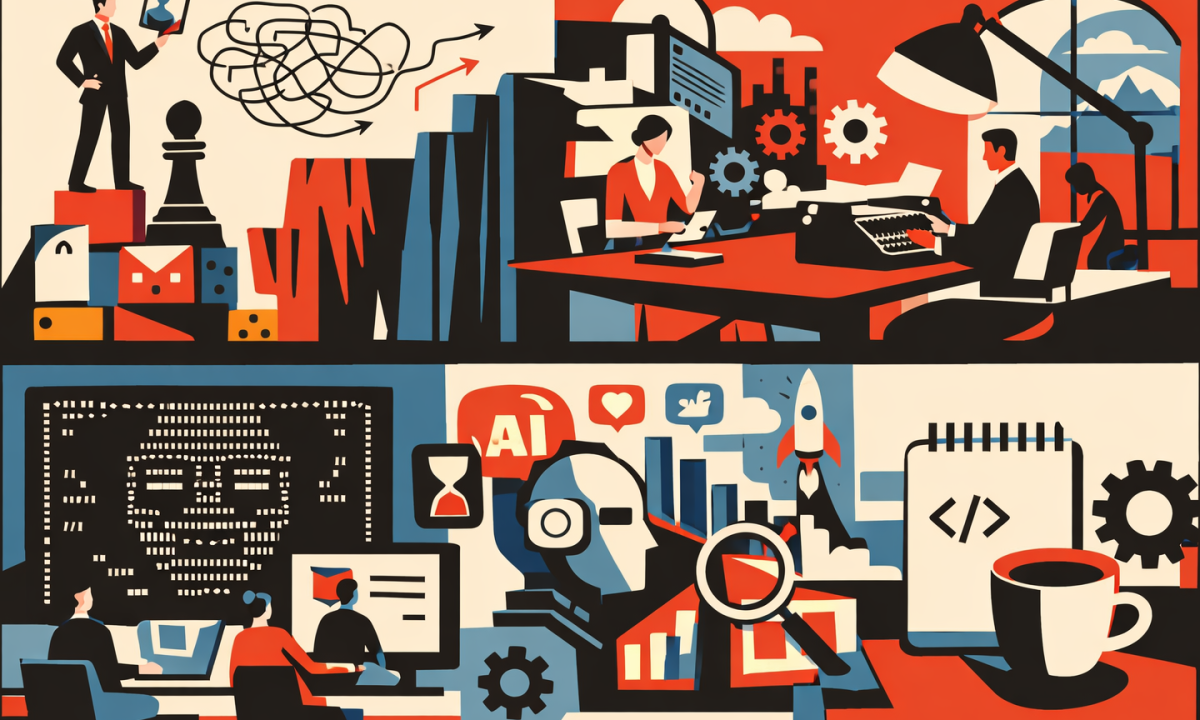
The longest month of the year is halfway through! 🙂 So lets start with… Scott Adams’ story! Which is a messy case study in being world-class at one thing, then spending years trying to outsmart reality into granting you mastery everywhere else, with persuasion-as-identity ending badly when the incentives turn. Then, Olivetti is the gorgeous corporate version of both craft, community, and ambition… right up until market arithmetic and debt start rewriting the values. On the nerdier end, the ASCII rendering post is a perfect example of doing the job properly by respecting the real primitives (glyph shape, not “pixels”), even if it means admitting the cost in complexity. There’s also the Reuters Institute report, meanwhile, is the least comforting: search and social shrinking, AI “answer engines” and creators taking discovery, and publishers scrambling towards distinctiveness, video, and human voice, it’s sensible, but not soothing. And finally, we have Markdown, quietly winning for decades by being legible, diffable, and “good enough”, is the punchline: boring, open, low-friction tools compound, and they end up steering surprisingly high-stakes systems.
In this issue
5 piecesScott Alexander sketches Scott Adams’ life as an extended Dilbert arc : a gifted comic artist convinced he should also win at business, philosophy, and influence.

The essay tracks Adams’ attempts to “hack” success via ventures like the Dilberito (a vitamin-fortified burrito), a local restaurant (Stacey’s), and ambitious side projects, alongside a turn to spiritual speculation in God’s Debris. Alexander portrays recurring self-awareness, but also escalating self-deception and craving for status beyond cartooning. The piece ties Adams’ trajectory to shifting cultural incentives: workplace cynicism giving way to startup hustle, and politics becoming a reputational “separating equilibrium” that pushes public figures into tribes. Adams’ persuasion framework is treated as both occasionally insightful and often corrosive, culminating in Trump-era notoriety, cancellation after racial remarks, and a final message emphasising usefulness, community, and legacy.
I can’t decide whether this is an obituary, a case study, or a warning label you stick on your own forehead. What lands is the pattern: being brilliant at one thing, then spending decades trying to “out-clever” reality into letting you be brilliant at everything. The persuasion stuff has the same vibe; sometimes sharp, often self-soothing, and occasionally outright self-sabotage. Still, the ending hits: the community was real, the “be useful” impulse wasn’t nothing, and the affection feels earned even while the politics don’t. It’s messy, human, and uncomfortably recognisable. Yes, the piece also highlights a late-stage risk: treating identity and ideology as proof of clever independence can end in credulity, including high-stakes health choices. Good read!
Bradford White traces Olivetti from Camillo Olivetti’s early electrical-engineering career into a vertically integrated typewriter maker founded in 1908 at Ivrea.

The article emphasises craft and industrial discipline: Camillo studies US production methods, builds the M1, and grows employment from 20 workers (1911) to 110 (1913). It also highlights unusually generous labour policies, including profit sharing, welfare services, and long paid maternity leave. The narrative then follows Olivetti’s repeated reinventions: successful interwar machines, postwar social vision under Adriano, and later pivots into calculators and computing. It spotlights the Programma 101’s 1965 debut and strong sales, then Carlo De Benedetti’s late-1970s restructuring, layoffs, and shift to microcomputers. Partnerships and acquisitions (including AT&T and Acorn) briefly lift European PC leadership, before intense pricing competition, debt, and 1990s losses culminate in a 2003 merger into Telecom Italia.
Olivetti’s early success combines product quality, disciplined production, and an unusually high-investment labour model that likely improved retention and skills, but also raised fixed costs. The later story is a textbook pivot problem: each transition (typewriters to calculators, calculators to microcomputers, microcomputers to commodity PCs, then telecoms) required new ecosystems, distribution, and pricing power. The Programma 101 stands out as a rare moment where a distinctive product created real leverage, contributing materially to revenue in the late 1960s. De Benedetti’s restructuring and layoffs underline a hard constraint: when debt and global competition tighten, social commitments become negotiable. But, I’m a sucker for companies that try to make engineering humane and objects beautiful at the same time. Olivetti, as told here, is basically that dream - and then the bill arrives. The early vertical-integration obsession feels oddly modern, and the welfare set-up reads like a town-sized employee benefits experiment.
Alex Harri explains why many image-to-ASCII renderers look blurry: they treat each character cell like a pixel and ignore glyph shape.

He walks through the standard pipeline of splitting an image into a monospace grid, converting RGB to lightness, and mapping that lightness to a density-sorted character set. He then shows how nearest-neighbour sampling produces jagged edges, and how supersampling reduces jaggies but still yields soft contours when the low-resolution result is scaled.
This is the sort of post that makes you realise you’ve been “doing the obvious thing” and calling it a day. Treating glyphs as pixels is convenient, but it’s basically throwing away the one superpower ASCII art has: the letters have shape. I like how he turns that into something measurable, then owns the ugly bit: performance. The contrast-enhancement trick is also a nice reminder that perception matters as much as sampling theory. Would I ship the full GPU pipeline for a weekend toy? Probably not. But as a blueprint for doing it properly, it’s genuinely satisfying. Crisp beats clever. Overall, this reads as a careful design that balances fidelity, compute cost, and implementation complexity.
This Reuters Institute report argues news media enter 2026 squeezed by two forces: Generative AI “answer engines” that distil information at scale, and human creators/influencers pulling attention towards personality-led news.
It says declining engagement and low trust encourage politicians and other elites to bypass publishers, using friendly podcasts and YouTube, alongside legal threats and “fake news” narratives. Against this, publishers plan to re-engineer for AI with more distinctive content and more human presentation. Findings draw on a survey of 280 digital leaders across 51 countries and territories. Only 38% feel confident about journalism’s prospects, while 53% feel confident about their own businesses. Executives expect search traffic to fall sharply (around -43% in three years) and further declines from social referrals. Strategies prioritise original reporting, analysis, human stories, and video, while scaling back service and evergreen content seen as vulnerable to chatbots.
This RI report describes the new redistribution of power in attention and distribution: platforms, creators, and AI interfaces increasingly control discovery, while publishers carry high fixed costs and growing political risk. This signals an industry that sees its own survival path (53% confident in their businesses) even as it doubts the wider sector’s trajectory (38% confident in journalism). The expected -43% search decline functions like a negative demand shock to ad-supported models, pushing rational responses: shift toward differentiated, hard-to-replicate output (original reporting, analysis, verification) and toward formats with stronger “unit integrity” (video/audio) that are harder to atomise. Yet, the creator pivot is presented as defensive adaptation, but it introduces governance costs and potential talent leakage. Overall the AI bits feel sober: lots of experimentation, not many headcount wins, and plenty of ways to accidentally ship nonsense faster. Net-net, it’s a sensible playbook, just not a comforting one.
Anil Dash explains how Markdown, created by John Gruber for blogging, became a default plain-text format across modern computing.

He situates its birth in early-2000s blogging, when writing posts often meant wrestling with fragile HTML inside tools like Movable Type. Gruber’s bet on Apple and Daring Fireball, plus rapid community uptake, helped Markdown spread. Dash highlights Aaron Swartz as a teenage beta tester, and argues Markdown’s simplicity made it easy to learn, share, and implement.
I enjoyed this because it’s basically a love letter to boring, useful things - and I mean that as praise. Markdown won by being good enough, legible, and easy to copy, which is how half the internet actually works. Markdown succeeds by lowering authoring error rates versus raw HTML while preserving a plain-text source that is readable, diffable, and cheap to implement. The “build tool era” point is particularly technical: Markdown’s role as an intermediate artefact fits pipelines that compile source into deployable outputs. The AI linkage is provocative rather than rigorously evidenced, but it highlights a real interface truth: many complex systems are steered through plain-text prompts and templates. Overall, the article argues that open, legible, low-friction formats compound over decades in predictable ways - and I agree!
Last Week in AI
- What's next for AI in 2026 | technologyreview.com
- AI coding is now everywhere. But not everyone is convinced. | technologyreview.com
- Building an agentic memory system for GitHub Copilot | github.blog
- TranslateGemma: A new family of open translation models | blog.google
- ChatGPT Translate is here to take on Google Translate | androidauthority.com
- Sparrow-1: Human-Level Conversational Timing in Real-Time Voice | tavus.io