
Edition #90 of the #RBM – wow! Anyway.. this week’s choice is very eclectic! We start with wealth that looks fat on paper but rests on thinning surplus energy; Morgan’s reminder that money is a claim, not the cake. Then swing to cities: Hughes shows how political economy, not planning poetry, locked-in low density and throttled growth. Zoom out to chips and the moat wars: SemiAnalysis has Google turning TPUs into a merchant system, pressuring CUDA’s rent with power-and-supply caveats. Meanwhile, “technical deflation” makes shipping cheaper tomorrow than today, which is great for fast followers, deadly for dithering… so architect for portability and sell like you mean it. And for anyone optimising kernels, that GPU primer nails the playbook: rooflines, fuse-or-tile, coalesced loads – mechanics that turn big talk into throughput. Scarcity, incentives, execution; same trilogy, five stories for you before Monday.
In this issue
5 piecesTim Morgan argues that financial wealth has detached from the material economy and will likely climax just as the monetary system breaks

. Using his SEEDS framework, he says material prosperity depends on surplus energy, not money, and measures this via the Energy Cost of Energy (ECoE), rising from 2.0% in 1980 to 11.3% today. He contends most wealth is “notional” because aggregates cannot be monetised at scale, citing the UK’s £12.2 trillion net worth and global markets at 160% of GDP. He links decades of asset inflation to policy support and moral hazard, from the 1987 crash through explicit post-2008 backstops. Renewables and technology, he says, cannot reverse rising ECoEs driven by fossil depletion.
His essay is a disciplined provocation about valuation regimes and policy-engineered asset inflation. Its core insight; that markets have been subsidised by implicit and explicit backstops while the material base tightens, deserves attention! If these trends and essential-cost inflation persist, the marginal utility of liquidity injections falls, and the “wealth effect” becomes less transmissible to real demand. So, like the clarity: money is a claim; prosperity comes from surplus energy. The narrative that we’ll “die rich” on paper while essentials bite feels uncomfortably plausible. I’d treat this as a stress-test, not gospel: model higher ECoE, pricier essentials, thinner liquidity, and weaker multipliers. Hedge exposure to notional mark-ups, prioritise cash-flow resilience. Hard truths, but useful ones, if you separate signal from sermon...
Samuel Hughes argues that Western cities once permitted far more building everywhere
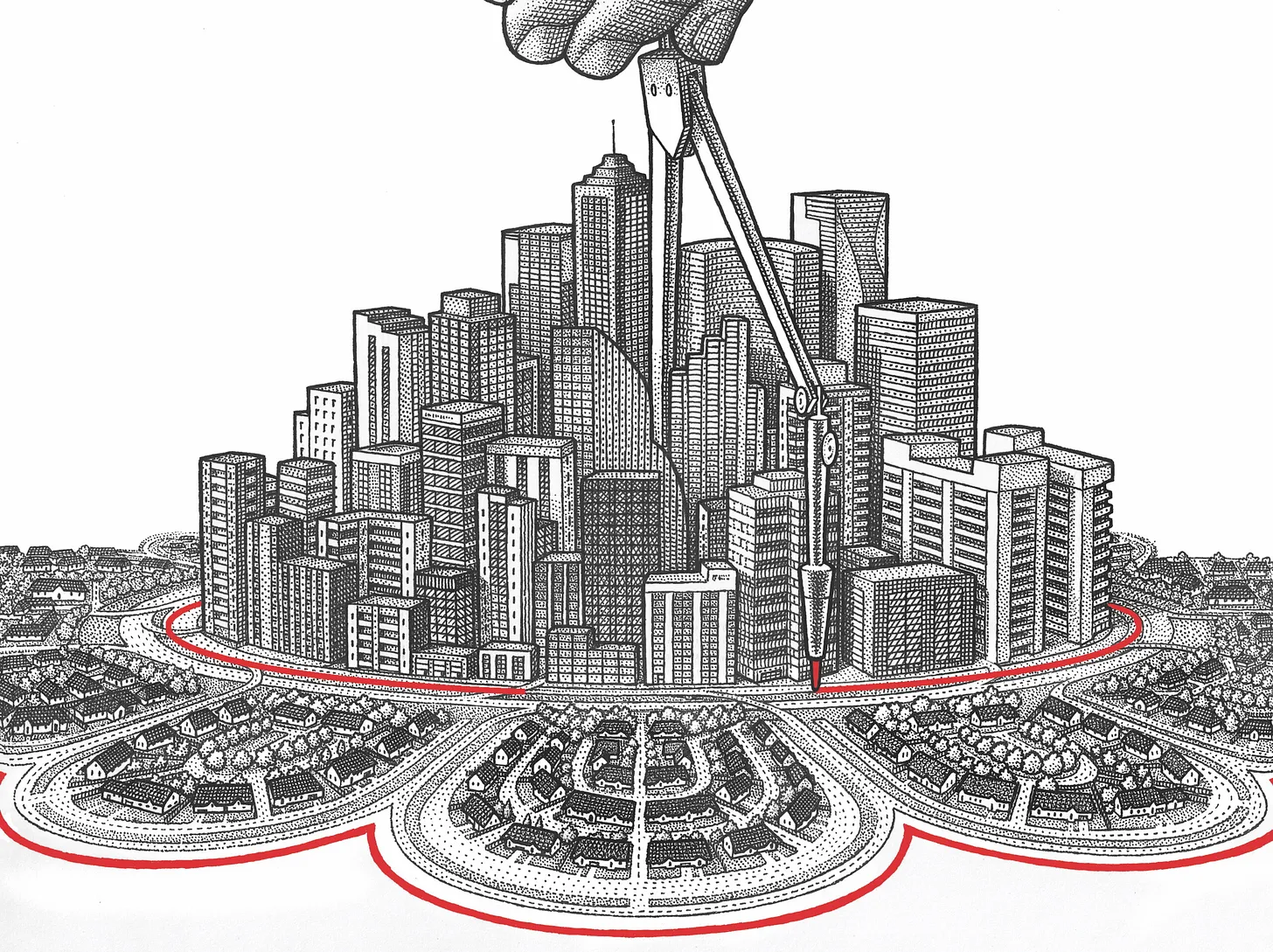
, but across a few decades they imposed rules that blocked densification. He names this shift “the Great Downzoning” and claims it is the main cause of today’s housing shortages, with adverse effects on health, families, the environment, and growth. He contends the driver was material interest rather than anti-density ideology: restrictions stuck where they lifted property values, and failed where they cut land values. The article traces a long prehistory in private covenants that restricted density and uses, then charts how public controls spread. Vivid examples include Paris’s customs walls and “Zone”, and Grunewald’s covenants limiting height to three storeys and mandating eight-metre gaps.
This reads like urban history with a sharp political economy spine. The interest-over-ideas thesis feels right: rules endured where homeowners gained, and wilted where landowners lost. The colourful examples land well, with Paris’s “Zone”, Grunewald’s fussy set-backs, but the empirical net is still a bit light. The GDP figure is illustrative rather than dispositive, but the mechanism is intelligible; labour reallocation, agglomeration, and housing cost relief. The weak spot is measurement: we still lack robust, comparable series on historical downzoning intensity, enforcement, and price effects across jurisdictions. Focus on corridors where marginal units have positive spillovers, bundle upzoning with transport, schools, and utilities, and trade predictable design codes for height and unit counts. Where heritage or environmental stakes are real, use narrow overlays rather than city-wide throttles. Reform will stick when it aligns incentives, not just ideals.
SemiAnalysis argues Google is escalating TPU commercialisation , challenging Nvidia’s dominance as leading labs adopt TPUs at scale.

They cite Anthropic’s “1GW+” TPU build and Google’s plan to sell complete TPU systems externally, not just via GCP. It frames TPU performance/TCO as competitive with Nvidia, notes Gemini 3 and Claude 4.5 training on TPUs, and suggests broader customer targets (Meta, SSI, xAI, possibly OpenAI). The authors call open-sourcing XLA:TPU compiler/runtime a critical missing ingredient for breaking CUDA’s moat. The piece describes concrete commercial terms behind Anthropic’s deal: 1 million TPUv7 “Ironwood” units split between ~400k racks sold directly (via Broadcom) and ~600k rented through GCP, linked to ~$42 billion of remaining performance obligations. It claims competitive pressure already cut OpenAI’s Nvidia fleet TCO by ~30% before deploying TPUs. Power constraints and datacentre financing frictions are highlighted, with “Neoclouds” (e.g., Fluidstack) and retooled cryptominers (TeraWulf, Cipher) positioned to host TPU capacity under hyperscaler backstops.
This reads as a vendor chessboard reset driven by systems economics, not raw FLOPS. The TPUv7/Anthropic numbers with 1M units, Broadcom-built racks, and $42bn RPO, simply imply Google shifting from captive silicon to merchant systems. That pressures Nvidia on two fronts: price discipline at foundation labs and ecosystem narrative. Yet switching costs remain high: CUDA’s mature tooling, kernels, and operator expertise still anchor workloads. Google’s bottlenecks, like power, slow MSAs, and partner capacity... also cap velocity, hence the “IOU” Neocloud template and miner PPAs. If Google open-sources XLA:TPU and hardens multi-pod orchestration (“MegaScaler”), the moat narrows; if not, TPU risks staying a premium niche. This is strategically significant but not yet decisive.
Benjamin Anderson coins “technical deflation” to describe a startup pattern mirroring macroeconomic deflation: w

hen building software keeps getting easier and cheaper, teams delay building because it will be easier and cheaper later. He argues rapid progress in AI models and coding assistance lowers complexity and accelerates functional output, even if quality can be overwrought. The result is a temptation to postpone non-essential builds, similar to consumers delaying purchases when they expect falling prices. He details drivers: models that follow rules, longer context windows, simpler workflows, and usable AI-generated code. Jevons-style effects still add complexity through tools and agents, but like-for-like functionality is simpler. He illustrates with a “desktop app later” example, then widens to timing advantages: late entrants can now replicate table-stakes features fast. Given this, focus may shift from building moats to distribution, customer understanding, and self-customising software, with uncertainty about the right near-term playbook.
This article usefully separates capability velocity from product advantage. Falling build costs favour fast followers, but they also raise operational risks like toolchain churn, model API instability, and creeping tech debt from “functioning” but messy code. Vendor exposure is non-trivial here: model pricing, rate limits, and safety policy changes can whipsaw unit economics. Practically, teams should architect for portability: clean seams around inference, prompt, and vector layers; contract-test agents; and budget for periodic rewrites as models shift. Treat distribution as the durable moat, with pipelines, integrations, and data rights, not one-off features that competitors can now clone in weeks. Governance matters too: enforce security reviews on AI-generated code and track latency/SLO regressions as agents proliferate. In short, assume technical deflation continues, but bank gains through cadence, portability, and sales machinery rather than waiting for a perfect model.
This tutorial-style explainer outlines how GPU performance is shaped by the gap between immense compute throughput and comparatively constrained off-chip memory bandwidth.

Using NVIDIA A100 figures (≈19.5 TFLOPS FP32 compute and ≈1.5 TB/s HBM bandwidth), it motivates the Roofline model and arithmetic intensity, with a ridge point around 13 FLOPs/byte separating memory-bound from compute-bound kernels. It then introduces operator fusion for memory-bound chains and tiling with shared memory for compute-oriented kernels, anchored in concrete A100-centric parameters and diagrams.
Nice reading! Practical without drowning you in micro-ops. The Roofline framing plus “fuse or tile” playbook is the right starter kit for anyone trying to make kernels go faster. I appreciate the honesty about power limits and unknowns; too many guides treat peak tables as gospel. If I were new to GPU optimisation, I’d lift the coalesced-load and bank-conflict sections verbatim into my mental checklist. Still, it’s NVIDIA-centric and single-GPU-leaning, which is fine for basics, but you’ll outgrow it. Just keep your scepticism switched on :)
Last Week in AI
- More than 1,000 Amazon workers warn rapid AI rollout threatens jobs and climate | theguardian.com
- The idiot’s guide to AI jargon | sherwood.news
- AI Adoption Rates Starting to Flatten Out | apolloacademy.com
- How to build a better AI benchmark | technologyreview.com
- Tech Titans Amass Multimillion-Dollar War Chests to Fight AI Regulation | archive.ph
- UAE’s AI ambitions advance | eiu.com