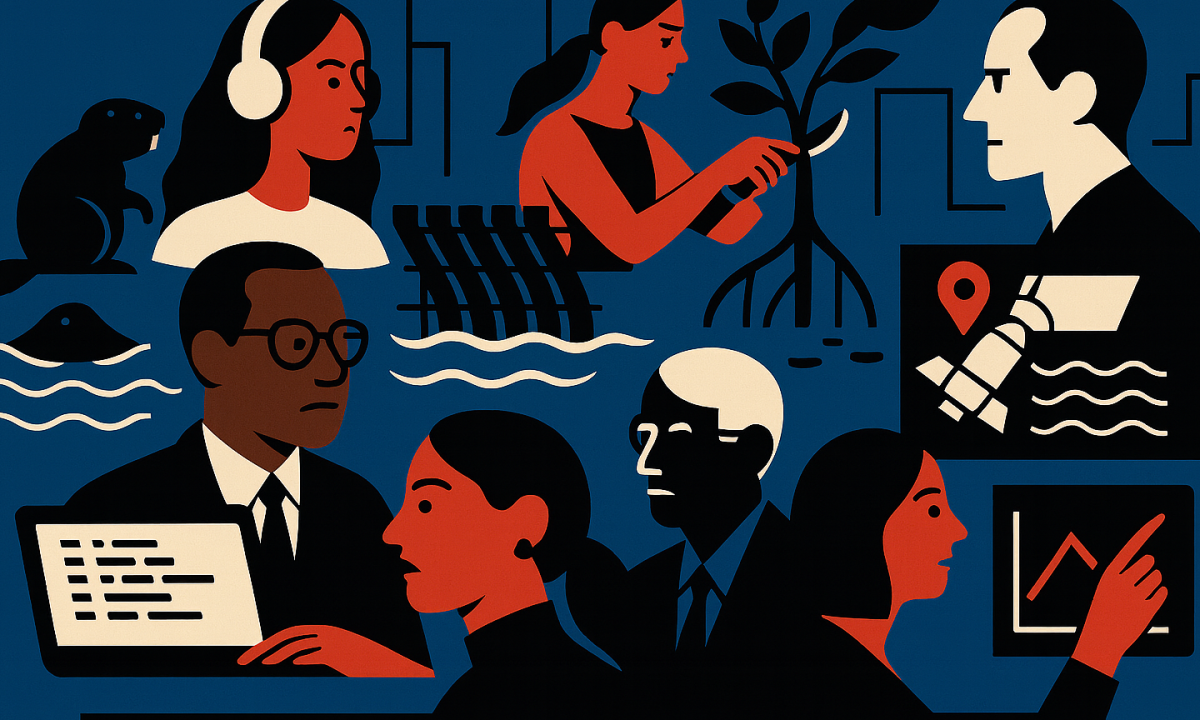
This week felt like one big lesson in engineered environments. We start with Atlas Obscura’s Irv Teibel, who couldn’t capture the sea he heard, so he built one and sold calm at scale. How about beavers, oysters, and mangroves as real infrastructure that works? Maybe if we industrialise deployment and finance… Then, Gregory Gundersen reminds me LLMs aren’t a rupture but compounded traditions, so plan around evaluation, safety, and data. Also, Lea Verou nails UX as effort economics: kill “usability cliffs” and push complexity inward. We end with Geoff Huston, that meanwhile, shows Starlink breaking country-centric geolocation, turning certain dashboards into fiction. Threaded together: design the environment and you shape behaviour; ignore the bill and it arrives later as authenticity debates, procurement friction, governance gaps, UX debt, or broken KPIs.
In this issue
5 piecesThis article profiles Irv Teibel , creator of the Environments records (1969–1979), who popularised carefully engineered “nature sounds” as functional audio for sleep, focus, and ambience.

After failing to capture the sea as he heard it, Teibel worked with Louis Gerstman at Bell Labs, using an IBM 360 to algorithmically sculpt a “perfect” ocean. He marketed the results through Syntonic Research with quasi-scientific claims and sold widely, helping seed ambient and new-age listening cultures. Atlantic Records expanded distribution in 1970. Beyond sales, Teibel’s legacy sits between Muzak and ambient music, influencing wellness devices and sound apps. The article situates Environments in 1970s urban environmentalism, office acoustics, and “orphic media,” noting how listeners used these records for everything from exam cramming to psychotherapy waiting rooms.
I buy the central claim! Teibel industrialised the vibe. It’s a classic tinkerer’s arc, from messy field tapes to engineered calm, sold with chutzpah. It reminds me of early productivity hacks that felt almost magical until they became wallpaper. Was it nature, or the idea of nature? Teibel’s enterprise foreshadows today’s wellness economy: a private good fashioned from a public ambience, then scaled via branding and distribution. He combined technical mediation (Bell Labs-grade signal work) with provocative, quasi-scientific copy to create a credible new use case for recorded sound. The model is familiar: define a functional job, package a repeatable solution, and let culture do the rest. Evidence was thin, but outcomes were legible to consumers. Modern incumbents - from sleep apps to noise machines - inherit both the market and its fragility: efficacy narratives invite scrutiny, and authenticity claims are hard to defend.
This piece argues for “all-natural geoengineering” : deploying living systems at landscape scale to buffer floods, cool cities, protect coasts, and modulate weather.

Drawing on Dune, Gaia theory, and recent science, it presents case studies including beavers as autonomous watershed engineers, urban bioswales and rain gardens, oyster-reef breakwaters, mangrove restoration, seaweed farming, and integrated agro-systems. It contrasts technical feasibility with persistent deployment barriers: ecological mismatch, governance limits, industrial bottlenecks, energy costs, and fragile political commitment.
I’m persuaded by the premise; life as infrastructure is less a metaphor than an operating model. This reads like swapping brute force for stewardship, with spreadsheets. The portfolio logic is sound. Nature-based assets deliver multi-service returns - flood protection, filtration, sequestration - yet fail to clear finance and procurement hurdles designed for concrete. The proposed remedy is industrial, not lyrical: cheap, clean electricity, automated fabrication for reefs and rigs, and outcome-based contracts that socialise risk and monetise avoided losses. China’s cost advantage in robotics and power complicates Western ambitions, suggesting joint ventures or domestic subsidies to bridge the gap. Governance models must be localised, with demonstration sites de-risking liability and insurance.
This essay sketches an academic history of large language models , connecting today’s systems to decades of research in distributed representations, finite-state transducers, attention, and the transformer.

Rather than treating LLMs as a rupture, it assembles a lineage: from statistical language modelling to neural methods, culminating in transformer-based pretraining. The piece reads as a guided tour of core papers and ideas that reappear across generations of NLP research, positioning modern capabilities as cumulative rather than sudden.
A lineage-based view of LLMs is strategically useful. It reframes “AI disruption” as the compounding of known mechanisms; representations, attention, and data, rather than a singular leap. So, capability road-mapping should track the maturation of adjacent layers: evaluation methods, safety tooling, and data governance, not just model releases. It also highlights durable talent bets: engineers who understand both statistical and neural traditions build more resilient systems. Where the essay is lighter? RLHF, agents, and multimodal - as we should extend the map with current deployment practices. But I like the thesis: today’s wow is yesterday’s groundwork with better tooling. My bias is toward lineages, but continuity comforts, while scale bends behaviour in ways history doesn’t fully predict. The line I’d keep handy: progress compounds; debt does too.
Lea Verou argues that great products optimise the “complexity-to-effort” curve: simple tasks must be easy, complex tasks possible, and the transitions smooth
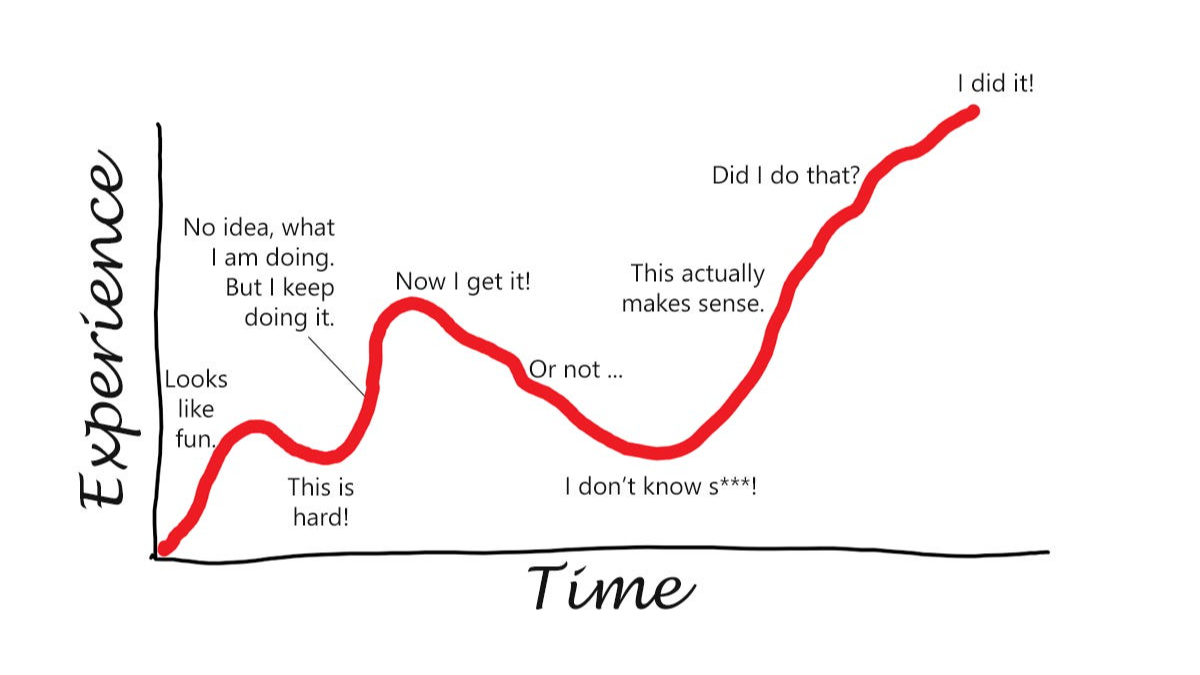
. She frames user effort as a currency; users feel either “ripped off” or delighted depending on perceived value for effort. Concrete examples include Google Calendar’s one-click event creation, HTML video’s all-or-nothing controls, Instagram’s filter flow, and Coda’s presets that generate tweakable formulas. The core prescription is to engineer out “usability cliffs” and maximise signal-to-noise.
This piece usefully reframes UX as unit economics of effort. Organisations that win translate Kay’s maxim into operating policy: instrument for outcomes but govern for friction. Smoothing the curve requires engineering capacity for encapsulation, a roadmap that privileges consumer experience over producer convenience, and leadership willing to accept local inefficiencies for system-level gains. Examples like Coda’s editable presets and Oslo’s PIN-less gates highlight a strategic trade: absorb internal cost to expand usable surface area. Users pay with effort, and good products feel like bargains. It echoes the best developer tools I’ve used, where a gentle tweak beats a full rewrite. As a rule of thumb, place pain where it will be noticed least and forgiven most.
Geoff Huston examines how IP-to-country geolocation breaks when retail satellite networks like Starlink enter the mix.

APNIC Labs estimates ISP “market share” by combining UN/ITU population baselines with some 35 million daily Google ad impressions, mapping each impression’s IP and origin AS to a country. The method works tolerably for terrestrial ISPs but fails when Starlink’s own geodatabase assigns roaming or maritime users to specific countries, creating implausible results such as Yemen showing 59 percent of users on Starlink.
This is a classic ops headache. Legacy heuristics crash into a new access model. Starlink collapses the old assumption that an IP block sits in one polity, and any pipeline that infers market structure from ad telemetry inherits that flaw. Huston’s patch, black-holing Starlink geodata into “unclassified,” is sensible triage for dashboards, not a strategy. The real work sits with vendors and standards bodies: dynamic geolocation attributes, tamper-resistant signals from gateways, and policy that distinguishes legal jurisdiction from physical position. Until then, security controls, content licensing, and competition analyses that hinge on country codes will misfire at the margins. The Yemen example reads like a parable of measurement drift when inputs quietly change.
Last Week in AI
- Adobe delivers AI Agents for B2B businesses to reimagine marketing and customer experiences | business.adobe.com
- Introducing Gemini Enterprise | cloud.google.com
- OpenAI says GPT-5 is its least biased model yet | axios.com
- Samsung AI researcher’s new, open reasoning model TRM outperforms models 10,000X larger — on specific problems | venturebeat.com
- Former British PM Sunak joins Microsoft, Anthropic in advisory roles | reuters.com
- A small number of samples can poison LLMs of any size | anthropic.com