
This week’s #RBM begins with The Better Data Center Project which estimates that Anthropic’s contracted US data centres could generate 17–38 million tonnes of CO2, with gas and coal doing much of the heavy lifting behind the industry’s shiny promises. Meanwhile, neuroscientist Anil Seth questions whether machines that appear conscious actually experience anything. He also warns that humans are remarkably good at developing feelings for things that may have none in return. Then back in 1981, Nintendo faced a more practical crisis: 2,000 unsold arcade machines, a failed attempt to license Popeye and a young designer called Shigeru Miyamoto. The result was *Donkey Kong*, proving that even a spectacular commercial mistake can occasionally produce an Italian plumber worth billions. Over at MotherDuck, former Google BigQuery engineer Jordan Tigani argues that Big Data might be rather less big than everyone thinks. Most analytical workloads, it turns out, involve surprisingly little information, despite companies spending fortunes on infrastructure designed to swallow petabytes. Finally, we travel back to a Paris kitchen in 1976, where Jean-Michel Jarre recorded *Oxygène* with a homemade mixer, an eight-track tape machine and a handful of synthesisers. Fifty years later, that electronic music landmark is being painstakingly reconstructed for Dolby Atmos.
In this issue
5 piecesAnthropic’s contracted US data centres could generate 17 to 38 million tonnes of CO2
The Better Data Center Project, drawing on infrastructure announcements, permits and grid modelling, projects that 87% of the relevant electricity will come from gas and 11% from coal. Its analysis considers both dedicated on-site generation and power plants responding to additional grid demand. The project argues that AI infrastructure expansion is increasing fossil-fuel dependence through both grid-connected facilities and dedicated generation, known as Bring Your Own Power (BYOP). It estimates that Anthropic's power requirements could cause $2–3 billion in annual health damages from air pollution. The analysis also identifies a gap between Anthropic's stated environmental commitments and the generation equipment supplying some contracted facilities, raising questions about the environmental consequences of rapidly expanding AI compute capacity.
So the difference between 839 and more than 1,000 pounds of CO2 per megawatt-hour is the hinge of this piece - and we only got these details because Anthropic went IPO. The lower figure reflects regional average grid emissions; the higher range estimates emissions from generation responding to Anthropic's additional demand, and oh boy, that's a substantial difference arising from how you frame the calculation... An electricity grid can have plenty of clean generation already running while the next megawatt of demand still requires burning more gas or coal. For anyone buying AI compute, this distinction becomes a bit uncomfortable, GPU capacity looks abstract when purchased through a cloud contract - right? -, but the electricity has to come from somewhere! Colossus 2 makes the abstraction particularly awkward, as the project reports that Anthropic is using compute there while much of the facility's electricity comes from temporary, unpermitted turbines, most without selective catalytic reduction. Anthropic's stated requirements for power-plant emissions controls seem difficult to reconcile with that arrangement. I'd like to see AI infrastructure commitments accompanied by site-level forecasts of electricity demand, marginal generation and the permitting status of associated power plants. The project's model has uncertainties, especially when projecting grid behaviour two years ahead. Those uncertainties deserve scrutiny rather than dismissal.
Neuroscientist Anil Seth argues that increasingly capable AI need not become conscious because intelligence and subjective experience are different phenomena

In an essay for Noema, he challenges computational functionalism, the assumption that running the right algorithm is sufficient for consciousness. Drawing on neuroscience, predictive processing and differences between living brains and digital computers, he proposes that consciousness may depend on the biological processes sustaining life, while acknowledging that no existing theory settles the question. That distinction has practical consequences for AI development and public debate. Seth warns that machines appearing conscious can prompt misplaced moral concern, emotional attachment and distorted behaviour, even without subjective experience. Truly conscious systems, were they created, would introduce potential suffering and ethical obligations that could complicate shutting them down. He therefore argues against deliberately engineering conscious AI, while suggesting that cerebral organoids and alternative computing approaches may raise different risks from today's language models.
This Müller-Lyer illusion is the detail I'd put in front of anyone designing a conversational AI product; two equal lines continue to look unequal even after you've measured them. Seth's suggestion is that our response to an apparently sentient chatbot may work much the same way. Knowing how the trick works might change our judgement without changing our feelings. That creates a peculiar design problem IMHO; a disclaimer explaining that a chatbot is software could coexist with an interface that apologises, expresses longing or acts wounded when a user leaves. The product would then be asking reason to undo an impression that its own conversation style keeps refreshing. I wouldn't assume more disclosure alone solves that. I'd want experiments comparing how different conversational styles affect attachment, trust and willingness to disagree, including what happens after weeks rather than a single session. None of this yet settles Seth's biological argument. Brains may require metabolic processes for experience, or there may be other routes we haven't understood. Product teams can leave that philosophical dispute open while taking responsibility for the impressions they deliberately create. We spend considerable effort making machines sound more human, then seem surprised when people start treating them as people....
Nintendo created Donkey Kong in 1981 to rescue approximately 2,000 unsold Radar Scope arcade cabinets stored near Seattle
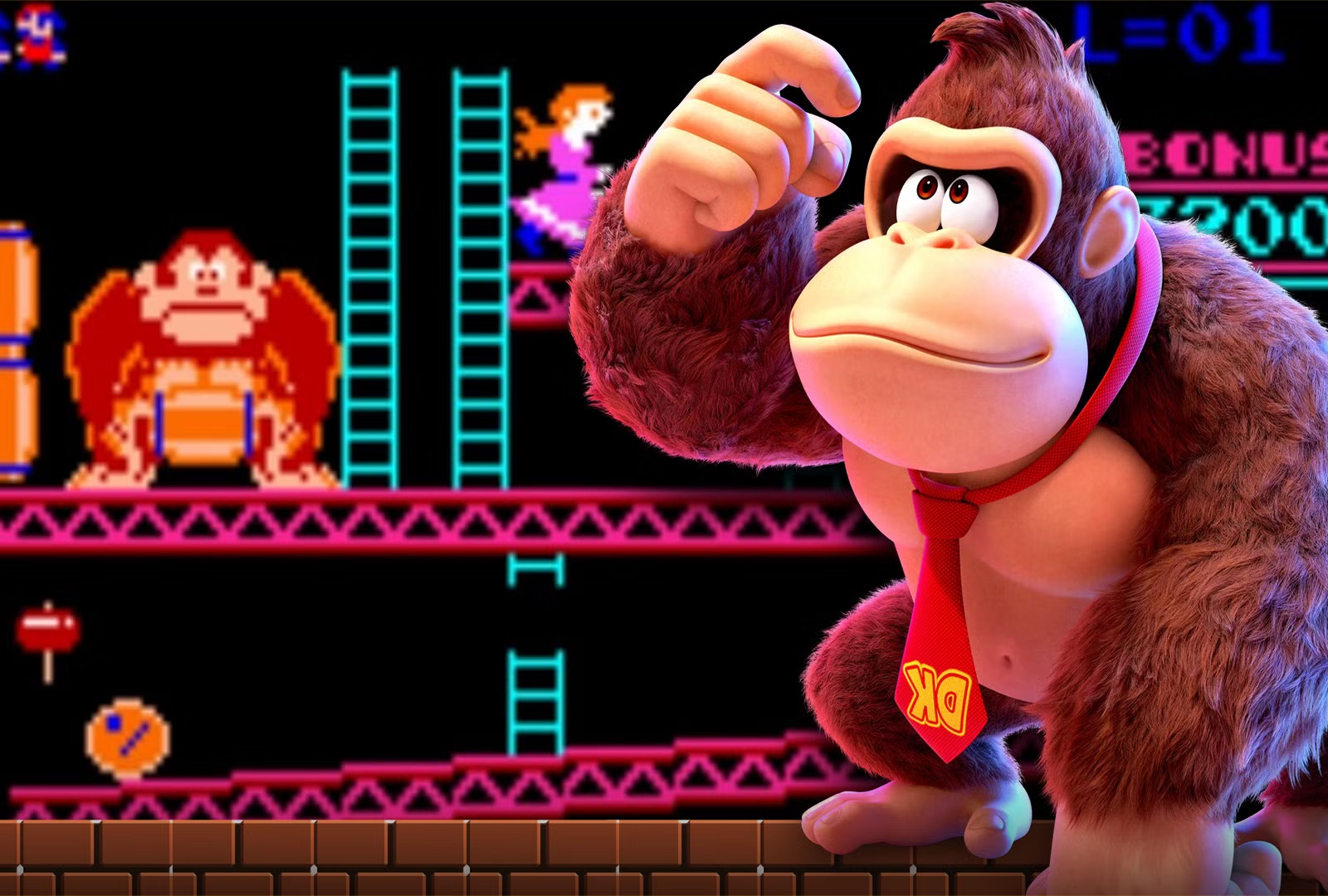
In 8bit Architect, Jules recounts how Nintendo of America struggling financially, first-time designer Shigeru Miyamoto and supervisor Gunpei Yokoi developed a replacement game using existing hardware. The article traces how an unsuccessful attempt to license Popeye characters produced Donkey Kong, Mario and Pauline, and how the resulting game transformed Nintendo's American business. The article describes Donkey Kong's technical constraints, its commercial breakthrough and the legal disputes surrounding its success. Nintendo subcontracted programming to Ikegami Tsushinki, later disputed software ownership, and defeated Universal's King Kong infringement claim. By June 1982, approximately 60,000 US cabinets had generated an estimated $180 million in revenue. The story also examines Britain's unofficial adaptations and argues that salvaging unwanted hardware provided the financial foundation for Nintendo's subsequent expansion.
I think this design constraint in this story is the monitor Nintendo couldn't afford to replace. Its vertical orientation helped shape Donkey Kong into a game about climbing. The failed Radar Scope had already determined the processor, screen and cabinet. Miyamoto's challenge was to make those inherited decisions feel like deliberate design choices. I find this appealing; the creative breakthrough emerging from such an unromantic problem, as we tend to imagine successful products beginning with an ambitious vision and engineers finding ways to realise it. Here, the physical inventory came first. Nintendo had approximately 2,000 expensive reasons to work within the hardware it already owned. The resulting limitations arguably gave Donkey Kong much of its character. Repurposing inventory was a clever survival tactic! Turning the resulting game into a commercially successful product required Nintendo to recognise demand, manufacture additional machines and build distribution capacity. Both achievements mattered. I also like the irony that one of gaming's most recognisable characters emerged partly because Nintendo couldn't secure somebody else's intellectual property. The failed Popeye licensing negotiations forced the creation of characters the company actually owned - and it's brilliant!
Jordan Tigani, a founding engineer on Google BigQuery, argues that most organisations do not need systems designed for enormous datasets

In MotherDuck's article, drawing on his former access to BigQuery customer and query logs, he reports that most customers stored under a terabyte and that 90% of queries among customers spending over $1,000 annually scanned less than 100 MB. He acknowledges that his accompanying graphs were reconstructed from memory rather than published measurements. Tigani distinguishes stored data from the much smaller portions repeatedly analysed. He describes a retailer whose warehouse grew from 100 TB to 30 PB on moving to the cloud without a comparable increase in compute requirements, and says older records quickly become infrequently used. Larger individual servers, aggregation and columnar query techniques, he argues, weaken the case for distributed processing for typical analytical workloads. MotherDuck, which sells analytics tooling, has a commercial interest in that conclusion.
So, a progression from revenue to revenue_usd to revenue_usd_audited captures years of changing business definitions in three field names; with each one representing a decision that becomes an archaeological layer. Retain five years of transactions and you may still be unable to answer a basic question about revenue consistently across those years. Storage faithfully preserves bytes, including yesterday's misunderstandings! Optimising for terabytes can distract from defining which records deserve to survive, how definitions change, and whether historical reports remain reproducible. I'd make temporal semantics part of the data model: record when a metric definition took effect, identify which historical periods it applies to, and preserve enough source material to reproduce corrections. Without that discipline, an apparently cheap archive accumulates expensive uncertainty. Indiscriminate deletion isn't the answer either; investigations and new questions sometimes need raw records. Yet, Tigani reconstructed his charts from memory, and MotherDuck sells an approach aligned with smaller analytical workloads. Still, this central argument offers a useful engineering test: before buying a bigger query engine, measure how many bytes your actual queries read and how often old records earn their keep.
Mark Gidley traces how Jean-Michel recorded Oxygène in his Paris kitchen in 1976 using a homemade mixer, an eight-track tape machine and a small collection of synthesisers

Writing for Jean-Michel Jarre's website, Mark aggregates recollections from Jean-Michel and engineer Michel Geiss describe improvised rhythms, hand-played sequences and severe tape limitations. The feature also recounts the album's initially difficult search for a record label and its eventual international success, with sales said to approach 20 million copies. The anniversary sections explain how David Kosten, Steven Wilson and Jean-Michel rebuilt the original recordings for Dolby Atmos and 5.1 surround, alongside a new stereo remaster. David describes working from digitised eight-track tapes, reconstructing the original balance before repositioning sounds in three dimensions, sometimes recovering material missing from the multitracks. The article presents the 2026 editions as both a commemoration of electronic music's early home-studio methods and an attempt to preserve the album's character while expanding its sonic presentation.
Ah! The birdsong at the end of Oxygène Part III poses a wonderfully awkward problem for anyone promising an authentic remix. It was absent from the multitrack tape, so David had to lift it from the finished stereo recording. Then he put it overhead in Atmos. The sound is historically authentic; its new position is a decision made half a century later. Both can be true, which makes restoration a rather slippery word. I like that JMJ was directly involved in these choices, down to making Part VI's waves travel front to back. An original artist's participation gives the reinterpretation authority, though it doesn't turn a 2026 decision into a 1976 one. Our memories of a recording are shaped by its original mix, the medium it was released on and the ordinary equipment on which we heard it. Recovering bass that vinyl couldn't easily reproduce may reveal information on the tape while changing the familiar balance listeners have lived with for decades.
My Week in AI
- Introducing Frostbite A new CPU architecture discovered, designed, and verified end-to-end by AI | architectlabs.com
- Introducing Inkling 2 Mini 1 | thinkingmachines.ai
- Open Computer - An open-source, faster Devin alternative | github.com
- Linger - Open-Source Personal Agent That Runs Fully on Your PC | github.com
- Three breaches, endless leaks Your AI supply chain needs canaries | dragos.com
- “We were looking at it wrong” The explosive claim that’s upended the AI world | technologyreview.com